
Reclaiming Your Life: Finding the Right PTSD Treatment Center
Post-traumatic stress disorder (PTSD) can make you feel stuck, affecting your daily life with flashbacks, nightmares, and intense anxiety. These feelings can be overwhelming, but there is hope. PTSD treatment centers are designed to help you process trauma and build a path to lasting recovery.
These centers offer specialized care, including personalized treatment plans, evidence-based therapies like CBT and EMDR, various levels of care, and support for co-occurring disorders. Many people find significant improvement, with alumni often reporting major symptom reductions six months after treatment. This guide will help you understand your options and choose the right center.
Addiction Helpline America is a dedicated resource providing compassionate support for recovery. We help individuals and families connect with top PTSD treatment centers to empower their healing journey.
Quick PTSD treatment centers terms:
Understanding PTSD and When to Seek Help
Post-traumatic stress disorder (PTSD) is a mental health condition that can develop after experiencing or witnessing a traumatic event. It can affect anyone, not just veterans. Traumatic events range from military combat and natural disasters to car accidents, assault, or abuse. Symptoms can appear immediately or surface months or even years later, often coming in waves.
Common Symptoms
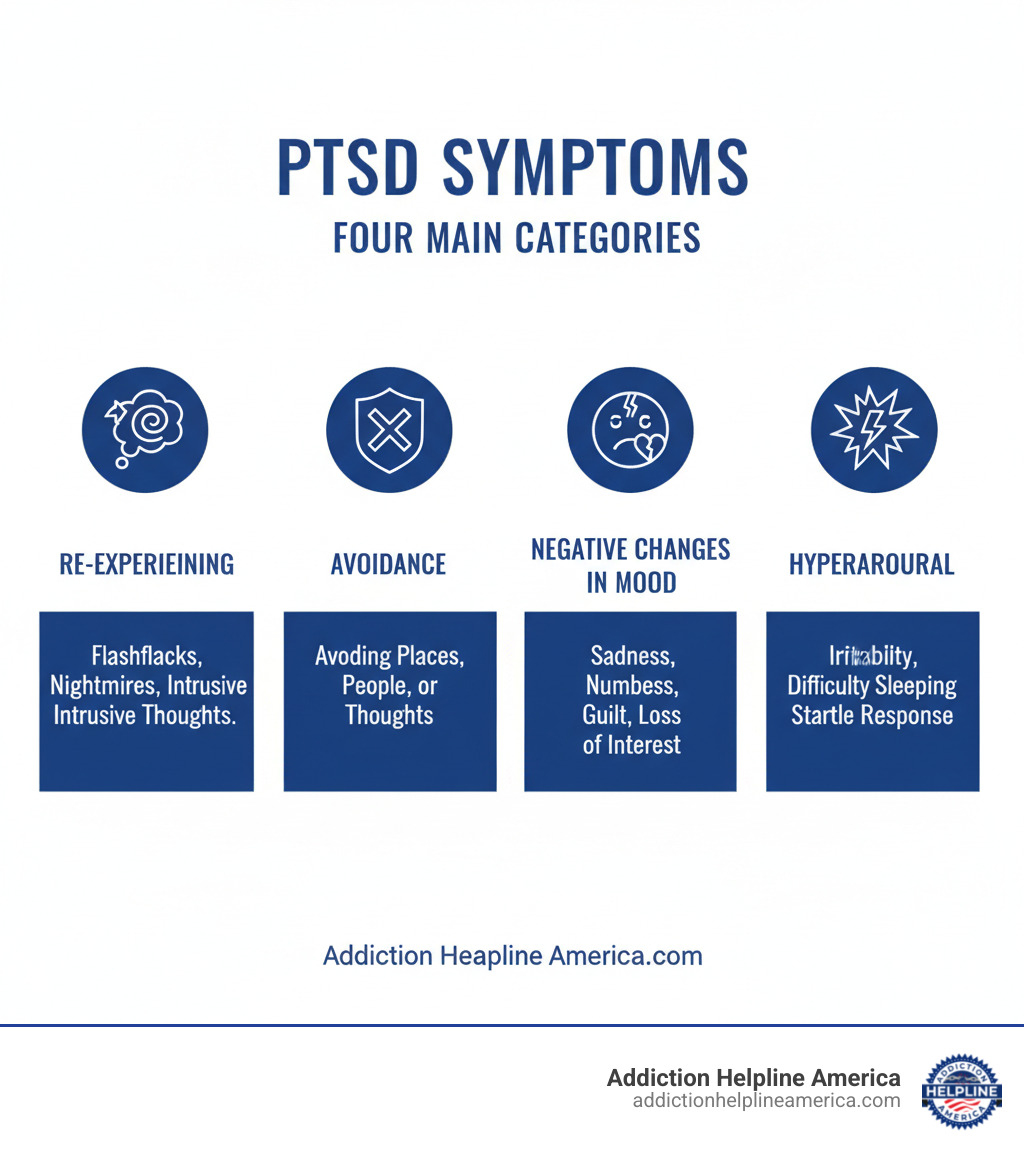
PTSD symptoms typically fall into four categories. You might have intrusive memories, such as flashbacks or nightmares, that make you feel like you’re reliving the trauma. To cope, you may find yourself avoiding people, places, or thoughts that remind you of the event. Many people also experience negative changes in mood, including emotional numbness, feelings of detachment, guilt, or loss of interest in activities. Finally, you may feel constantly on edge, leading to irritability, difficulty sleeping, and being easily startled.
These symptoms can disrupt your relationships, work, and daily functioning. In children and teens, PTSD may manifest as school problems or aggressive behavior.



Assessing Your Need for Treatment
While strong reactions after trauma are normal, it’s time to seek professional help if your symptoms last longer than a month, disrupt your daily life, or are getting worse. Ask yourself: Are your symptoms affecting your relationships or work? Are you avoiding more situations? Do you feel constantly anxious or on edge? Have you started using alcohol or drugs to cope?
If you answered yes to any of these, reaching out to a mental health professional is a sign of strength. Specialists at PTSD treatment centers can provide a comprehensive assessment to determine the best path forward. You don’t have to figure this out alone. For more information on available support, see our Mental Health Services Guide 2025. Recovery is possible.
How to Compare and Choose the Best PTSD Treatment Centers
Searching for PTSD treatment centers is a courageous step toward reclaiming your life. Since healing is not a one-size-fits-all journey, finding the right fit is crucial. What works for one person may not be perfect for another.
At Addiction Helpline America, our goal is to guide you through this process. We’ll help you understand what to look for in a center so you can make an informed choice and find a place that offers the personalized care you deserve for your unique path to recovery.
1. Accreditation and Licensing
When researching PTSD treatment centers, the first thing to verify is their accreditation and licensing. These credentials are non-negotiable, as they ensure a facility meets strict standards for patient care, safety, and ethical practices. They are your assurance of high-quality, trustworthy treatment.
Look for accreditation from recognized bodies like The Joint Commission, whose “Gold Seal of Approval” signifies that a facility meets high-performance standards. Also, confirm that the center holds the proper state licenses to operate legally.
You can verify these credentials by asking the facility directly or checking with state licensing boards. Resources like SAMHSA’s 2024 National Directory of Mental Health Treatment Facilities can also help confirm a center’s licensed status. Taking this step provides peace of mind that you’re choosing a legitimate, quality option.
2. Evidence-Based Therapies
The best PTSD treatment centers use evidence-based therapies—treatments proven by scientific research to be effective. Psychotherapy, or “talk therapy,” is central to recovery.
Key approaches include:
- Cognitive Behavioral Therapy (CBT): Helps change negative thought patterns and behaviors related to trauma. Trauma-Focused CBT is a specialized form.
- Eye Movement Desensitization and Reprocessing (EMDR): Uses bilateral stimulation (like guided eye movements) to help the brain process traumatic memories and reduce their emotional impact.
- Prolonged Exposure (PE): Involves gradually and safely confronting trauma-related memories and situations with a therapist’s support to reduce fear and avoidance.
- Somatic Experiencing: Focuses on releasing physical tension and trauma stored in the body.
Other effective therapies like Dialectical Behavior Therapy (DBT) and mindfulness-based approaches may also be offered. These methods help you process trauma, manage symptoms, and build healthier coping skills for lasting change.
3. Personalized Treatment Plans
Your trauma story is unique, which is why the best PTSD treatment centers avoid a one-size-fits-all approach. A treatment plan that works for one person may not be effective for another, even if they experienced a similar event.
A quality center begins with a comprehensive assessment of your physical and mental health, trauma history, and specific symptoms. This evaluation is used to create an individualized care plan custom to your needs. For example, a plan for a combat veteran may address moral injury, while a plan for a sexual assault survivor might focus on rebuilding a sense of safety.
Your treatment should adapt to you as you progress. Your therapist will work with you to set goals and adjust your plan as needed, ensuring the care you receive truly fits your healing journey. At Addiction Helpline America, we connect you with centers that see you as an individual, not just a case file.
4. Levels of Care in PTSD Treatment Centers
PTSD treatment centers offer different levels of care to match the intensity of support you need. Finding the right level is key to your recovery.
Inpatient/Residential Programs
Inpatient or residential programs provide 24/7 support in a safe, structured environment. This option is ideal if you are in crisis, need stabilization, or your home environment is not supportive of recovery. It allows for focused, immersive therapy with constant medical monitoring.
Outpatient, IOP, and PHP Programs
Outpatient programs, including Intensive Outpatient Programs (IOPs) and Partial Hospitalization Programs (PHPs), offer more flexibility. You live at home while attending scheduled therapy sessions during the day. This is a great choice if you have a stable living situation and a strong support system.
Here’s a quick comparison:
| Feature | Inpatient/Residential PTSD Treatment | Outpatient/IOP/PHP PTSD Treatment |
|---|---|---|
| Intensity | High; constant supervision and structured therapeutic activities. | Moderate to high; structured therapy sessions several times a week, but not 24/7 supervision. |
| Duration | Typically weeks to months, depending on individual needs. | Varies widely; can range from several weeks to several months, or ongoing for less intensive programs. |
| Cost | Generally higher due to 24/7 care, accommodation, and staffing. | Generally lower than inpatient, as it doesn’t include residential costs. |
| Ideal Candidate | Individuals in crisis, those needing stabilization, lacking a safe home environment, or with severe co-occurring disorders. | Individuals with stable living situations, good support systems, and those transitioning from higher levels of care. |
5. Staff Qualifications and Expertise
The quality of the staff at PTSD treatment centers is as important as the therapies offered. A strong team provides comprehensive support for every aspect of your healing.
Look for a multidisciplinary team that includes psychiatrists, psychologists, licensed therapists (LCSWs, LMFTs, LPCs), nurses, and case managers. This collaborative approach ensures all your needs are met.
Exceptional centers employ trauma specialists with advanced certifications in therapies like EMDR or PE. They have a deep understanding of trauma-informed care. Some centers, like many Vet Centers, are staffed by combat Veterans who bring invaluable lived experience and a personal understanding of your journey.
Also, consider the staff-to-patient ratio. A lower ratio allows for more personalized attention, which is crucial when processing complex trauma. Addiction Helpline America connects you with centers where the staff have both the credentials and the compassion to help you heal.
6. Holistic and Integrative Approaches
Effective PTSD treatment centers understand that healing involves the whole person—mind, body, and spirit. This bio-psycho-social-spiritual model addresses all dimensions of your well-being, not just symptoms.
Many centers offer complementary therapies that work alongside evidence-based treatments to support recovery:
- Yoga and movement therapy help release physical tension stored in the body and reconnect you with a sense of calm.
- Art therapy provides a non-verbal outlet to process emotions and memories that are too difficult to talk about.
- Equine therapy, working with horses, can help rebuild trust, self-esteem, and healthy connection skills.
- Mindfulness and meditation teach you to stay grounded in the present moment, reducing anxiety and managing stress.
These holistic approaches help you regain emotional balance, manage triggers, and build a foundation for long-term recovery, reminding you that healing is about learning to live fully again.

7. Co-Occurring Disorder Treatment
PTSD rarely exists in a vacuum. Many people also struggle with co-occurring disorders (or dual diagnosis), such as depression, anxiety, or substance abuse. These conditions often develop as a way to cope with untreated trauma.
The best PTSD treatment centers provide integrated treatment, addressing your PTSD and any co-occurring conditions simultaneously. Treating one issue while ignoring the other is ineffective and reduces the chance of lasting recovery. For example, if alcohol is used to self-medicate PTSD symptoms, both the trauma and the substance use must be treated together.
This integrated approach ensures that all aspects of your health are addressed in a coordinated care plan, which significantly improves outcomes. Our Behavioral Health Complete Guide offers more insight into this comprehensive approach.
8. Specialized Programs in PTSD Treatment Centers
Since not all trauma is the same, the best PTSD treatment centers offer specialized programs for specific populations. This custom support is essential for true healing.
- For veterans and first responders, programs often address unique challenges like moral injury and repeated trauma exposure. The VA’s Vet Centers, often staffed by combat Veterans, provide confidential counseling. The Vet Center Call Center is available 24/7 at 877-927-8387.
- For survivors of sexual trauma, specialized programs create a safe, supportive environment with staff trained to handle the complex emotions of shame and fear that accompany such experiences.
- Gender-specific programs (for men or women) can foster a more comfortable environment for sharing vulnerable experiences, leading to deeper connections and more honest conversations.
Addiction Helpline America can connect you with centers that offer programs custom-built for your unique experiences.
9. Family Involvement and Support
Trauma affects the entire family, not just the individual. The best PTSD treatment centers recognize this and incorporate family support into their programs, as healing often happens within the context of relationships.
Family therapy and educational sessions are key components. They provide a safe space to improve communication, help loved ones understand what PTSD is, and teach them how to offer meaningful support. When family members learn that symptoms like irritability aren’t personal, they can respond with compassion instead of hurt.
Building a stable, understanding support system at home is crucial for lasting recovery. This involves creating a safe environment and being patient with the healing process. It’s also vital for family members to take care of their own emotional health. Supporting someone with PTSD can be draining, and you can’t pour from an empty cup. At Addiction Helpline America, we look for programs that involve the family, knowing it’s a powerful part of the healing journey.
10. Aftercare and Long-Term Recovery
Finishing a treatment program is a major accomplishment, but recovery is an ongoing journey. The best PTSD treatment centers emphasize comprehensive aftercare planning to set you up for long-term success.
This process starts early with discharge planning, creating a roadmap for life after treatment. This plan typically includes referrals to outpatient therapists, support groups, and follow-up appointments.
Many centers offer alumni programs that provide a supportive community through meetings, workshops, and social events. A key part of aftercare is relapse prevention, which involves identifying personal triggers and building healthy coping skills to manage challenges without returning to old patterns.
This ongoing support is crucial for maintaining progress and tackling new challenges. It’s a key reason why many alumni report significant, lasting improvements in their quality of life long after leaving treatment.
Key Components of a Comprehensive PTSD Treatment Program

A comprehensive program at PTSD treatment centers uses multiple approaches to promote healing from every angle.
Therapeutic Approaches Used in Treatment
Beyond individual, group, and family therapy, many centers use creative and experiential methods. Psychodrama uses role-playing to explore feelings and events in a new way. Experiential therapies like adventure therapy, music therapy, or art therapy offer non-verbal ways to process emotions that words alone can’t reach, helping to facilitate deeper healing.
The Role of Medication in PTSD Treatment
Medication can be a helpful component of a PTSD treatment plan, particularly for managing overwhelming symptoms. It is prescribed and managed by a psychiatrist or medical doctor to ensure it is safe and effective.
Commonly prescribed medications include SSRIs and SNRIs, which can help balance brain chemistry to reduce depression, anxiety, and irritability. While medication is not a cure, it can stabilize symptoms enough for you to fully engage in and benefit from therapy. It is almost always used as an adjunct to therapy, not a standalone solution.
Treating Co-Occurring Disorders Alongside PTSD
As mentioned, it is crucial for PTSD treatment centers to use an integrated approach that addresses both PTSD and any co-occurring conditions like substance use or depression at the same time. This comprehensive strategy prevents symptoms of one disorder from worsening another and is essential for lasting recovery. For more on managing specific conditions, see our Bipolar 1 Treatment Complete Guide.
Navigating the Logistics of PTSD Treatment
Understanding the practical side of treatment is a key step. Here’s a breakdown of common logistical questions.
Duration and Cost of Treatment
The length and cost of PTSD treatment vary. Inpatient programs may last from a few weeks to several months, while outpatient programs can extend longer to provide ongoing support. The cost depends on the level of care and duration.
The good news is that many PTSD treatment centers accept major insurance plans, including Aetna, Blue Cross Blue Shield, Cigna, and others. It’s essential to confirm your benefits with the center, as being “in-network” can significantly lower your costs. Private pay options are also available, and many facilities offer payment plans.
How to Find a Reputable Facility
Finding the right facility can feel overwhelming, but you don’t have to do it alone. Start by researching centers based on the criteria in this guide: accreditation, evidence-based therapies, and personalized care. Online resources like SAMHSA’s national directory can be helpful.
This is where Addiction Helpline America can make a difference. Our service is free, confidential, and personalized. We listen to your needs and connect you with reputable PTSD treatment centers from our nationwide network that align with your situation and insurance coverage. We’re here to help you steer the options and find the right fit.
Frequently Asked Questions about PTSD Treatment
How do I know if I need inpatient or outpatient treatment for PTSD?
The choice depends on several factors. Inpatient care is often recommended if you have severe symptoms (intense flashbacks, panic attacks), are in crisis or have thoughts of self-harm, lack a safe or supportive home environment, or are dealing with severe co-occurring disorders like substance abuse. It provides 24/7 support and stabilization. Outpatient care is a good fit if your symptoms are less severe and you have a stable, supportive living situation, allowing you to integrate treatment into your daily life.
Can PTSD be cured completely?
While “cure” isn’t a term mental health professionals typically use, PTSD is highly treatable, and full recovery is possible. Effective treatment at PTSD treatment centers helps you manage symptoms so they no longer control your life. You learn powerful coping skills to handle triggers and challenge negative thoughts. Many people achieve “remission,” where symptoms no longer interfere with daily functioning. With commitment to treatment and aftercare, you can live a full, meaningful life.
How can family and loved ones support someone in treatment?
Family support is vital. Here are key ways to help:
- Participate in family therapy: These sessions, offered by many PTSD treatment centers, improve communication and heal relationships.
- Educate yourself about PTSD: Understanding the condition builds empathy and helps you respond with patience.
- Create a stable environment: A calm, predictable home reduces stress and supports healing.
- Be patient and understanding: Recovery takes time and isn’t linear. Avoid pressure and judgment.
- Take care of yourself: Supporting someone with PTSD is demanding. Tend to your own well-being by seeking support for yourself.
Conclusion: Taking the First Step Towards Healing
Seeking information about PTSD treatment centers is a courageous first step. Living with PTSD is challenging, but recovery is real and achievable.
This guide has covered the hallmarks of a quality treatment center: proper accreditation, evidence-based and personalized therapies, appropriate levels of care, holistic approaches, and robust aftercare planning. Finding the right fit is a personal journey, but it’s the key to finding a place where you feel safe and understood.
You don’t have to steer this alone. Addiction Helpline America provides free, confidential guidance to connect you with a treatment center that matches your unique needs and insurance. We are here to make the process easier.
Recovery from PTSD is possible. You deserve to live a life free from the weight of trauma. Take the next step today.
Reach out to us and Find the right treatment program for you. Your healing journey can start now.
Best PTSD Treatment Centers: 2025 Recovery Guide
Post-traumatic stress disorder is a disease that changes the lives of those who suffer from it in a very personal way, and sometimes it happens long after the traumatic event. In this sense, the awareness and research of the disease have been improving and as a result, PTSD treatment centers in 2025 focus more and more on individualized care, trauma, informed practices, and emotional stability for the future instead of just symptom relief for a short period of time.
This manual explains the characteristics of high, quality PTSD treatment nowadays and how recovery can be sustained with the help of different centers.
How PTSD Treatment Has Evolved
First of all, today treatment centers have different methods of dealing with PTSD. They don’t simply choose one approach anymore. However, they work with a layered approach which considers the biological, psychological, and physiological aspects of traumatic experience that have been changing for some time.
Current treatment models often focus on:
- Nervous system regulation
- Trauma processing at a manageable pace
- Emotional safety and stabilization
- Building long-term coping capacity
This change makes it possible for people to get well without a sense of being overwhelmed and/or retraumatized.