Narcotics Anonymous meetings are free, peer-led gatherings where people recovering from drug addiction support each other — one day at a time.
Here’s a quick overview to get you started:
| What You Need | Where to Find It |
|---|---|
| In-person meetings | na.org meeting search |
| Virtual meetings | virtual-na.org |
| Phone helpline | Call your local NA Area Service Committee |
| Newcomer support | Attend any open meeting — no registration needed |
| Free literature | Available at na.org in 49 languages |
NA’s core message is simple: any addict can stop using drugs, lose the desire to use, and find a new way to live. That promise of hope and freedom is what brings people through the door — and keeps them coming back.
Whether you’re struggling yourself or trying to help someone you love, knowing how to find and access these meetings is often the first and most important step.
At Addiction Helpline America, we connect individuals and families to recovery resources — including narcotics anonymous meetings — through our free, confidential helpline, staffed 24/7 by experienced addiction specialists. We’re here to guide you, no matter where you are in your journey.
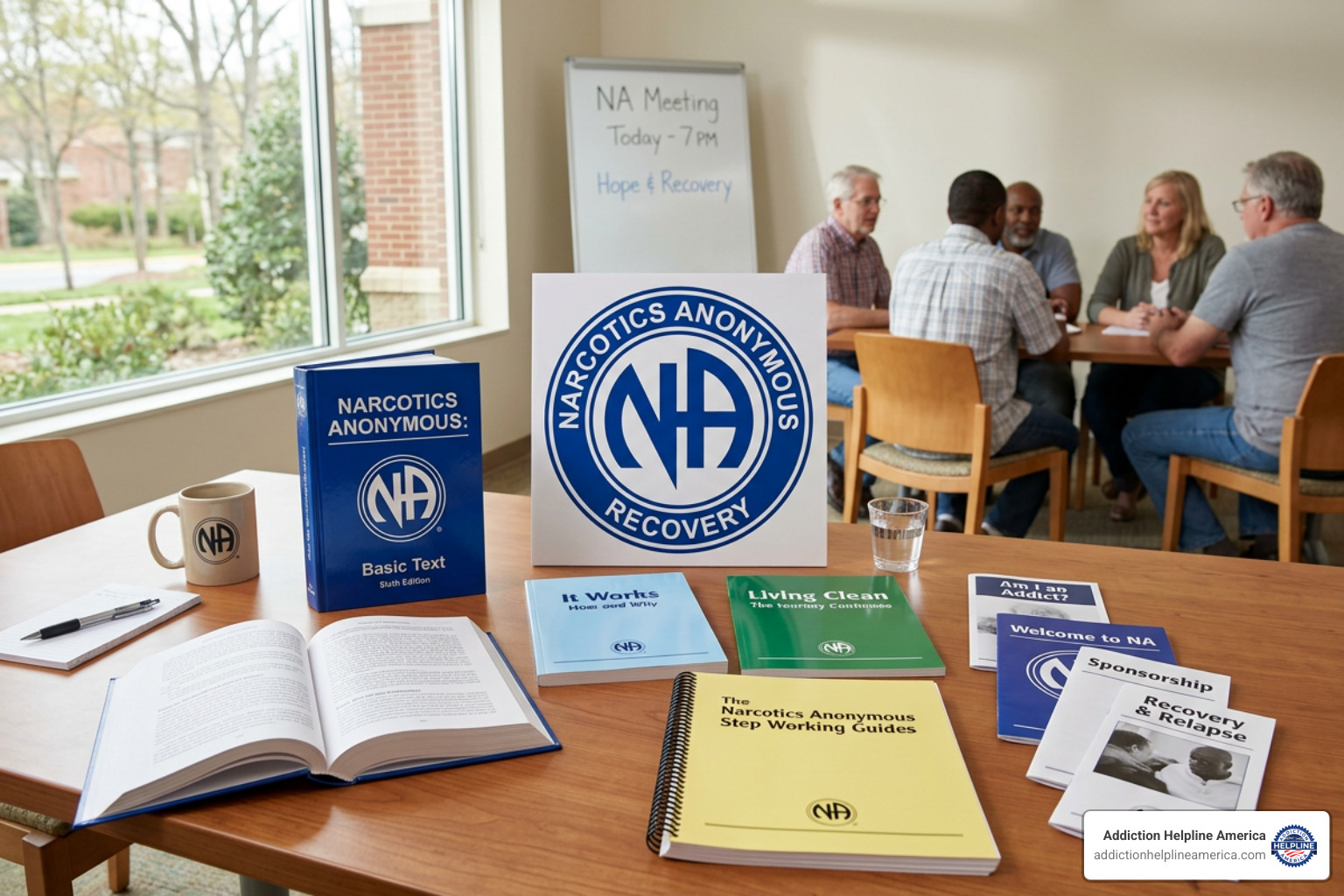
Narcotics Anonymous (NA) is a global, community-based, nonprofit fellowship of recovering addicts. It grew out of the Alcoholics Anonymous program in the late 1940s, with the first official meetings starting in Los Angeles in the early 1950s. Today, it is established across the Americas, Europe, Australia, and emerging rapidly in Asia and Africa.
One of the most common questions we hear is: “Am I eligible to join?” The answer is simpler than you might think. In NA, we define an addict as anyone whose life is controlled by drugs. Membership is not based on which specific drug you used or how much you used. Instead, the only requirement for membership is a desire to stop using.
NA is a spiritual, not religious, program. While we often talk about a “Higher Power,” this is defined by each individual member. It can be a religious deity, the collective wisdom of the group, or simply a “loving force” that helps you stay clean. This flexibility makes the program accessible to people of all faiths or no faith at all.
When searching for narcotics anonymous meetings, you will notice two primary types:
If you are looking for more information on how these groups compare to other options, you can explore our guide on Addiction Recovery Support Groups. To better understand the program’s philosophy, you can also learn how to access free recovery literature on na.org, which is currently available in 49 different languages.
Finding a meeting shouldn’t be a barrier to your recovery. Because NA is a decentralized fellowship, there are several different tools and methods available to help you find a seat in a room (or a spot on a Zoom call).
| Meeting Type | Best Use Case | Primary Tool |
|---|---|---|
| In-Person | Building local community and face-to-face connection. | NAWS Meeting Search |
| Virtual | Accessibility for those who are remote, isolated, or housebound. | Virtual-NA.org |
| Hybrid | Combines physical presence with a digital link for flexibility. | Local Area Websites |
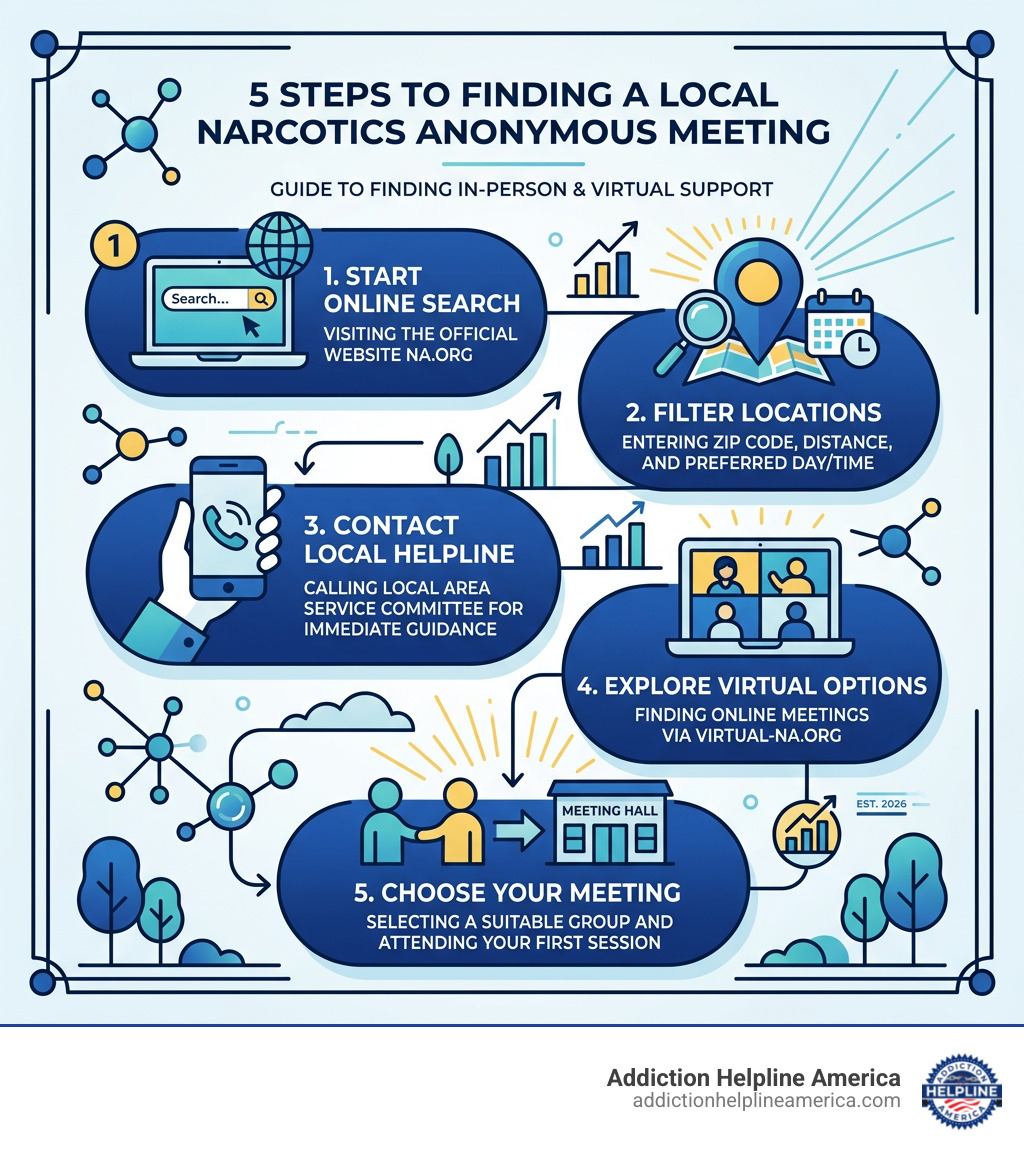
The most comprehensive way to find narcotics anonymous meetings is through the official Narcotics Anonymous website. Their database includes thousands of meetings worldwide.
When using official search tools, you’ll often see a map with colored pins.
Many regions, such as the Volunteer Region, use a specialized tool called the BMLT. This allows for highly accurate, real-time updates to meeting schedules. You can often find printable lists here, which are great to keep in your car or wallet.
If you are traveling or live in a rural area, tools like ketchupsearch.org allow you to search for meetings within a specific radius (like 50 miles) of your current location.
Sometimes, the best way to find a meeting is to talk to a human. Most Areas maintain a 24-hour phoneline. Members of the fellowship answer these calls to provide directions and support to newcomers.
Individual groups often maintain their own sites. For example, the North Alabama area provides specific schedules for meetings in Tennessee and Alabama, including updates on which meetings have moved or changed times.
If you can’t find what you need on the main site, try searching for your specific state or region. Directories often list “Face-to-Face” (F2F) meetings separately from virtual ones to help you plan your travel.
For those who cannot attend in person, the Virtual Meeting Search is an essential resource. It lists thousands of meetings happening via phone or video platforms.
Some platforms, like Narcotics Anonymous Live, offer meetings that run almost continuously. This is a lifesaver for those struggling with cravings in the middle of the night.
If you find a meeting that is no longer active, or if you want to start a new one, you can list or update virtual meeting information through the official NAWS form. This keeps the community accurate and helpful for the next newcomer.
If you’ve never been to a meeting, the prospect can be intimidating. We want to assure you that NA meetings are welcoming, informal, and designed to put you at ease.
Not all narcotics anonymous meetings are the same. Common formats include:
Most meetings start with standard readings, such as “Who Is an Addict?” and “Why Are We Here?” Many members also use daily meditation books like Just for Today or A Spiritual Principle a Day (SPAD). These readings help keep recovery at the forefront of our minds.
One of the most moving parts of an NA meeting is the recognition of clean time. Newcomers are encouraged to pick up a “Welcome” keytag. As you stay clean, you can earn different colored tags for 30 days, 60 days, 90 days, 6 months, 9 months, 1 year, and multiple years. It’s a way for the group to celebrate your progress.
To keep the environment safe, NA has a few simple rules. “Crosstalk” (interrupting or responding directly to someone else’s share) is generally discouraged. We share our own experience rather than giving advice to others. We also ask that you silence your cell phone and avoid side conversations. For a deeper look at these traditions, you can check out the YouTube Channel with valuable resources provided by NA World Services.
The heart of the NA program is the Twelve Steps. These are a set of principles that, when followed, allow us to experience a “spiritual awakening” and stay clean long-term.
A sponsor is another member of NA who has more experience in the program and has worked the steps. They serve as a guide, mentor, and confidant. Finding a sponsor is often as simple as going to narcotics anonymous meetings and listening for someone who “has what you want”—someone whose recovery seems solid and attractive.
Service is vital to staying clean. This can be as simple as making coffee, greeting people at the door, or setting up chairs. On a larger scale, it involves participating in “Area” or “Regional” business meetings to ensure the fellowship continues to function.
You might hear people talk about the “Seventh Tradition,” which states that “every NA group ought to be fully self-supporting, declining outside contributions.” This means that the meetings are funded entirely by the voluntary donations of the members. There are no dues or fees; if you can’t afford to give, you are still 100% welcome.
For those interested in the logistical side of starting a meeting or getting involved in service, there is a Google Drive with valuable resources that includes templates and guides for groups.
Anonymity is the “spiritual foundation of all our traditions.” It means that who you see at a meeting and what is said there stays there. This protects members’ privacy and ensures that no one person becomes the “face” of NA. This extends to social media; members are encouraged to be mindful of how they represent the fellowship online. You can read more in the pamphlet Social Media and Our Guiding Principles.
It is completely free. There are no entrance fees, no membership dues, and no “sign-up” costs. While a basket is passed for voluntary contributions to pay for rent and literature, newcomers are often encouraged not to give until they are back on their feet.
Yes. We welcome anyone with a desire to stop using. If you are still using, detoxing, or on medication-assisted treatment (like methadone or buprenorphine), you are welcome to attend. We only ask that you do not bring any drugs or paraphernalia into the meeting room and that you listen rather than share if you are “under the influence” during the session.
Finding your way to narcotics anonymous meetings can be the turning point in your life. Whether you attend in a church basement, a community center, or via a Zoom link, the message remains the same: you don’t have to use drugs today.
At Addiction Helpline America, we understand that the first step is often the hardest. Our mission is to provide free, confidential, and personalized guidance to help you find the right recovery path. Whether you need help finding a local meeting or you are looking for more info about rehab in Connecticut, our specialists are here to support you.
Recovery is a journey, not a destination. By connecting with the NA fellowship, you gain a worldwide family of people who truly understand what you are going through. There is hope, and there is a way out.