Understanding Your Treatment Options: A Critical First Step
Comparing Inpatient vs Outpatient Rehab is one of the most important decisions you’ll make on your path to recovery. Here’s what you need to know:
Quick Answer:
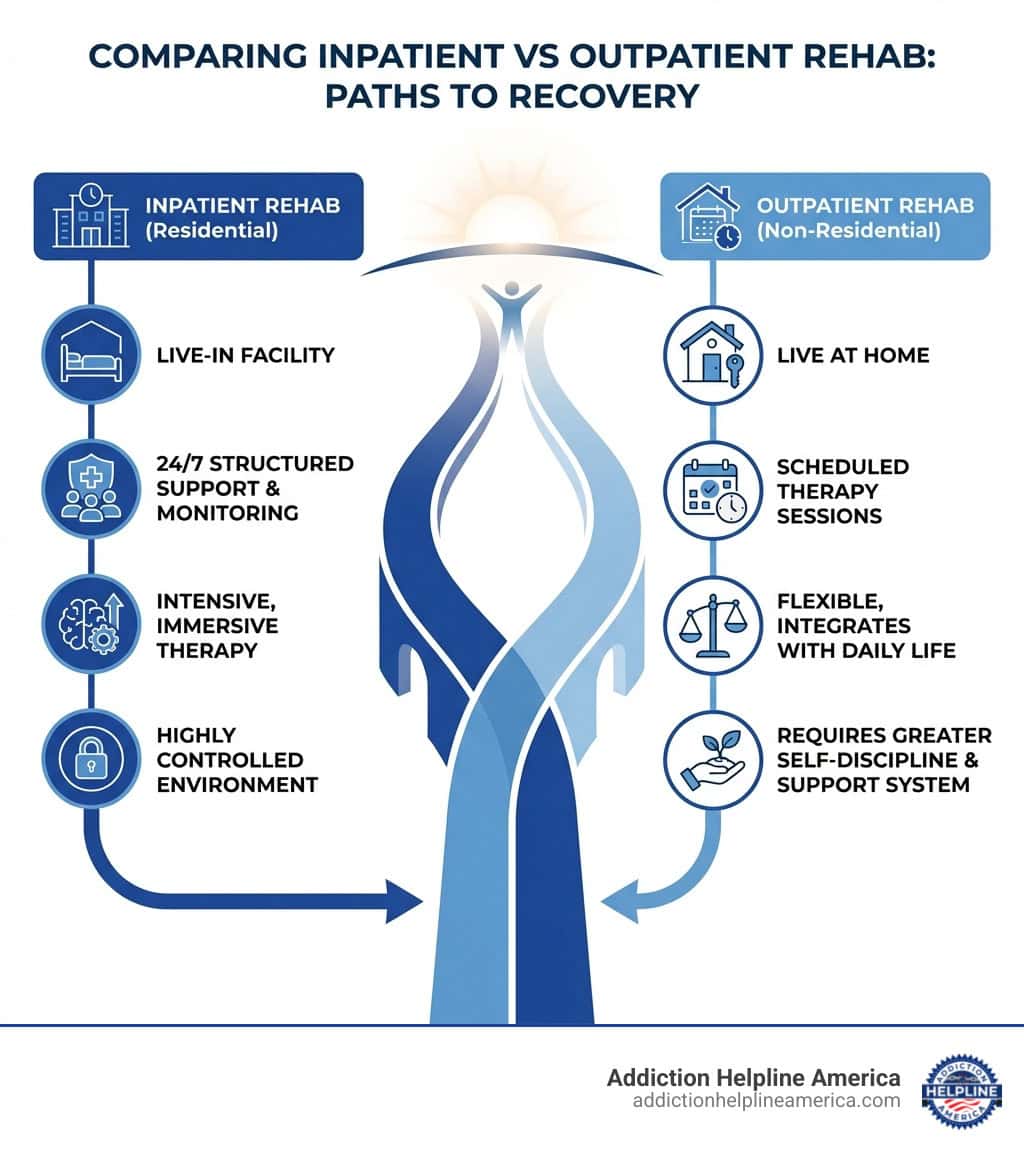
- Inpatient (Residential) Rehab: You live at a treatment facility 24/7, receiving round-the-clock medical care and intensive therapy. According to the National Institute on Drug Abuse (NIDA), this is best for severe addiction, co-occurring mental health conditions, or unstable home environments.
- Outpatient Rehab: You attend scheduled treatment sessions while living at home, allowing you to maintain work, school, and family responsibilities. NIDA suggests this is best for mild to moderate addiction with a strong support system.
- Key Differences: Inpatient offers more intensive care in a controlled environment (typically 30-90 days), while outpatient provides flexibility and is more affordable (3 months to over a year).
The fundamental difference is simple: inpatient care requires staying overnight at a facility, while outpatient care lets you return home each day. But choosing between them involves understanding your addiction severity, support system, medical needs, and life circumstances.
Research shows both approaches can be effective. A study published in Drug and Alcohol Dependence found that individuals showed significant improvements in quality of life after residential treatment. Similarly, research in Psychiatric Services has demonstrated that intensive outpatient programs (IOPs) can produce positive outcomes comparable to inpatient care for many individuals. The right choice depends entirely on your unique situation.
At Addiction Helpline America, we’ve guided thousands of individuals and families through this exact decision when comparing inpatient vs outpatient rehab, helping them find the treatment path that best fits their needs. Our free and confidential service is available 24/7 to answer your questions and connect you with appropriate care. Learn more about what addiction is and how it affects you.

What is Inpatient Rehab? A Deep Dive into Residential Care
Inpatient rehab, often referred to as residential treatment, is the most intensive level of care for substance use and mental health disorders. When we talk about inpatient care, we’re discussing a program where you live at the treatment facility, receiving round-the-clock medical attention, therapy, and support. This continuous supervision is a defining characteristic, ensuring patients are under constant medical care and observation. The goal is to remove individuals from their daily environment and immerse them completely in a healing process, free from triggers and distractions.

In an inpatient setting, you’ll follow a highly structured daily schedule. This typically includes individual and group therapy sessions, educational workshops, skill-building exercises, and recreational activities. The residential environment fosters a strong sense of community among peers, providing invaluable support from others who are also on their recovery journey. As the National Center for Biotechnology Information (NCBI) notes, inpatient care refers to any treatment or medical procedure that requires a person to be admitted to a hospital or care facility. This type of care is often reserved for serious or complex health conditions that need close monitoring. We understand that preparing for such an immersive experience can feel daunting, so we’ve put together a guide on what to expect in rehab.
The Role of Medical Detox and Aftercare
For many entering inpatient rehab, the first crucial step is medical detoxification. This process involves the safe and monitored removal of substances from the body. Depending on the substance and the severity of dependence, withdrawal symptoms can range from uncomfortable to life-threatening. For example, as MedlinePlus.gov explains, withdrawal from alcohol, opioids, or benzodiazepines can be particularly dangerous, necessitating constant medical supervision to manage cravings, alleviate symptoms, and prevent complications. Our drug detox guide provides more detailed information on this critical phase.
Once detox is complete and a stable foundation is established, the focus shifts to intensive therapy and developing coping mechanisms. However, recovery doesn’t end when the inpatient program does. A vital component of inpatient rehab is aftercare planning. This involves creating a comprehensive transition plan to support long-term sobriety. This plan often includes referrals to outpatient programs, sober living arrangements, support groups like Alcoholics Anonymous (AA) or Narcotics Anonymous (NA), and continued therapy. Aftercare is crucial for relapse prevention, helping individuals integrate back into daily life with ongoing support. We believe strongly in the power of continued care, which is why we offer comprehensive aftercare planning services to all our clients.
Typical Duration and Environment
The typical duration of inpatient rehab programs can vary significantly depending on individual needs and the facility’s structure. Common program lengths are 30, 60, or 90 days. However, some programs, especially for more complex cases, can extend to several months. The National Institute on Drug Abuse (NIDA) states that for most patients, a program of at least 90 days is most effective. It’s also important to note that treatment duration can be influenced by state regulations and insurance plan coverage, which may initially approve shorter stays before re-evaluation. For those considering shorter stays, our 30-day inpatient rehab tips might be helpful.
The environment of an inpatient facility is intentionally designed to be a safe, controlled, and trigger-free space. This immersive setting allows individuals to focus solely on their recovery without the stressors, temptations, or negative influences of their previous environment. It’s a place where you can completely dedicate yourself to healing, engage in intensive therapy, and build a strong foundation for a sober future.
What is Outpatient Rehab? Flexibility in Your Recovery Journey
Outpatient rehab offers a different approach to addiction treatment, providing flexibility that allows individuals to continue living at home and maintain their daily responsibilities while receiving care. This model is ideal for those who have a stable and supportive home environment, have a milder substance use disorder, or are stepping down from a more intensive inpatient program, as noted by the Substance Abuse and Mental Health Services Administration (SAMHSA).

As Definitive Healthcare explains, outpatient care involves medical services that do not require a hospital stay. In an outpatient setting, you’ll attend scheduled therapy sessions, group meetings, and educational workshops at a treatment facility for a set number of hours each week. The beauty of outpatient care is its ability to integrate treatment into your existing life, allowing you to continue working, attending school, or caring for your family. This also means you get to practice newly learned coping mechanisms and relapse prevention strategies in real-time, within your everyday environment. If you’re looking for flexible options, our guide to outpatient rehab near you can help.
Levels of Outpatient Care
Outpatient rehab isn’t a one-size-fits-all solution; it comes in various levels of intensity, designed to meet diverse needs as defined by the American Society of Addiction Medicine (ASAM) criteria:
- Partial Hospitalization Programs (PHP): This is the most intensive form of outpatient care. PHPs often involve attending treatment for 5-6 hours a day, 5-6 days a week, making it almost a full-time commitment. It provides a high level of structure and support, similar to inpatient care, but without the overnight stay.
- Intensive Outpatient Programs (IOP): A step down from PHP, IOPs typically require attending sessions for about 3 hours a day, 3-5 days a week. This level offers significant flexibility, allowing individuals to balance treatment with work, school, or family obligations. For those in Virginia, our Intensive Outpatient Richmond guide offers specific insights.
- General Outpatient Programs (GOP) or Standard Outpatient: This is the least intensive level, involving fewer hours per week (e.g., 1-2 hours per session, 1-2 days a week). It’s often used for ongoing support, relapse prevention, or as a long-term aftercare option.
These stepped levels allow for a smooth transition as individuals progress in their recovery, gradually increasing their independence while still providing necessary support.
Benefits and Typical Duration
The benefits of outpatient rehab are numerous. It’s generally more cost-effective than inpatient care because it doesn’t include the expenses of room and board, a fact supported by information from the National Institute on Drug Abuse (NIDA). This can make it a more accessible option for many. Outpatient programs empower individuals to apply their learned skills immediately in their daily lives, helping to build resilience and confidence in real-world situations. The ability to maintain close contact with friends and family is another significant advantage, as a strong support system at home can be a powerful asset in recovery.
The duration of outpatient rehab can vary widely. While some programs might last for a few months (e.g., a 3-month intensive program), it’s not uncommon for outpatient treatment, especially for more serious cases or as part of long-term aftercare, to continue for well over a year. The longer duration allows for sustained support and the continued development of staying sober tips and strategies, reinforcing healthy habits over time. A systematic review from CADTH found that for alcohol use disorders, outpatient care can lead to better short-term detoxification completion and abstinence rates in some studies, although inpatient care might offer benefits for severe alcohol dependence over longer periods.
Comparing Inpatient vs Outpatient Rehab: Key Differences
When you’re trying to figure out the best path forward, understanding the core distinctions between inpatient and outpatient rehab is essential. It’s not about one being inherently “better” than the other, but rather which one is the right fit for your unique circumstances. Let’s break down the main differences:
| Feature | Inpatient Rehab | Outpatient Rehab |
|---|---|---|
| Setting | Live at facility, 24/7 care | Live at home, attend scheduled sessions |
| Intensity | Round-the-clock medical & therapeutic support | Scheduled sessions (e.g., 3-30+ hours/week) |
| Duration | Typically 30, 60, or 90 days (can be longer) | Typically 3 months to over a year |
| Cost | Higher (includes room & board, 24/7 staff) | Lower (no accommodation costs) |
| Supervision | Constant medical and emotional monitoring | Less direct, self-managed between sessions |
| Ideal Candidate | Severe addiction, co-occurring mental health, unstable home, need for medical detox | Mild-to-moderate addiction, strong home support, need to maintain responsibilities |
A systematic review published by the Canadian Agency for Drugs and Technologies in Health (CADTH) and summarized by NCBI on substance use disorders highlights nuanced differences in effectiveness. For instance, while some studies found better short-term detox completion in outpatient settings for alcohol use disorders, a study with longer follow-up found inpatients consumed less alcohol than outpatients in the year after treatment. Additionally, inpatients are more likely to complete treatment than outpatients for substance use disorders in general.
Comparing Inpatient vs Outpatient Rehab: Treatment Intensity
The intensity of treatment is perhaps the most significant differentiator when comparing inpatient vs outpatient rehab.
Inpatient rehab offers a completely immersive experience. You are surrounded by therapeutic support 24 hours a day, 7 days a week. This means immediate access to medical staff for any physical health concerns, round-the-clock emotional support from counselors, and a structured environment that minimizes external temptations. This level of intensity is particularly beneficial for individuals whose withdrawal symptoms require constant medical oversight, or for those with co-occurring mental health conditions that need integrated and continuous care. The focus is entirely on healing, with a daily schedule packed with various therapies, including individual counseling, group therapy, and educational sessions.
Outpatient rehab, while less intensive in terms of continuous supervision, still provides robust therapeutic support. Sessions are typically scheduled for several hours per week, allowing individuals to engage in their recovery while navigating the demands of daily life. This can include Partial Hospitalization Programs (PHPs) which might be 5-6 hours a day, 5-6 days a week, or Intensive Outpatient Programs (IOPs) which might be 3 hours a day, 3-5 days a week. These programs often incorporate various psychotherapies, such as Cognitive Behavioral Therapy (CBT), Dialectical Behavioral Therapy (DBT), motivational interviewing, and family therapy. Medication-assisted treatment (MAT) can also be a crucial part of both inpatient and outpatient programs, providing support for cravings and withdrawal symptoms. Our page on the role of medication in recovery offers more information.
Comparing Inpatient vs Outpatient Rehab: Cost and Lifestyle Impact
The financial aspect is often a major consideration for individuals and families. Generally, inpatient rehab programs carry a higher cost than outpatient programs. This is primarily due to the expenses associated with providing 24/7 supervision, medical care, accommodation, meals, and a comprehensive range of on-site therapies. For instance, according to data compiled by the National Center for Drug Abuse Statistics, a 30-day inpatient program can range from $14,000 to $27,000, while a 3-month outpatient program can cost between $4,000 and $10,000.
Outpatient rehab is typically more affordable because it doesn’t include residential costs. This financial accessibility can make it a more viable option for many. However, the “best” treatment isn’t always the cheapest. We dig deeper into these considerations in our guide on how much rehab costs in Alabama. Many insurance providers, including Medicaid, often cover at least part of the cost for both inpatient and outpatient treatment, and we can help you steer these options. Learn more about Medicaid coverage for drug and alcohol rehab.
Beyond cost, the lifestyle impact is a critical factor. Inpatient rehab requires you to take a significant leave of absence from work, school, and other daily responsibilities. This can be challenging to arrange but offers the benefit of complete focus on recovery. Outpatient rehab, conversely, allows you to maintain your daily schedule, continuing your job, education, or family duties while integrating treatment into your routine. This flexibility can be a major advantage for those with unavoidable commitments.
How to Choose: Factors to Consider for Your Unique Situation
Choosing between inpatient and outpatient rehab is a deeply personal decision, and there’s no universal “better” option. The ideal choice depends entirely on your individual needs, the severity of your condition, your personal circumstances, and your support system. As NIDA Director Dr. Nora Volkow emphasizes, “no single treatment is right for everyone.” A thorough assessment by a qualified professional is essential to match an individual with the most appropriate care setting. Our team is here to help you understand all your treatment options.
When Inpatient Rehab is Recommended
Inpatient rehab is generally recommended for individuals facing more severe challenges, where a structured and supervised environment is crucial for safety and effective recovery. According to the American Society of Addiction Medicine (ASAM), consider inpatient if:
- Severe Substance Use Disorder: If your addiction is long-standing, involves significant physical dependence, or has led to serious health complications, inpatient care provides the necessary medical oversight and intensive therapy.
- Co-occurring Mental Health Conditions: Many individuals struggling with addiction also have underlying mental health issues like depression, anxiety, or PTSD. Inpatient facilities are often equipped to provide integrated treatment for these co-occurring disorders, offering comprehensive care that addresses both conditions simultaneously. This is where mental health facilities can offer specialized support.
- Unstable or Triggering Home Environment: If your home or social environment is not conducive to sobriety, perhaps due to the presence of substances, unsupportive relationships, or significant stressors, an inpatient setting offers a vital escape and a safe space to heal.
- High Risk of Relapse: For those with a history of multiple relapses, the controlled nature of inpatient rehab significantly reduces access to substances and provides constant support to prevent a recurrence.
- Need for Medical Detox: If you anticipate severe or dangerous withdrawal symptoms (common with alcohol, benzodiazepines, or opioid dependence), inpatient medical detox is the safest and most effective starting point. Federal guidelines for opioid treatment programs note the importance of supervised withdrawal management, which is a cornerstone of inpatient care.
Research published in the Journal of Substance Abuse Treatment found that individuals with poor social support or significant psychiatric problems have better outcomes in inpatient settings. Additionally, a study in the Journal of Clinical Psychiatry suggests that patients with recent suicidal ideation may have better abstinence outcomes following inpatient treatment.
When Outpatient Rehab is Recommended
Outpatient rehab offers an excellent alternative for those whose circumstances allow for a less restrictive treatment environment. Consider outpatient if:
- Mild to Moderate Addiction: If your substance use disorder is less severe, or if you have a strong motivation for recovery, outpatient programs can provide effective treatment without disrupting your daily life, as supported by SAMHSA’s treatment guidelines.
- Strong Support System at Home: Having a supportive family and friends who are committed to your recovery journey is a significant asset in an outpatient setting. They can provide encouragement, accountability, and a healthy environment. This is often a key factor for individuals seeking alcoholism treatment centers that allow them to stay connected to their support network.
- Cannot Leave Work or School: For those who cannot take an extended leave due to employment, academic commitments, or family responsibilities, outpatient rehab allows them to continue these obligations while receiving care.
- As a Step-Down from Inpatient Care: Outpatient programs are an excellent transition option after completing an inpatient stay. They provide continued support and help you gradually integrate back into daily life, applying learned skills in real-world scenarios. This continuity of care is often crucial for long-term success.
It’s worth noting that individuals with good mental health and/or social support often show similar outcomes between inpatient and outpatient care, highlighting the effectiveness of outpatient options for suitable candidates. Furthermore, a systematic review published in BMC Health Services Research found that when given the choice, many patients expressed a preference for outpatient treatment due to its flexibility and lower disruption to their daily lives.
Find the Right Path to Recovery Today
Choosing between inpatient and outpatient rehab is a significant decision that impacts your entire recovery journey. While we’ve highlighted the key differences, benefits, and considerations, the “best” program is ultimately the one that aligns perfectly with your unique needs, circumstances, and goals. Both paths, when chosen thoughtfully and with professional guidance, can lead to lasting recovery and a healthier, more fulfilling life.
Taking that first step towards seeking help is a courageous act, and you don’t have to steer this complex decision alone. At Addiction Helpline America, we are dedicated to providing free, confidential, and personalized guidance to help you find the right recovery program from our vast network of treatment centers. Whether you’re exploring rehab near you or need immediate assistance, our team is available 24/7.
We’re here to answer your questions, assess your situation, and connect you with the resources you need, whether that’s an inpatient facility or an outpatient program that fits your lifestyle. Don’t hesitate to reach out to us, or explore our Addiction and Rehab Hotlines: Illinois Numbers for state-specific resources. Your journey to recovery starts here.