
Why Understanding Interventions Can Save a Life
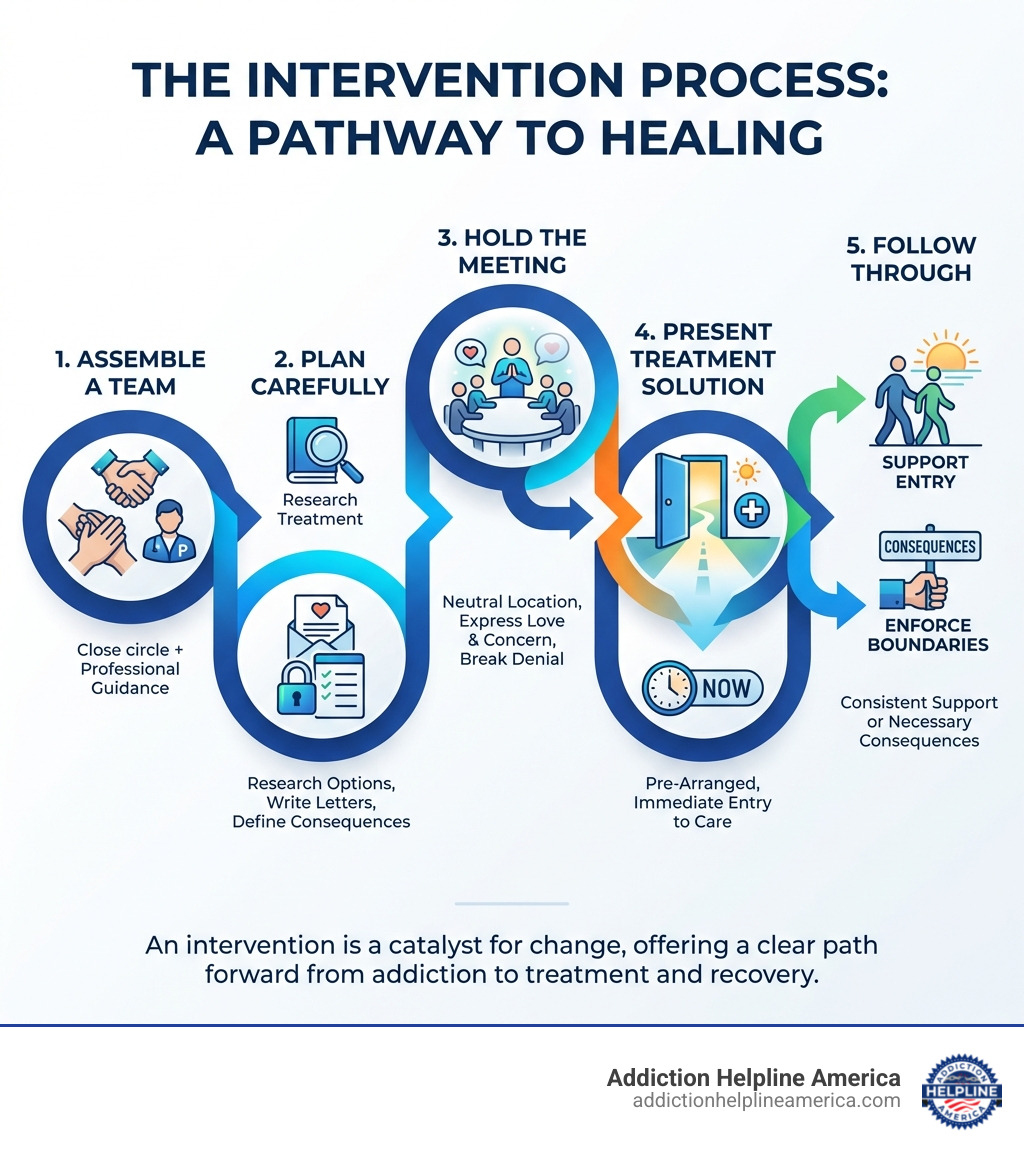
How do interventions work? An intervention is a structured process where loved ones confront someone about their addiction in a compassionate way. The goal is to help them recognize the harm their substance use is causing and motivate them to accept treatment. The basic process involves:
- Assembling a team of loved ones, ideally with a professional interventionist.
- Careful planning, including researching treatment, writing impact letters, and setting consequences.
- Holding the meeting in a neutral space where each person reads their letter.
- Presenting a pre-arranged treatment solution that is ready immediately.
- Following through by supporting their entry into treatment or enforcing consequences if they refuse.
The power of an intervention is its ability to break through denial with undeniable facts and offer a clear path forward. With professional guidance, interventions can have success rates up to 90%, with around 80 percent of people seeking treatment within 24 hours.
If you’re watching a loved one struggle with addiction, you may feel helpless and desperate. While not a guarantee, an intervention is often the catalyst that breaks through the denial and shame trapping them.
At Addiction Helpline America, we guide families through the intervention process. Our free, confidential services connect you with experienced professionals who can help you plan an effective and compassionate intervention that prioritizes safety and lasting change.
How do interventions work helpful reading:
Understanding the “Why”: The Goal of an Intervention

Watching a loved one struggle with addiction can feel like being trapped in a cycle of frustration and despair. An intervention is a strategic move designed to interrupt this cycle and initiate healing.
Key Points:
- Breaking through denial: Denial is a major barrier to recovery. An intervention aims to break through it by holding up a mirror to destructive behaviors, making the reality of the situation impossible to ignore.
- Holding up a mirror to destructive behaviors: This isn’t about blame, but about presenting facts and feelings. When confronted with concrete examples of the pain their actions have caused, it can create a powerful moment of realization.
- Not waiting for “rock bottom”: You don’t have to wait for a catastrophe. An intervention can create the feeling of “rock bottom” in a safe, controlled environment, prompting action before the situation worsens.
- Creating a moment of clarity: An intervention provides a structured, sober moment for clarity. Surrounded by love, the individual faces the truth, and this clarity, combined with an immediate offer of help, can be the catalyst for change.
- It’s a process for the whole family: Addiction impacts the entire family. An intervention begins the healing process for everyone, providing support and education that is vital for long-term, collective recovery. Learn more with our Addiction Help: Families Guide.
How do interventions work to address enabling and codependency?
Addiction often creates patterns of enabling and codependency. Understanding how do interventions work to untangle these dynamics is crucial.
- Defining enabling behaviors: Enabling is when loved ones inadvertently allow addiction to continue by shielding the person from consequences (e.g., providing money, making excuses). While well-intentioned, it prevents them from facing reality.
- Defining codependency: Codependency is a dysfunctional relationship where one person’s self-worth is tied to “helping” the other, creating a cycle where both remain stuck.
- Shifting family dynamics from enabling to supporting recovery: An intervention helps families recognize and change these patterns. By setting clear boundaries, it empowers the family to stop enabling and start supporting recovery. This provides a clearer perspective, free from clouded emotional judgment.
- The intervention as a tool for family healing: Interventions are also for family healing. It’s a chance for family members to voice their pain, set healthy boundaries, and start their own recovery journey, creating a healthier environment for everyone. For additional support, explore our Resources for Families of Addicts. The importance of family support is highlighted in discussions about love, honesty, and support within interventions.
The Step-by-Step Guide to How Interventions Work
An intervention is a structured process, not a spontaneous confrontation. Each step is crucial for understanding how do interventions work effectively.
Step 1: Assemble the Team and Seek Professional Guidance
The foundation of a successful intervention is a well-prepared team, often with professional guidance.
- Forming the intervention team: Form a team of 4 to 6 important people in the loved one’s life whom they respect. The goal is to present a united front of love and concern.
- Who to include; Who to exclude: Include people who can stay calm and stick to the plan. Exclude anyone with their own substance abuse or unmanaged mental health issues, or those who may become accusatory.
- The role of a professional interventionist: A professional interventionist is highly recommended. They are trained to structure the process, guide the team, and lead the meeting, keeping it focused and productive.
- When professional help is essential: Professional help is essential if the person has a history of violence, serious mental illness, suicidal thoughts, or polysubstance abuse. An interventionist can assess risks and ensure safety.
- Finding a qualified professional: Find a professional through referrals from doctors, therapists, or organizations like the Association of Professional Intervention Specialists. Our team at Addiction Helpline America can also connect you with qualified professionals. For more information, refer to our Learn About Intervention resources.
Step 2: Create a Detailed Plan

Meticulous planning is the next critical step.
- Choosing a neutral time and place: Choose a neutral location, like a professional’s office, to avoid emotional manipulation. Schedule the meeting for a time when the person is likely to be sober.
- Gathering information about the specific addiction: Research the specific addiction to understand its effects, withdrawal symptoms, and treatment options. This knowledge helps you empathize and prepare.
- Researching and pre-arranging a treatment program: Before the intervention, have a concrete treatment plan ready. Research facilities, verify insurance, and make preliminary arrangements to remove barriers to immediate help. Our Inpatient Addiction Treatment: Complete Guide can help.
- Writing impact letters with “I” statements: Each team member writes a letter using “I” statements to express how the addiction has affected them personally (e.g., “I feel scared…”). The letters should include specific examples and emphasize love and concern, not blame.
- Defining clear, non-negotiable consequences: The team must define clear consequences if treatment is refused. These are not punishments but protective boundaries to motivate change, such as withdrawing financial support. Everyone must be prepared to follow through.
Step 3: Rehearse and Hold the Meeting
The intervention meeting is the culmination of your planning.
- The importance of rehearsal: Rehearsal is essential. Practice with the interventionist to clarify roles, speaking order, and how to handle reactions. This helps the team stay focused.
- Managing emotions: Participants must manage their emotions and remain calm. The interventionist will help maintain a loving and concerned tone.
- Sticking to the plan: Stick to the script. Diverging from the plan can reduce effectiveness. Letters should be read as written.
- The intervention meeting: The interventionist begins the meeting by explaining its purpose, then guides each person as they read their letter, focusing on concern and truth.
- Reading letters with love and concern: Letters are read with a tone of love and compassion, not judgment. The goal is to help the person see the addiction’s impact from the perspective of those who care.
- Presenting the pre-arranged treatment option as a solution: After the letters, the pre-arranged treatment plan is presented as a concrete, immediate solution with all logistics handled. Having a bag packed using a list like What to Pack for Rehab can help.
- Asking for an immediate decision: The person is asked for an immediate decision: accept treatment or face the consequences. This prevents delay and stops denial from returning.
Step 4: Follow Through with Support and Consequences
The intervention doesn’t end with the meeting. Follow-through is key to how do interventions work for long-term change.
- If they accept help: If they accept, transport them to the treatment facility immediately. The family’s role continues through ongoing support and therapy (like Group Therapy Pasadena: Complete Guide), which is vital for everyone’s healing.
- If they refuse help: If they refuse, the team must enforce the consequences. This is difficult but crucial for consistency. It involves setting boundaries to protect yourselves (“detaching with love”) while keeping the door open for when they are ready, without enabling. The message has been delivered, and seeds for change are planted.
Exploring Different Types of Intervention Models
Not all interventions are the same. The best model depends on the situation, and understanding these variations clarifies how do interventions work in different contexts.
| Feature | Johnson Model | ARISE Model | Family Systemic Model |
|---|---|---|---|
| Approach | Direct, often surprise, confrontational (but caring) | Invitational, collaborative, gradual, less confrontational | Holistic, addresses entire family system |
| Family Involvement | Planning team presents concerns, consequences | Whole family involved from the beginning, stages of engagement | Focuses on all family relationships and dynamics |
| Preparation | Extensive, rehearsed, specific examples, treatment ready | Initial call, multiple pre-intervention meetings, therapist-led | Professional guidance, deep dive into family patterns |
| Key Goal | Immediate entry into treatment | Engage family, motivate individual, enter treatment | Heal family, change dynamics, support individual recovery |
The Johnson Model
Pioneered by Vernon Johnson, this is one of the most recognized intervention models.
- Confrontational but caring approach: This model uses a direct, often surprise, confrontation. The team presents facts about the addiction’s consequences, framed with love and concern, to break through denial.
- Surprise element to bypass denial: The surprise element is a key aspect, designed to bypass the individual’s usual defenses and denial mechanisms, creating a critical moment for them to hear the truth.
- Focus on presenting reality: The team prepares specific facts about the substance use and its impact, presenting this evidence clearly to urge them toward treatment. For more, see resources on the Johnson Model.
The ARISE Model
The ARISE (A Relational Intervention Sequence for Engagement) model is a less confrontational, more invitational approach.
- Invitational and collaborative: Unlike the Johnson Model, ARISE begins with invitational meetings. The goal is to build a collaborative relationship, inviting the individual to participate rather than ambushing them.
- Gradual, three-stage process: The model unfolds in three levels, starting with a first call and pre-intervention meetings where the family learns intervention strategies, with the ultimate goal of treatment enrollment.
- Less confrontational: By involving the individual from the start, ARISE aims to reduce defensiveness and resistance.
- Involves the entire family from the start: ARISE emphasizes involving the entire family system, recognizing that family support is crucial for recovery. Research supports the effectiveness of the ARISE model.
Family Systemic Intervention
This model views addiction as a symptom of dysfunction within the entire family system.
- Treats the family system, not just the individual: This approach focuses on the family unit’s dynamics, acknowledging that all relationships are affected and the entire family needs healing.
- Addresses dysfunctional family roles and communication: The model helps identify and change enabling behaviors, codependency, and other unhealthy patterns that may have developed.
- Aims for long-term healing for all members: By focusing on the family as a whole, this approach supports a healthier environment for sustained sobriety for everyone. Learn more about the Family Systemic Intervention.
Other Intervention Approaches
- Brief Interventions: These are short, one-on-one meetings with a professional, often in a medical or school setting. The goal is to motivate a specific behavior change or prompt further treatment. More can be found on brief interventions in medical settings.
- Crisis Intervention: This is for acute situations like a mental health crisis or overdose, often involving clinical support and law enforcement. The immediate goal is safety and stabilization, followed by a connection to care. Learn more about Crisis Intervention for acute situations.
- SMART Interventions: This approach uses the SMART acronym (Specific, Measurable, Attainable, Relevant, Time-specific) to set clear goals for behavior change within the intervention process.
Maximizing Success: Common Mistakes and Best Practices
A well-planned intervention has a high success rate, but it’s not foolproof. Understanding how do interventions work effectively means knowing what to do and, crucially, what to avoid. When planned with professional help, interventions can be up to 90 percent successful in convincing the person to get help.
Common Mistakes to Avoid
Here are some “don’ts” that can sabotage an intervention:
- Don’t be spontaneous: An unplanned confrontation will likely fail. Interventions require careful planning and rehearsal.
- Don’t blame or shame: Accusations are counterproductive and cause defensiveness. As one source states, “Guilt trips will get you absolutely nowhere with addicts and alcoholics.” Focus on expressing concern with love.
- Don’t hold the meeting when the person is intoxicated: Wait for a time when they are sober and can think clearly.
- Don’t be vague about consequences: Consequences for refusing treatment must be specific, and the family must be prepared to enforce them.
- Don’t give up if the first attempt fails: Even if unsuccessful, the intervention plants a seed. Maintain boundaries and hope.
How Interventions Work Best: Keys to Effectiveness
Conversely, here are the “do’s” that increase the chances of success:
- Do plan carefully: This is the most important factor, including choosing the right team, timing, location, and script.
- Do work with a professional: An interventionist provides crucial guidance, structure, and safety, especially in complex cases.
- Do present a united front: The team must be unified in its message of love and concern. Rehearsal helps achieve this.
- Do focus on love and specific facts: Use “I” statements and specific examples to express concern without making accusations.
- Do have a treatment plan ready: A pre-arranged program with logistics handled provides an immediate solution and removes excuses.
- Do follow through: Consistency is vital. Enforce consequences or provide support as planned to maintain credibility and promote change.
Frequently Asked Questions About the Intervention Process
How do you know if it’s the right time for an intervention?
It’s time when you see a consistent pattern of destructive behavior that the person denies or is unable to stop. If addiction is negatively impacting their health, relationships, work, or finances, and they are unwilling to seek help, an intervention is needed. The goal is to intervene before they hit “rock bottom.”
What if the person gets angry and walks out?
This is a possibility your professional interventionist will prepare you for. The key is to remain calm and not argue. The interventionist can help de-escalate. Even if they leave, the message has been delivered. The family must then enforce the agreed-upon consequences, which can be a powerful motivator for future change.
Can an intervention make things worse?
A poorly planned, angry, or shaming intervention can worsen the situation by creating resentment and defiance. This is why following a structured, compassionate model with professional guidance is critical. A correctly conducted intervention is a loving act designed to open the door to recovery, not to alienate. Working with a professional minimizes risks and maximizes the chances of a positive outcome.
Conclusion
An intervention is a powerful and structured act of love designed to save a life. It is the first step on a path to healing for both the individual and their family. Understanding how do interventions work and committing to a carefully planned process can break through years of denial and enable your loved one to accept recovery. You have the power to start the process, and help is available now.
Addiction Helpline America is here to provide free, confidential guidance to find the right treatment program. Call our 24/7 helpline or explore our drug addiction programs to take the first step today.