Understanding Your Two Main Treatment Paths
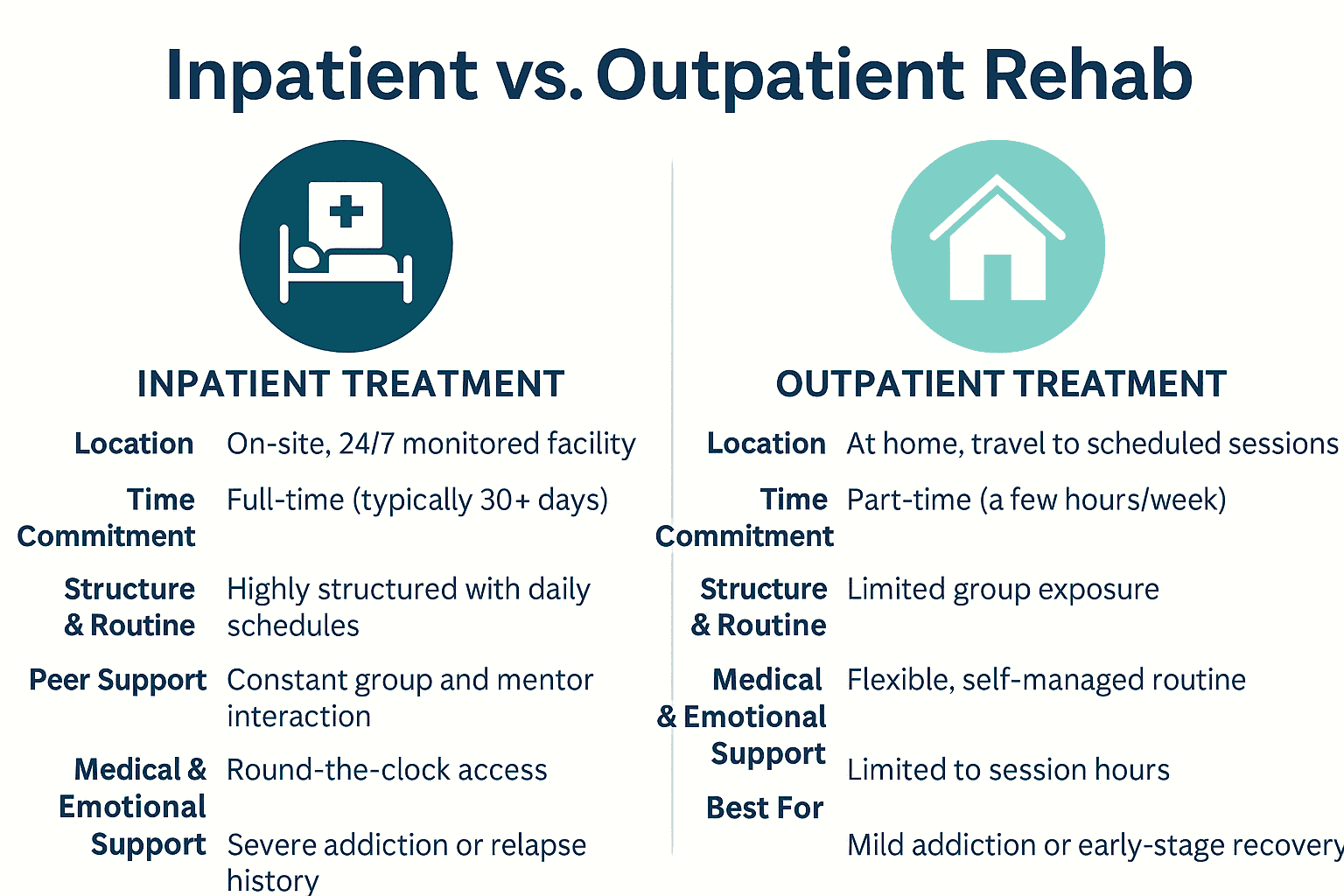
How do residential and outpatient rehab programs compare? The core difference is where you live during treatment. Residential programs require you to stay at the facility 24/7, offering intensive, structured care with constant medical supervision. Outpatient programs let you live at home while attending scheduled therapy sessions, giving you flexibility to maintain work, school, or family responsibilities.
Quick Comparison:
| Factor | Residential Rehab | Outpatient Rehab |
|---|---|---|
| Living Situation | Live at the facility full-time | Live at home, attend sessions |
| Intensity | High – 24/7 structured care | Varies – a few hours per week to daily sessions |
| Best For | Severe addiction, unsafe home environment, need for medical detox | Mild-moderate addiction, strong home support, ongoing responsibilities |
| Cost | Higher (includes room, board, 24/7 care) | Lower (pay per session) |
| Duration | Typically 30-90 days | Several months to over a year |
Choosing the right path during a crisis is overwhelming. Whether for yourself or a loved one, know that both approaches work. The key is finding the right fit for the unique situation.
Addiction Helpline America has guided thousands through this decision. We help you compare residential and outpatient rehab to find the path to lasting recovery. Our team offers confidential, 24/7 support, connecting you to the right resources and treatment options without judgment.

Know your how do residential and outpatient rehab programs compare terms:
Defining the Two Paths: What Are Residential and Outpatient Rehab?
When seeking help for addiction, you’ll find two main options: residential and outpatient programs. One requires stepping away from daily life to heal, while the other integrates treatment into your current life. Understanding how residential and outpatient rehab programs compare begins with their core offerings.
What is a Residential Rehab Program?
A residential rehab program, or inpatient treatment, requires you to live at the facility full-time. This immersive approach removes you from daily triggers and stressors, allowing you to focus entirely on recovery.
Your days follow a structured routine of therapy, counseling, and workshops, which helps rebuild healthy habits. A key benefit is 24/7 care and medical supervision, which is crucial during detoxification when withdrawal symptoms can be dangerous. Living with others on a similar journey fosters powerful peer support, creating a safe, non-judgmental space for healing.
This environment protects you from triggers while you build coping skills. Comprehensive therapies like Cognitive Behavioral Therapy (CBT) and holistic methods (yoga, art therapy) are common. Life skills training is also integrated, helping you build a life worth staying sober for.
Programs typically last 30 to 90 days, though some people need longer. We offer more info about long-term addiction rehab centers to help you understand what extended care looks like.
What is an Outpatient Rehab Program?
An outpatient rehab program allows you to live at home while attending scheduled treatment sessions. This model fits treatment around your life rather than replacing it.
The primary benefit is flexibility, allowing you to maintain work or school commitments. This provides stability and lets you apply coping skills in real-world situations immediately, creating a valuable feedback loop for learning.
Your existing support systems are central to outpatient recovery. Programs vary in intensity, from a few hours a week in general outpatient to daily sessions in an Intensive Outpatient Program (IOP) or Partial Hospitalization Program (PHP). This model is also more cost-effective as it doesn’t include room and board. We can help you explore more info about different treatment options to find the right level of care.
Outpatient care is ideal for those with mild to moderate addiction and a stable home environment. It’s also a common step-down from residential care. Understanding how residential and outpatient rehab programs compare reveals they serve different needs; the right choice depends on your circumstances, and that’s exactly what we’re here to help you figure out.
How Do Residential and Outpatient Rehab Programs Compare in Structure and Intensity?
The biggest differences in how residential and outpatient rehab programs compare lie in their structure and intensity. These factors shape your entire recovery experience.
Residential rehab is a full-time immersion where your entire day is structured around recovery, free from outside distractions. Outpatient programs integrate into your life; you attend scheduled sessions and then return to your daily routine, applying what you’ve learned in real time.
Here’s how residential and outpatient rehab programs compare across the most important factors:
| Factor | Residential Rehab | Outpatient Rehab |
|---|---|---|
| Living Arrangements | Live at the facility; removed from normal life. | Live at home; attend sessions at a facility. |
| Intensity/Time Commitment | Full-time, 24/7 immersion; highly structured. | Part-time; flexible hours (e.g., 3-6 hours/day, 3-5 days/week). |
| Level of Supervision | Constant, 24/7 medical and emotional support. | Scheduled supervision during sessions; self-managed outside. |
| Typical Duration | 30, 60, 90 days, or longer (up to 6 months to a year). | Several weeks to over a year, depending on intensity. |
| Cost | Higher (includes room, board, 24/7 care, amenities). | Lower (billed per session/program; no living costs). |
| Ideal Candidate | Severe addiction, co-occurring disorders, unstable home, history of relapse, need for medical detox. | Mild-moderate addiction, strong home support, stable environment, work/school commitments. |
The intensity difference is key. Residential care provides a 24/7 safety net, which is vital for severe addiction, co-occurring conditions, or during withdrawal. Outpatient programs require more self-management, as you are responsible for your sobriety outside of sessions. This independence can be empowering for those with strong support systems but may be overwhelming for others.
Understanding the Different Levels of Outpatient Care
Outpatient rehab isn’t one-size-fits-all; it exists on a spectrum of intensity, allowing you to move between levels of care as your needs change.
Partial Hospitalization Programs (PHP) are the most intensive, with treatment for 5-6 hours a day, 5-6 days a week. It offers near-residential structure while you live at home.
Intensive Outpatient Programs (IOP) are less intensive, typically involving 3 hours of treatment, 3-5 days a week. This allows room for work or school. NAMI explains levels of care in more detail if you want to explore these options further.
General Outpatient Programs (GOP) are the least intensive, with just a few sessions per week. This level is ideal for mild issues or as a step-down from more intensive care.
The beauty of these different levels is that they’re flexible. You can start at one level and move to another as your needs change.
Typical Program Durations
The duration of rehab varies, but there are typical timelines.
For residential programs, stays are typically 30, 60, or 90 days. The National Institute on Drug Abuse suggests at least 90 days for the best outcomes. Long-term programs can last six months or more. You can learn more info about 30-day inpatient rehab or more info about long-term addiction rehab centers if you’re considering extended care.
Outpatient programs are more variable, often lasting from three months to over a year. This continuum of care allows treatment to evolve with your progress.
The key is that recovery takes time. The right duration is whatever provides the foundation you need for lifelong sobriety.
Weighing the Pros and Cons: Key Benefits of Each Program
When deciding how residential and outpatient rehab programs compare, it’s crucial to see which benefits align with your needs. Residential rehab is a focused pause from life, while outpatient treatment integrates recovery into your daily routine. Both have powerful advantages.

Key Benefits of Choosing a Residential Rehab Program
Immersive Environment: You are in a protected space focused solely on healing. This helps break old patterns and build new, healthy routines without outside distractions.
24/7 Medical and Emotional Support: Constant access to medical and counseling staff provides a crucial safety net, especially during withdrawal or emotional crises.
Freedom from External Triggers: Being removed from your usual environment gives you a safe space to build coping skills before facing triggers again.
Strong Peer Community: Living with others on the same journey creates powerful, non-judgmental bonds and a built-in support network.
Integrated Treatment for Co-occurring Conditions: These programs are equipped to treat addiction and mental health issues like depression or anxiety simultaneously. Learn more with our more info about dual diagnosis rehabs.
Comprehensive Care: All therapies—individual, group, family, and holistic—are coordinated under one roof for a unified treatment approach.
Key Benefits of Choosing an Outpatient Rehab Program
Flexibility for Daily Life: You can continue working, attending school, and caring for your family, fitting treatment around your responsibilities.
Lower Cost: Without room and board, outpatient care is significantly more affordable. If cost is a concern, explore more info about free alcohol rehab options.
Maintaining Employment and Family Roles: Staying engaged in your life provides purpose and structure, which can strengthen recovery.
Immediate Application of Coping Skills: You can immediately practice new skills in your actual environment, which reinforces learning and builds confidence.
Utilizing Home Support Systems: Your family and friends can be actively involved, helping you build a strong, local support network for long-term success.
Discreet Treatment: The flexible scheduling allows for more privacy, which can be important for those concerned about stigma in their career or social circles.
Continuity of Care: It serves as an excellent step-down from residential treatment, providing a bridge back to independent living with continued support.
Understanding the benefits of each helps you choose the program that best fits your personal circumstances and recovery goals.
Making the Right Choice: Factors to Consider for Your Recovery Journey
Choosing the right treatment is about finding the right fit for you. A personal assessment should consider the severity of your addiction, your home environment, and your daily responsibilities. When figuring out how do residential and outpatient rehab programs compare for your situation, professional guidance is key. We’re here to help you find the best rehab programs that truly align with your needs.

How do residential and outpatient rehab programs compare for co-occurring disorders?
Addiction often co-occurs with mental health conditions like anxiety or depression. This is called a “dual diagnosis,” and integrated treatment is essential for recovery. So, how do the programs compare for these complex challenges?
Residential rehab is often the best choice for severe co-occurring disorders. The 24/7 support and controlled environment provide medical stability and psychiatric care, shielding you from stressors that could worsen symptoms. This is supported by scientific research. The deciding factor is the level of support needed. If your mental health is precarious, residential care offers a crucial safety net. We have more info about dual diagnosis rehabs if you’re navigating this dual challenge.
Outpatient programs can work for milder or stabilized dual diagnosis cases. Many IOPs and PHPs offer integrated mental health services, making them a viable option or a good step-down from residential care.
Comparing the Cost of Residential vs. Outpatient Rehab
Cost is a major factor in your decision. Here’s how do residential and outpatient rehab programs compare financially.
Residential rehab is more expensive because the cost includes treatment, room, board, and 24/7 staffing. Prices can range from $10,000 to $30,000 or more per month.
Outpatient rehab is more affordable, often billed per session. Costs might range from $3,000 to $10,000 for a comparable treatment period.
Insurance coverage can significantly reduce costs for both options. Check your plan’s specific benefits. We can help you steer insurance and find other options, like more info about free drug abuse rehab centers.
Regarding long-term value, the higher upfront cost of residential treatment can be more cost-effective for severe addiction if it prevents future relapses and related expenses.
The Role of Your Support System and Family Involvement
Your support system is vital for recovery. The programs involve them in different ways.
In residential rehab, family involvement occurs through scheduled family therapy and visits. The primary support community is built within the facility among peers and staff. We provide resources for families of addicts to help them understand their role.
Outpatient rehab relies heavily on a supportive home environment. Family and friends act as accountability partners. Family therapy is often a core component to ensure the home dynamic supports recovery.
If your home environment is unstable or triggering, residential care offers a necessary escape. If you have a strong support system, outpatient treatment can leverage that to build a lasting sober network.
The Continuum of Care: Transitions, Success, and Long-Term Recovery
Recovery is a journey, not a destination. The “continuum of care” model allows you to move between different levels of support as your needs evolve. The data says both work, but context matters. Success in either program depends on finding the right match. Relapse prevention, aftercare planning, and a commitment to lifelong recovery are key, regardless of where you start.
How do residential and outpatient rehab programs compare for long-term success?
When comparing how residential and outpatient rehab programs compare for long-term success, there’s no single winner.
Treatment completion rates are often higher in residential programs due to the immersive, distraction-free environment. However, abstinence and relapse statistics are more nuanced. Some studies show outpatient care has advantages for certain substance use disorders, while inpatient care is initially better for severe dependence.
This is because individual progress is more critical than program type. Factors like mental health, social support, and commitment to recovery are better predictors of success. Inpatient care often yields better outcomes for those with weak support or poor mental health, while those with strong support may succeed in either.
A key factor for success is duration: longer-term care generally improves recovery outcomes. This highlights the importance of aftercare in addiction recovery, as recovery is an ongoing process.
Can You Transition Between Program Types?
Yes, you can transition between program types. In fact, moving between levels of care is a sign of a smart, flexible recovery plan.
Step-down care is a common and effective path. A person might start in a residential program to stabilize, then transition to an Intensive Outpatient Program (IOP) or Partial Hospitalization Program (PHP). This allows for gradual reintegration into daily life with continued support. Research on transitioning from inpatient to outpatient confirms this improves long-term outcomes.
Transitions can also mean stepping up in care. If outpatient treatment isn’t enough, moving to a residential program is a sign of strength and self-awareness.
Creating a long-term recovery plan involves flexibility and continued support. Recovery is a lifelong commitment that requires ongoing connection through therapy, support groups like AA/NA, or sober living to prevent relapse.
Understanding how do residential and outpatient rehab programs compare shows they are complementary tools. The goal is to build a personalized plan that evolves with you, using the right tool at the right time.
At Addiction Helpline America, we help you understand these options and connect you with treatment programs that can provide the appropriate level of care—right now, and as your needs change. Recovery is possible, and we’re here to help you find the path that works for you.
Conclusion
Choosing between residential and outpatient treatment is about finding the right environment for your healing. As we’ve explored in how residential and outpatient rehab programs compare, there is no single “right answer.” The best program is the one that matches your specific addiction severity, home life, mental health needs, and responsibilities.
Residential treatment offers a safe cocoon for rebuilding, while outpatient care integrates recovery into your daily life. Both approaches are effective. The key is honest self-assessment and professional guidance.
This decision is overwhelming, and that’s why Addiction Helpline America is here. We provide free, confidential support to help you understand your options and connect with a treatment center that fits your unique needs. Our team will guide you toward the care that makes sense for your journey.
We serve every state and the District of Columbia, simplifying the process of finding help.
Recovery begins with asking for help. You’ve taken a step by educating yourself. Now, reach out to us and find the right type of treatment program for your needs. Your journey to a healthier, substance-free life is waiting—and you don’t have to walk it alone.