
Why Finding the Right Intensive Outpatient Program Matters
Best iop programs near me offer a critical bridge for individuals needing more support than weekly therapy without requiring 24-hour supervision. These programs provide 9-12 hours of structured treatment per week, allowing you to maintain work, school, or family life while receiving comprehensive care for substance use or mental health conditions.
When searching for a top IOP, prioritize programs with accreditation (Joint Commission or CARF), evidence-based therapies (CBT, DBT), flexible scheduling, and in-network insurance acceptance. Specialized tracks for specific demographics and a history of strong patient outcomes are also key indicators of quality.
Research shows IOPs produce outcomes comparable to inpatient programs, with 93% of clients reporting improved depression symptoms and 90% experiencing reduced anxiety. A typical program runs 6-12 weeks, meeting 3-4 days per week. IOPs are ideal for stepping down from residential treatment or stepping up from weekly therapy when more structure is needed.
At Addiction Helpline America, we help individuals and families find quality addiction treatment, connecting them with the best iop programs near me that match their needs and insurance. We provide confidential, personalized guidance 24/7 to simplify this overwhelming process.
Important best iop programs near me terms:
What is an Intensive Outpatient Program (IOP) and Who Is It For?
An Intensive Outpatient Program (IOP) offers structured addiction and mental health treatment with the flexibility to live at home. Unlike 24/7 inpatient care, an IOP allows you to maintain your work, school, and family life while attending therapy sessions several days a week.
Most programs involve about 9 hours of treatment per week, typically in 3-hour sessions. This level of care is ideal when you need more support than a weekly therapy appointment but don’t require constant medical supervision. An IOP can serve as a step-down from inpatient care, providing support as you transition back to daily life, or a step-up from traditional therapy when you need more intensity.
Research shows no significant difference in outcomes between inpatient and IOP completion. Impressively, 90% of patients maintain their progress without needing higher levels of care for 12 months or more after treatment. This higher level of support bridges the gap effectively. For more details, explore our resources on Intensive Outpatient Programs (IOP).
The Benefits of Choosing an IOP
When looking for the best iop programs near me, consider these key advantages:
- Cost-Effective: IOPs provide intensive care without the high cost of 24/7 residential facilities.
- Real-World Application: You can immediately practice coping skills learned in therapy in your home environment.
- Peer Support: Group sessions build a strong sense of community with others facing similar challenges, reducing isolation.
- Maintain Responsibilities: The flexible schedule allows you to continue with work, school, and family commitments.
- Family Involvement: Many programs include family therapy, which is a leading predictor of long-term success.
- Proven Mental Health Improvements: Studies show 93% of clients report better depression symptoms, and 90% experience reduced anxiety.
Signs You or a Loved One Might Need an IOP
An IOP might be the right fit if you or a loved one are:
- Struggling to manage daily responsibilities at work, school, or home.
- Finding that weekly therapy sessions are no longer sufficient.
- Needing a structured environment with built-in accountability to thrive.
- Facing a high risk of relapse and needing to strengthen coping strategies.
- Recently discharged from inpatient or PHP care and needing continued support.
- Dealing with co-occurring disorders (both mental health and substance use issues) that require integrated treatment.
IOP vs. Other Levels of Care: PHP and Inpatient
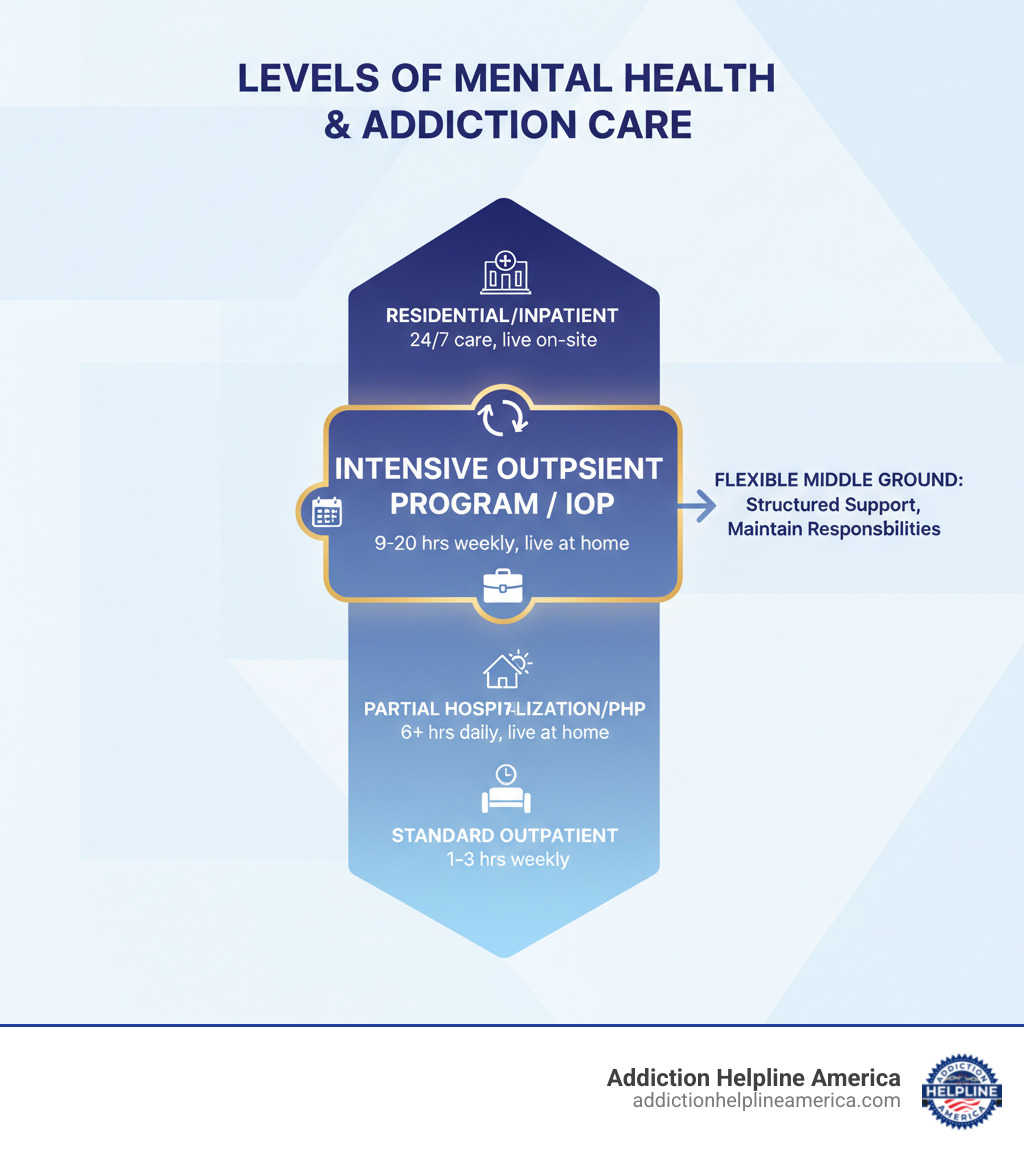
Understanding where IOPs fit in the treatment continuum helps you choose the right level of care. Here’s a comparison:
| Feature | Inpatient Treatment (Residential) | Partial Hospitalization Program (PHP) | Intensive Outpatient Program (IOP) |
|---|---|---|---|
| Living Situation | Live at the facility 24/7 | Live at home or in sober living | Live at home or in sober living |
| Hours/Week | 24/7 care and supervision | 30+ hours/week (typically 6+ hours/day, 5 days/week) | 9-20 hours/week (typically 3-5 days/week, 3-4 hours/day) |
| Supervision Level | Highest: Constant medical and clinical oversight | High: Clinical oversight during program hours | Moderate: Structured clinical oversight during program hours |
| Ideal Candidate | Acute, severe symptoms; requires medical detox or constant monitoring; unsafe at home | Transitioning from inpatient; significant symptoms not requiring 24/7 care; direct entry for high-level support needs | Stepping down from PHP/inpatient; stepping up from outpatient; needs structured support while maintaining daily life |
| Typical Cost | Highest | High (less than inpatient) | Moderate (most cost-effective for intensive care) |
Inpatient care is for acute cases requiring 24/7 medical supervision. Partial Hospitalization Programs (PHP) are a step down, offering 30+ hours of treatment per week while you live at home. Learn more about Partial Hospitalization Programs (PHP).
IOPs offer the most flexibility, delivering 9-20 hours of intensive care weekly that fits around your life. This makes IOPs a sustainable and effective option for many people seeking recovery while managing daily responsibilities.
A Look Inside a Typical IOP: Therapies, Schedule, and Duration
When you start an IOP, the first step is a thorough assessment to create an individualized treatment plan custom to your history, symptoms, and goals. This plan guides your journey through the program.

Most IOPs require at least 9 hours of treatment per week, usually in 3-hour sessions on 3-5 days. This structure provides the intensity needed for change while allowing you to maintain your daily life. The average program length is 6-12 weeks, but this varies based on individual progress. The goal is to ensure you have the skills for lasting recovery, not to rush through a timeline. IOPs are also well-equipped to treat co-occurring disorders, addressing mental health and substance use issues simultaneously.
Common Therapies and Treatment Modalities
The best iop programs near me use a mix of evidence-based therapies to build a comprehensive recovery toolkit.
- Group therapy is the core of most IOPs, creating a supportive community where you can share experiences and practice new skills with peers who understand.
- Individual counseling offers one-on-one time with a therapist to address personal issues and tailor strategies to your specific goals.
- Cognitive Behavioral Therapy (CBT) teaches you to identify and change negative thought patterns that lead to unhealthy behaviors.
- Dialectical Behavioral Therapy (DBT) focuses on skills like mindfulness, distress tolerance, and emotion regulation, which is especially helpful for managing intense emotions.
- Family therapy involves loved ones in the recovery process to improve communication and build a strong support system at home.
- 12-Step facilitation introduces the principles and peer support of groups like AA and NA, providing a valuable resource for ongoing recovery.
- Drug and alcohol monitoring is a standard tool for accountability that provides objective feedback on your progress toward sobriety.
Other therapies may include motivational interviewing, psychoeducation, and case management.
What a Typical Week in an IOP Looks Like
An IOP’s weekly schedule is predictable and designed to fit your life. Sessions are held 3 to 5 days per week for 3 to 4 hours each. Morning and evening programs accommodate various work and school schedules.
Group sessions cover essential recovery topics like managing cravings, coping with anxiety, setting boundaries, and preventing relapse. These are active sessions where you practice skills in real-time. Weekly individual check-ins with your therapist provide dedicated time to discuss personal progress and challenges. If family sessions are part of your plan, they typically occur weekly or bi-weekly to address family dynamics and improve support.
Throughout the week, you apply what you learn at home, facing real-world triggers with new tools and a strong support system. This immediate application is what makes IOP treatment so effective.
How to Find the Best IOP Programs Near Me
Finding the right IOP is a crucial step. At Addiction Helpline America, we specialize in connecting people with the best iop programs near me from our extensive network across the country. We can help you steer your options with confidence.
To find reputable programs, start by asking for referrals from your doctor or therapist. A critical step is checking accreditations from organizations like the Joint Commission or CARF, which signify high standards of care. Also, verify that the staff holds appropriate state licenses and certifications. For a detailed walkthrough, see our Find the Right Rehab Facility Guide.
Key Factors for Choosing the Best IOP Programs Near Me
As you evaluate programs, consider these essential factors:
- Location and Accessibility: A convenient location reduces travel stress and makes consistent attendance easier. Check for proximity to your home or work and access to public transportation.
- Evidence-Based Therapies: Ensure the program uses research-backed methods like CBT, DBT, EMDR, and Motivational Interviewing.
- Staff Credentials: Look for a team of licensed and experienced professionals, including therapists, counselors, and medical staff with specializations relevant to your needs (e.g., trauma, co-occurring disorders).
- Patient Reviews: Testimonials can offer insight into a program’s environment and effectiveness. Look for feedback on staff compassion and program structure.
- Aftercare Planning: Great programs provide robust aftercare support, including referrals to ongoing therapy, support groups, and alumni programs to help sustain recovery.
- Program Environment: A safe, welcoming, and non-judgmental atmosphere is vital for healing. Trust your instincts during a tour or consultation.
- Specializations: Programs custom to specific populations (e.g., adolescents, veterans, LGBTQ+) or conditions (e.g., eating disorders, trauma) can provide more effective, customized care.
- Insurance Acceptance: Always confirm that the program is in-network with your insurance plan to understand your out-of-pocket costs upfront.
Specialized and Virtual IOP Options
Modern treatment offers more customized and accessible care than ever before.
Specialized programs cater to the unique needs of different groups, creating a more relevant and supportive therapeutic environment. These include tracks for:
- Veterans and First Responders: Addressing service-related trauma and stress.
- Age-Specific Groups: Programs for adolescents, young adults, and adults.
- Gender-Specific Groups: Safe spaces for men or women to discuss sensitive topics.
- Professionals: Offering discretion and flexible scheduling for demanding careers.
- LGBTQ+ Community: Providing culturally competent and affirming care.
- Eating Disorders: Integrating nutrition counseling and specialized therapies.
Virtual IOP (vIOP) has made intensive treatment highly accessible. Using secure telehealth platforms, you can receive the same structured care from home. This eliminates geographic barriers, transportation issues, and commute times, making it easier to fit treatment into a busy life. While some people prefer the face-to-face connection of in-person programs, others thrive with the convenience and comfort of virtual care. Both models deliver the same evidence-based therapies and counseling.
Navigating the Cost and Insurance Coverage for IOPs
Understanding the financial side of treatment is essential. The good news is that IOPs are generally more affordable than inpatient programs, making intensive care more accessible.

The cost of an IOP varies based on geographic location, program length, and the services offered. While prices differ, the most important factor for most people is insurance coverage. Many programs will accept insurance, and most major providers cover at least a portion of IOP treatment.
How to Verify Your Insurance for an IOP
Verifying your insurance can be straightforward if you follow these steps:
- Contact Your Insurance Provider: Call the member services number on your insurance card. Ask specifically about your benefits for mental health and substance use “intensive outpatient programs.”
- Understand Network Status: Ask if a potential program is in-network (contracted, lower cost) or out-of-network (not contracted, higher cost). This is a crucial factor in your total expense.
- Check for Pre-authorization: Your insurance may require approval before treatment begins. The IOP’s admissions team can usually help manage this process for you.
- Know Your Policy Details: Familiarize yourself with key terms:
- Deductible: The amount you pay before insurance coverage starts.
- Copayment: A fixed fee you pay per session.
- Out-of-Pocket Maximum: The most you’ll pay in a year for covered services.
- Talk to the IOP Admissions Team: When you contact a program, have your insurance information ready. They can run a benefits check, estimate your costs, and discuss payment plans or financial assistance options.
At Addiction Helpline America, our navigators can help you verify your benefits and connect you with programs in our network that work with your insurance plan. You don’t have to figure this out alone.
Frequently Asked Questions about IOPs
It’s natural to have questions when considering an IOP. Here are answers to some of the most common concerns.
Can an IOP treat both mental health and substance use disorders?
Yes. Many of the best iop programs near me specialize in dual diagnosis or co-occurring disorders. They use an integrated approach to treat conditions like depression and alcohol use simultaneously, recognizing that these issues are often interconnected. This comprehensive care includes specialized behavioral therapies and medication management to address the whole person, not just isolated symptoms.
How long does an IOP program usually last?
The length of an IOP is based on your individual progress, not a fixed timeline. While the typical range is 6 to 12 weeks, some programs may be shorter or longer depending on your needs. Treatment duration is guided by clinical milestones, such as achieving stability and developing strong coping skills, ensuring you are ready to step down to a lower level of care.
What is the main difference between an IOP and regular outpatient therapy?
The key differences are intensity, time commitment, and structure. Regular outpatient therapy usually involves 1-3 hours per week, focusing on individual counseling. In contrast, an IOP is far more intensive, requiring 9 to 20 hours per week of structured programming.
This includes a mix of group therapy, individual counseling, and family sessions. The emphasis on group therapy provides a level of peer support and community that is not typically found in traditional weekly therapy. An IOP is the ideal middle ground when weekly therapy isn’t enough, but 24/7 care isn’t necessary. Learn more about different levels at our Outpatient Treatment resource page.
Find the Right IOP For Your Journey to Recovery
Choosing an Intensive Outpatient Program is a pivotal decision. IOPs offer a unique opportunity to heal while staying connected to your life, providing structured support, evidence-based therapies, and a peer community.
The results are compelling: 93% of clients see improvements in depression, 90% experience reduced anxiety, and 90% of patients maintain their progress for 12 months or more. These statistics represent real people who found a path to lasting recovery through the right IOP.
We know that searching for the best iop programs near me can be overwhelming. You might be worried about insurance, scheduling, or simply where to begin. That’s why Addiction Helpline America exists. We offer free, confidential, and personalized guidance to help you steer treatment options. Our team can connect you with a quality program from our vast network that matches your specific needs, location, and insurance.
You don’t have to do this alone. Taking the first step takes courage, and we’re here to ensure you find the right support. Recovery is possible, and it starts with a single conversation. Reach out to us today, and let’s work together to find the right treatment program for you. We’re here whenever you’re ready.