
Why Stories of Alcohol Addiction Matter
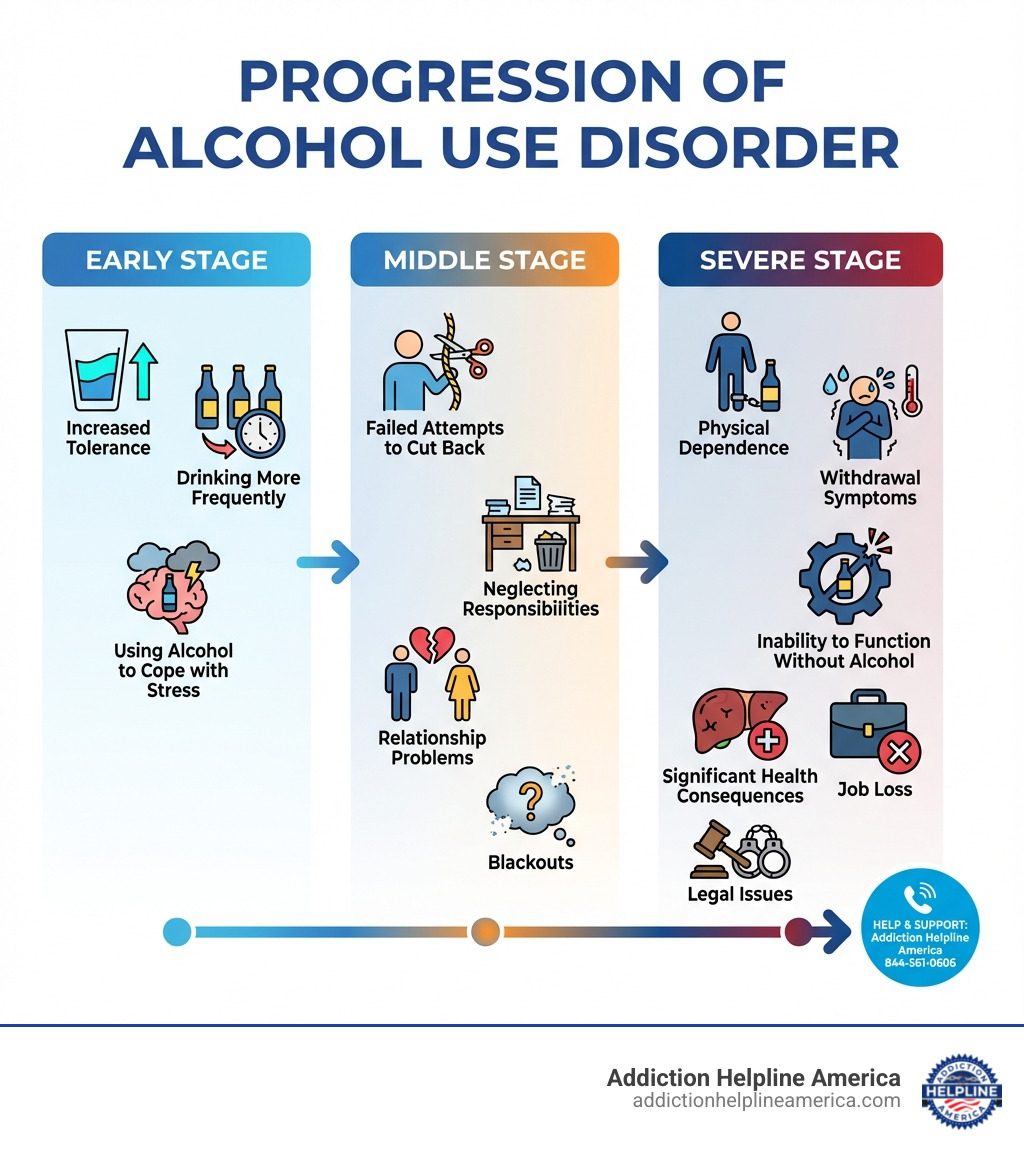
Stories of alcohol addiction illuminate the journey from the first drink to recovery. They show common patterns like building tolerance, using alcohol to cope, experiencing blackouts, relationship breakdowns, hitting a turning point, and finding hope through treatment. These narratives reveal that addiction has recognizable stages and recovery is possible with support.
Key insights from stories of alcohol addiction:
- Early signs include building tolerance, drinking alone, using alcohol to manage emotions, and experiencing blackouts
- Progression often involves job loss, strained relationships, legal troubles, health problems, and increasing isolation
- Turning points frequently come from health scares, interventions, or realizing you’ve become someone you don’t recognize
- Recovery requires admitting the problem, seeking professional help, building a support network, and addressing underlying mental health issues
- Long-term sobriety brings improved physical health, rebuilt relationships, mental clarity, and a more fulfilling life
The power of these stories lies in breaking through isolation. Reading about someone else’s struggle—a college student blacking out, a parent hiding bottles, or a professional’s drinking spiraling after a divorce—helps you see yourself reflected. You realize you’re not alone, not uniquely broken, and that change is possible.
At Addiction Helpline America, we’ve supported thousands through their recovery journeys and know how transformative it is to hear stories from people who’ve walked this path. We provide free, confidential guidance 24/7 at 844-561-0606 to connect you with treatment options and support.
Stories of alcohol addiction vocab to learn:
- 32 pills my sister’s suicide
- people before and after drugs
- best addiction recovery videos on youtube
The Subtle Beginnings: Common Triggers and Early Signs
In many stories of alcohol addiction, the beginning is subtle. It rarely starts with a dramatic crash but with small choices that build into dependency. Many don’t recognize the early signs because they blend into what society considers “normal” drinking.

From “Social Drinker” to Dependence
Alcohol often starts as a social lubricant, but “social drinking” can morph into something more. As one person shared, their “consumption of alcohol increased by the month.” A weekend indulgence can become a daily ritual. Stories like Laura’s, who at 17 began drinking as a “cool party girl,” show how blurry the line between managing and dependence can be.
Building tolerance is a key indicator of dependence. What seems like holding one’s liquor well can be a sign the body is adjusting to more alcohol. This means you need more to get the same effect, creating an illusion of control while the body becomes reliant. This made it hard for individuals like Paul to recognize the problem, as he saw alcohol as a relaxant that didn’t impact his work.
Alcohol-induced blackouts are another alarming, often unaddressed, early sign. Studies show 35-50% of undergraduates have blacked out. While 59% of women reported being scared enough by a blackout to change their habits, only 25% of men did. This shows many continue down a dangerous path, dismissing blackouts as “part of the fun.” Waking up with no memory of the night before is a terrifying, yet often unheeded, warning.
These patterns are common in stories of alcohol addiction. If you’re wondering if your drinking habits might be problematic, our complete guide to understanding alcoholism offers valuable insights.
The Link Between Mental Health and Early Alcohol Use
For many, alcohol is a coping mechanism used to numb feelings like social anxiety, depression, or trauma. Robert’s story illustrates this; his first drink at 21 brought a sense of ease that felt like an antidote to his worries. This “quick fix” feels like a solution but often worsens underlying mental health conditions.
Laura’s story shows how she used alcohol to cope with anxiety, OCD, and panic attacks, which only made her mental health worse. Similarly, Natasha self-medicated crippling anxiety and negative self-talk with alcohol, leading to suicidal ideation. She associated alcohol with medicine because her father called his evening whisky “medicinal.”
This intertwining of mental health and alcohol use is so common it’s called co-occurring disorders. Alcohol can temporarily quiet anxiety or depression, but it ultimately disrupts the brain’s mood-regulating chemicals, creating a vicious cycle. If you or a loved one are struggling, it’s crucial to seek integrated treatment. You can learn more about drugs for anxiety and depression and explore rehab for co-occurring disorders to find support.
The Downward Spiral: How Addiction Impacts Daily Life
As alcohol dependence deepens, its impact spills into every facet of daily life, changing individuals and straining relationships. The subtle signs give way to more destructive patterns.

One heartbreaking aspect of stories of alcohol addiction is the “Jekyll and Hyde” duality. Chelsea Ocean described her partner as “a perfect man when he was sober… And then when he was drunk, he was the worst human being on the planet.” This contrast creates immense pain for loved ones.
Professionally, a desire to appear successful can mask addiction, as it did for Ben. But performance inevitably suffers. Richard admitted, “I made bad judgments, was forgetful, missed deadlines and lost drive and energy” as a vice-president. The struggle to maintain a facade is exhausting and unsustainable, often leading to financial debt and legal issues like DUIs.
The Toll on Mental and Physical Health
The impact on mental and physical health is profound. Paul experienced severe anxiety and depression as his liver began to fail. Natasha self-medicated crippling anxiety with alcohol, leading to suicidal ideation. Richard used alcohol to sleep, which worsened his depression and created a damaging cycle of poor sleep and heart palpitations.
Physically, the body pays a heavy price. Alcohol is a carcinogen linked to seven types of cancer. It can severely damage the liver, like in Paul’s near-fatal case, and disrupt gut health and memory. Physical dependence leads to severe withdrawal symptoms (tremors, sweats, anxiety attacks) that make it incredibly difficult to stop drinking. These physical realities, detailed in our resources on drug withdrawal symptoms, are a powerful barrier to recovery.
The Breaking of Trust in Relationships
One of the most devastating consequences is the erosion of trust. Dishonesty becomes constant. Lying about drinking, hiding bottles, and breaking promises creates a chasm with loved ones. The burden on family, especially children like Kevin who was deeply affected by his father’s drinking, is immense.
Chelsea Ocean’s story shows the futility of trying to control someone’s drinking. Her attempts to manage her partner’s alcohol use were ineffective. She realized that while support is essential, it cannot force recovery; the individual must make the choice. This led her to set firm boundaries for her own well-being. For more insights, our alcohol education resources offer guidance.
The Turning Point: Reaching “Rock Bottom” and Seeking Help
Amidst the chaos and despair of active addiction, there often comes a pivotal moment—a “rock bottom”—that serves as a catalyst for change. These turning points, while painful, are frequently the genesis of powerful stories of alcohol addiction and recovery.
What “Rock Bottom” Really Looks Like in Stories of Alcohol Addiction
“Rock bottom” isn’t a universal destination; it looks different for everyone. For some, it’s a severe health scare. Paul’s liver failure, where he was not expected to last the night, was his undeniable moment of truth, a “miracle” survival that prompted his recovery. For Laura, it was waking up in a hospital bed for the second time after a night of drinking, losing her purse, shoes, and sanity. This shock to her system made her realize her life needed to change.
For others, the turning point might be a legal crisis. The individual who wrote “Democracy Dies in Darkness” recounted waking up in a strange basement with a bloody face, getting arrested for public drunkenness, and breaking into a professor’s home with a near-fatal blood alcohol content. Hearing the professor’s father describe the impact on his children was a profound moment of reckoning.
Sometimes, the catalyst comes from an external intervention. Robert’s employer told him, “Bob, we think you have a drinking problem. We want to support you… but you need to go get some help and you need to get sober and clean before you come back to work.” This act of support, rather than punishment, gave Robert “permission” to seek help. For the physician in another story, it was their chairman inquiring about an ER visit and offering assistance, followed by a stark realization on their living room floor: “my drinking needed to end, I needed to be honest, and I needed to ask for help.”
The realization can also come from a deeply personal, internal reflection. Jan, who grew up vowing never to be like her alcoholic father, found herself sneaking vodka from her knicker drawer. Seeing her reflection, she realized she had become the very person she swore she wouldn’t be. This profound moment led her to pour away the alcohol and seek help from her GP the next morning. For Richard, it was the unimaginable tragedy of losing his first wife and son, followed by his second wife leaving him, culminating in a suicide attempt. Surviving that attempt became his powerful “rock bottom,” propelling him into intensive recovery.
These moments, whether a health crisis, legal trouble, an intervention, or a deep personal realization, all share a common thread: the profound loneliness of addiction gives way to the first courageous step of asking for help. The desire to reach out, to call an addiction and rehab hotline or confide in a trusted person, marks the true beginning of the recovery journey. We understand how daunting this step can be, and we are here to offer guidance on how to reach out for addiction help whenever you’re ready.
Life in Sobriety: How Stories of Alcohol Addiction Inspire Hope for the Future
The journey through addiction is arduous, but the stories of alcohol addiction that culminate in sobriety offer immense hope and inspiration. They demonstrate that not only is recovery possible, but it can also lead to a life far more fulfilling and joyful than one could ever imagine in the throes of addiction.
The Journey of Healing and Recovery
The path to sobriety is rarely linear, often involving challenges, but the rewards are transformative. One of the immediate benefits often highlighted in recovery stories is the improvement in physical health. Consider these powerful changes:
- After just one week without alcohol, your liver begins to heal, and you reduce your risk of cancer.
- After two weeks, your glucose levels stabilize, your cholesterol can drop by 5%, and your cortisol and adrenaline levels begin to balance, leading to more energy.
- Three weeks without alcohol can significantly improve gut health and nutrient absorption, which can positively impact mood.
These tangible benefits are echoed in Natasha’s story, where her GP reported “much improved liver and kidney functions” a year after she quit drinking. The physical healing goes hand-in-hand with mental clarity and emotional regulation.
Different paths lead to recovery, including inpatient and outpatient programs, therapy, and support groups. Robert found a vital sense of community and hope in Alcoholics Anonymous (AA), connecting with individuals who had achieved long-term sobriety. He also emphasized the importance of family support, with his father’s involvement in Al-Anon fostering deeper communication. Relapse, while painful, is often a part of the journey, offering valuable lessons. Robert’s own relapse, though leading to a night in jail, ultimately propelled him into a 59-day treatment program that he described as “the most humbling, but yet. Most incredible experience in my life.”
Treatment programs, such as the 28-day program Robert attended at the Mayo Clinic, offer tools and strategies for lasting sobriety by addressing underlying issues like emotional pain, trauma, and mental health conditions. If you’re exploring options, we can help you learn about 30-day inpatient rehab programs and find a program that fits your needs.
Refinding Life and Maintaining Long-Term Sobriety
Beyond the initial healing, long-term sobriety is about rebuilding and creating a life of purpose and joy. This often involves personal growth, rebuilding relationships, and finding new passions. Laura Silverman, after her recovery, found a life “more full and beautiful than I ever could have imagined.” She became a public advocate, creating The Sobriety Collective, and emphasized that sobriety is not boring, but offers “more fun and adventure.” She highlights that creativity and storytelling can be powerful tools in celebrating and maintaining recovery.
Richard’s story is another testament to this. After hitting his “rock bottom,” he acceptd a comprehensive recovery plan that included regular counseling, group therapy, AA, and trying different medications. Crucially, he picked up new hobbies like photography and writing, completed degrees, and began volunteering. This active engagement in new passions helped him redefine himself beyond his addiction. Paul, too, transformed his near-fatal experience into advocacy, becoming a published author and community champion.
Maintaining sobriety long-term requires continuous effort, self-awareness, and a commitment to a better future. The physician in our research found that “alcoholism, paradoxically, has been a catalyst for personal growth and the integration of positive life principles,” emphasizing the critical role of honesty and self-acceptance, often learned through tools like the AA “Big Book.”
Sobriety allows individuals to become reliable, responsible, and accountable, as Laura shared. It’s about being fully present in life, enjoying improved sleep, increased energy, and better skin—all benefits highlighted in a story about a 40-day alcohol fast. This change from a life dominated by alcohol to one of purpose and fulfillment is at the heart of many stories of alcohol addiction. We encourage you to explore your treatment options today and consider a holistic approach to recovery, as offered in a holistic rehab program, to support your journey.
A Message for Those Still Struggling and Their Loved Ones
If you’re currently struggling with alcohol addiction, or watching a loved one struggle, we want you to know: you are not alone, and recovery is absolutely possible. The stories of alcohol addiction we’ve shared are not just narratives of despair, but powerful testaments to human resilience and the profound capacity for change.
Advice for the Individual
Those who have walked the path of recovery offer invaluable advice:
- Admit you need help. This is the crucial first step. As Kelli realized, “Pretending that it doesn’t exist doesn’t help.” Sandy admitted she needed help and found tools to succeed. The physician in our research learned that “until I could accept my alcoholism, I could not stay sober.”
- Be honest with yourself and others. Rigorous honesty is a cornerstone of recovery.
- Seek tools and resources. This could mean therapy, a 12-step program like AA, or professional medical detox. For example, if you need immediate medical assistance, you can find a medical detox center in Colorado Springs or other locations nationwide.
- Focus on what you gain, not what you lose. As Natasha wisely put it, “If you can understand what you will gain, instead of focusing on what you believe you are losing, it can reframe things in a far more positive light.” Sobriety offers gifts like improved health, transformed relationships, and renewed purpose.
- Forgive yourself. As Natasha advised, “Forgive yourself for the mistakes and poor choices you made. You are taking back your power. You are not weak, you are AMAZING!”
- One day at a time. Robert’s journey, which involved continuous self-awareness, maintenance, and willingness to seek support, highlights that recovery is an ongoing process, not a destination.
Remember Richard’s profound insight: “Help is anywhere and everywhere. You just have to see it. And if you need it – take it.” It’s never too late to ask for help. For immediate, confidential help, call 844-561-0606. We also have many substance use help tips for 2025 to guide you.
How Family and Friends Can Provide Support
Supporting a loved one through addiction is incredibly challenging, and care for yourself too.
- Educate yourself on addiction. Understanding it as a disease, not a moral failing, is critical.
- Set healthy boundaries. As Chelsea learned, “While love and support are essential, they cannot force someone into recovery. The individual with the addiction must ultimately make the choice.” Self-preservation and setting firm boundaries are crucial for your well-being and that of any children involved.
- Don’t enable. While well-intentioned, actions that shield a person from the consequences of their drinking can inadvertently prolong the addiction.
- Offer love and support, not judgment. Create a safe space for them to eventually seek help.
- Encourage professional help. This is where Addiction Helpline America can assist, connecting your loved one to treatment centers. Our guide on how to help someone with an addiction provides practical strategies.
- Find support for yourself. Support groups like Al-Anon for families offer a community where you can share experiences, gain insight, and learn effective coping strategies. Robert’s father’s involvement in Al-Anon fostered deeper connection and communication within their family.
By sharing stories of alcohol addiction, we actively work to decrease the stigma surrounding alcoholism, making it easier for more people to reach out. Your understanding and support can be a guide of hope.
Frequently Asked Questions about Alcohol Addiction
We understand that you might have many questions about alcohol addiction and recovery. Here, we address some of the most common ones, drawing from the insights found in stories of alcohol addiction and expert knowledge.
Why is it so hard to “just stop” drinking?
Many people, and even those struggling, wonder why they can’t simply “just stop.” The reality is far more complex than willpower alone.
- Physical Dependence and Withdrawal: As the body adapts to regular alcohol consumption, it becomes physically dependent. Stopping abruptly can lead to severe and dangerous withdrawal symptoms like tremors, anxiety attacks, hot flashes, and palpitations, as experienced by the physician in our research. These symptoms can be so debilitating that individuals continue drinking just to avoid them.
- Psychological Cravings: Alcohol suppresses the brain’s natural production of dopamine and serotonin. When drinking stops, the brain struggles to produce these “feel-good” chemicals, leading to intense psychological cravings and a profound sense of sadness or unease.
- Underlying Mental Health Issues: Many stories of alcohol addiction highlight how alcohol is used to self-medicate underlying mental health conditions like anxiety, depression, or trauma. The cyclical nature of depression and alcohol addiction makes it hard to distinguish which came first, and without addressing these underlying issues, the urge to drink to cope remains strong.
- The Cycle of Guilt and Shame: The negative behaviors and consequences associated with addiction often lead to overwhelming guilt and shame. Individuals may drink again to numb these painful emotions, perpetuating a vicious cycle. Denial, as Kelli observed, is a significant barrier: “Pretending that it doesn’t exist doesn’t help.”
Can you recover from alcoholism without hitting a “rock bottom”?
Absolutely, yes. While many powerful stories of alcohol addiction feature a dramatic “rock bottom” moment, it is not a prerequisite for recovery. Early intervention and recognizing warning signs before major life consequences occur can be incredibly effective.
- Early Recognition: Individuals like the author of “My 40-Day Alcohol Fast” chose to explore sobriety because they felt life could be better without alcohol, rather than waiting for a severe crisis. This desire for a better quality of life can be a powerful enough motivator.
- Seeking Help Proactively: Recognizing the subtle signs of increased tolerance, blackouts, or using alcohol to cope with emotions can prompt someone to seek help before they lose their job, family, or health. Resources like alcohol training and education programs can provide valuable insights for early intervention.
- Understanding Addiction as a Disease: The revelation that alcoholism is a disease, not a moral failing, can be a significant turning point, empowering individuals to seek treatment without needing to experience the most severe consequences.
What is the first step to getting help for alcohol addiction?
The very first and most crucial step is admitting there is a problem and then reaching out for help.
- Acknowledge the Issue: This can be incredibly difficult due to shame, guilt, or denial. However, as Richard West finded, once he opened up to a psychologist, “a huge burden was lifted.”
- Confide in a Trusted Person: This could be a friend, family member, doctor, therapist, or spiritual leader. Jan’s story shows her immediately going to her GP after her moment of realization.
- Contact a Professional Resource: Addiction Helpline America provides free, confidential guidance 24/7. Calling a substance abuse hotline like 844-561-0606 can connect you with compassionate experts who can help you explore treatment programs and resources custom to your needs. Robert’s first step was calling Alcoholics Anonymous, saying, “I don’t feel good. I’m shaking. What do I do to stop drinking? What can I do?” This immediate action was life-changing.
Conclusion
The vast mix of stories of alcohol addiction reveals a shared human experience of struggle, resilience, and change. Each narrative, whether it’s of a college student struggling with blackouts, a professional masking their pain, or a parent fighting for their family, underscores a universal truth: addiction is a powerful force, but recovery is an even more powerful journey.
From the subtle beginnings of increased tolerance and using alcohol as a coping mechanism, to the devastating impact on mental health, physical well-being, and relationships, these stories illuminate the progression of the disease. They also highlight the diverse and often painful “rock bottom” moments that serve as catalysts for change—be it a health crisis, an intervention, or a profound moment of self-realization.
But most importantly, these stories of alcohol addiction are infused with hope. They showcase the different paths to recovery, the incredible personal growth achieved, and the fulfilling lives built in sobriety. They remind us that healing is possible, relationships can be mended, and new passions can be finded. Recovery is not merely the absence of alcohol; it is the presence of a life lived fully and authentically.
At Addiction Helpline America, we believe in the power of these stories to break down stigma and inspire action. We are here to connect you with the resources you need to start your own recovery story, offering free and confidential guidance 24/7 at 844-561-0606. Don’t let your story end in despair; let it be a testament to your resilience. Find more inspirational recovery stories and begin your path to healing today.