

You Can Get Free Rehab With Medicaid — Here’s What to Know
Rehabilitation that accepts Medicaid is more available than most people realize — and it can cover everything from detox to long-term outpatient care, often at little or no cost to you.
If you or a loved one needs help right now, here’s a quick overview:
| What You Need to Know | The Short Answer |
|---|---|
| Does Medicaid cover rehab? | Yes — in all 50 states |
| What’s covered? | Detox, inpatient, outpatient, MAT, therapy, and more |
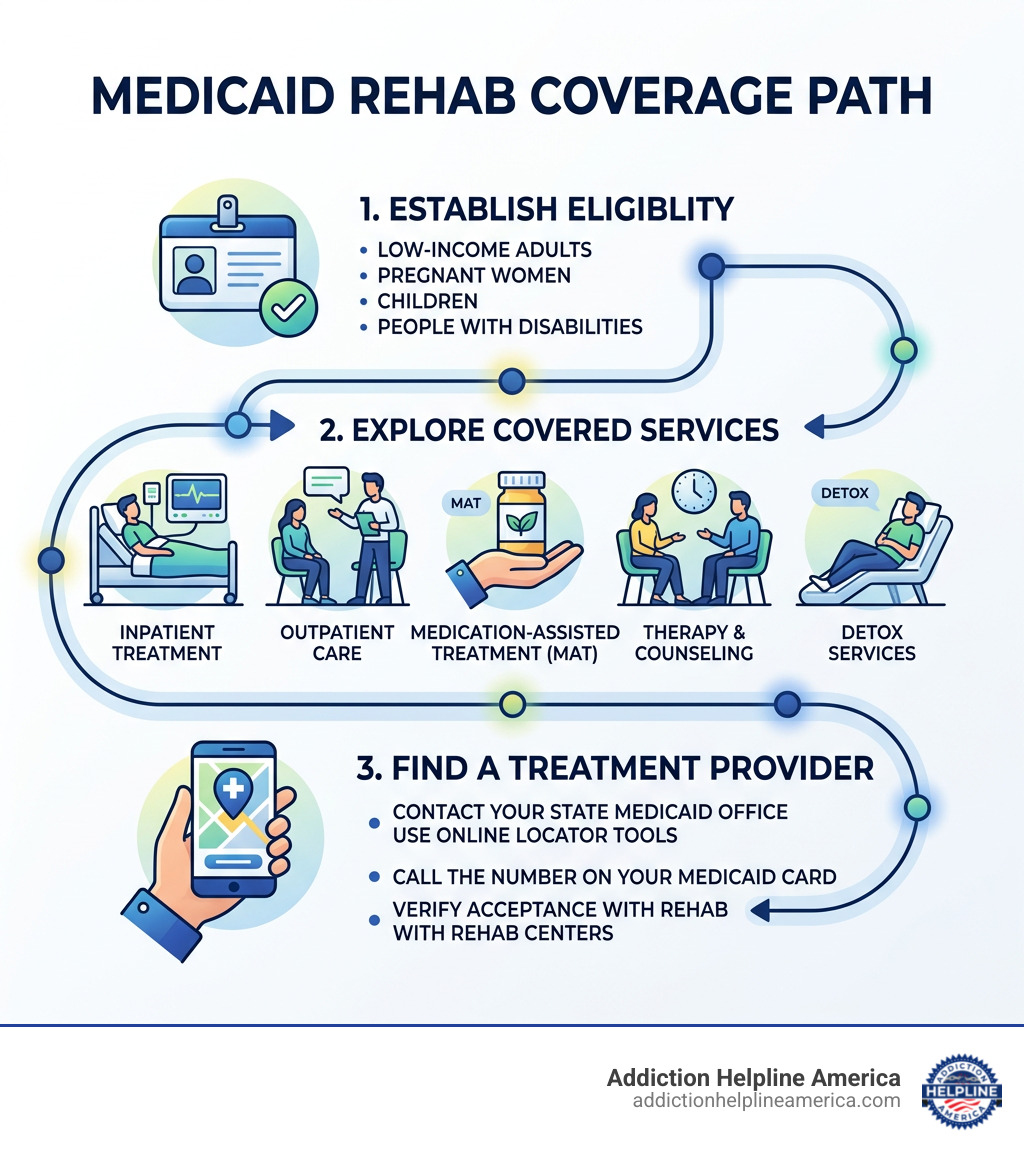
| Who qualifies? | Low-income adults, pregnant women, children, people with disabilities |
| How much does it cost? | Often $0–$10 per visit, depending on your state and plan |
| How do I find a rehab that accepts Medicaid? | Call the number on your Medicaid card or contact a helpline |
Many people don’t realize that Medicaid is one of the largest payers for addiction treatment in the country. According to the Kaiser Family Foundation (KFF), Medicaid covers nearly 40% of non-elderly adults with an opioid use disorder. The Affordable Care Act (ACA) expanded Medicaid to cover substance use disorder treatment as an essential benefit — meaning if you qualify, you have real options.
And yet, millions of Americans in crisis still don’t know where to start.
That’s the gap this guide is designed to close. Whether you’re applying for Medicaid for the first time, trying to understand what your plan covers, or looking for a rehab center that will actually accept your insurance — this guide walks you through every step.
At Addiction Helpline America, we’ve helped thousands of individuals and families navigate the process of finding rehabilitation that accepts Medicaid, connecting them with treatment options that fit their needs and their budget. We’re a free, confidential resource available 24/7 — and we’re here to help you take that first step.
Understanding Rehabilitation That Accepts Medicaid

When we talk about rehabilitation that accepts Medicaid, we are looking at a system designed to provide a safety net for those who need it most. Thanks to the Affordable Care Act (ACA), substance use disorder (SUD) services are now considered “essential health benefits.” This means that Medicaid plans are required to cover mental health and addiction services with the same level of importance as surgical or medical care.
Medicaid is a joint federal and state program. While the federal government sets the baseline rules, each state has the power to manage its own program. This is why you might see different names for Medicaid depending on where you live, such as TennCare in Tennessee or Health First Colorado.
According to scientific research on outpatient rehabilitation providers, these facilities must meet strict health and safety standards to participate in federal programs. For you, this means that a facility accepting Medicaid isn’t just “affordable”—it’s regulated for quality.
Understanding the difference between Inpatient vs Outpatient care is vital when using Medicaid. Inpatient care involves staying at a facility 24/7, while outpatient care allows you to live at home while attending scheduled therapy sessions. Medicaid typically covers both, provided they are deemed “medically necessary” by a healthcare provider.
Core Medicaid Rehab Benefits:
- Screenings and Assessments: Professional evaluations to determine the severity of addiction.
- Detoxification: Medically supervised withdrawal management.
- Therapy: Individual, group, and family counseling sessions.
- Medication-Assisted Treatment (MAT): Use of FDA-approved medications like methadone or buprenorphine.
- Inpatient/Residential Stay: Short-term or long-term stays in a clinical setting.
- Outpatient Services: Flexible programs that fit into your daily life.
Treatment Services and Specialized Care
The journey to recovery often begins with detoxification. This is the process of clearing toxins from the body while managing withdrawal symptoms. Medicaid frequently covers inpatient detox because it requires 24/7 medical supervision to ensure safety.
Following detox, many individuals transition into Intensive Outpatient Treatment. This level of care is a “middle ground,” offering several hours of therapy per week while allowing the individual to maintain employment or family responsibilities. For those who need a stable environment after treatment, Sober Living homes provide a drug-free residence, though it is important to check if your specific state Medicaid plan covers the housing portion or just the associated clinical services.
As Dr. Nora Volkow, Director of the National Institute on Drug Abuse (NIDA), notes, “Medication-assisted treatment (MAT) decreases opioid use, opioid-related overdose deaths, criminal justice involvement, and infectious disease transmission.” This evidence-based approach is a cornerstone of rehabilitation that accepts Medicaid.
Medicaid Coverage Comparison: Inpatient vs. Outpatient
| Service Type | Medicaid Coverage Status | Typical Duration |
|---|---|---|
| Medical Detox | Highly Covered (Inpatient) | 3–7 days |
| Residential Rehab | Covered (State-dependent) | 28–90 days |
| IOP (Intensive Outpatient) | Widely Covered | 9–20 hours/week |
| Standard Outpatient | Widely Covered | 1–5 hours/week |
| MAT (Medication-Assisted) | Covered in all states | Ongoing |
Specialized Rehabilitation That Accepts Medicaid for Vulnerable Groups
Medicaid is particularly robust when it comes to protecting vulnerable populations.
- Pregnant Women: In many states, pregnant women receive priority access to treatment. Medicaid coverage for this group often extends to specialized prenatal care alongside addiction services to ensure the health of both mother and baby.
- Dual Diagnosis: Many people struggling with addiction also face mental health challenges like depression, anxiety, or PTSD. Medicaid-accepting facilities often provide integrated care that treats both conditions simultaneously.
- Adolescents: Specialized youth programs focus on age-appropriate therapy and family stabilization.
Quality Indicators and Facility Accreditations
How do you know a Medicaid rehab is actually good? We always recommend looking for “Gold Standard” accreditations. The Joint Commission and CARF (Commission on Accreditation of Rehabilitation Facilities) are independent organizations that inspect facilities to ensure they use evidence-based practices.
Eligibility and State-Specific Coverage
Eligibility for Medicaid is primarily based on your Modified Adjusted Gross Income (MAGI). However, the rules can shift significantly from one state to another.
In Ohio, Medicaid is a massive pillar of the healthcare system. According to the Ohio Department of Medicaid, the program covers approximately 3 million residents. This is crucial in a state that has faced significant challenges with the opioid crisis. Most enrollees in Ohio are children and adults who qualify through income-based expansions.
In Illinois, the Illinois Department of Healthcare and Family Services manages the expansion program. For a single person to qualify, their annual income must generally be below 138% of the Federal Poverty Level. This threshold makes it a viable option for many working families who lack private insurance.
Navigating State Differences in Rehabilitation That Accepts Medicaid
Each state has its own unique programs:
- Nevada: To qualify, you must be a resident and meet specific income limits. The Nevada Department of Health and Human Services provides detailed eligibility charts for residents.
- Texas: The Comprehensive Rehabilitation Services (CRS) program specifically assists Texans with Traumatic Brain Injuries (TBI) or Spinal Cord Injuries (TSCI). While CRS is a separate program, it requires you to exhaust your Medicaid benefits first.
- North Carolina: There are approximately 381 centers in North Carolina that accept Medicaid for addiction and mental health treatment. This high number of providers gives residents a wide variety of choices between urban and rural settings.
Managed Care Plans and Network Providers
Most people on Medicaid are enrolled in a “Managed Care Plan.” This means a private insurance company handles your benefits on behalf of the state.
For example, in Illinois, the HealthChoice Illinois program is the primary managed care system. In Ohio, you might be covered by Caresource, Buckeye Health, or Molina Healthcare. When you call a rehab center, you should have your specific plan name ready. You can learn more about how these plans work in our Outpatient Rehab Programs Complete Guide.
How to Apply and Verify Your Benefits
Applying for Medicaid doesn’t have to be a nightmare. Most states allow you to apply online through a central portal (like Access Nevada or the Health First Colorado website).
The Application Process Generally Follows These Steps:
- Gather Documents: You will need your Social Security Number, proof of income (pay stubs or tax returns), and proof of residency.
- Submit Application: This can be done online, by mail, or in person at a local county office.
- Wait for Determination: It can take anywhere from a few days to a few weeks. If you are in an emergency situation (like needing immediate detox), some states offer “presumptive eligibility” to get you into care faster.
- Verify with the Rehab: Once you have your Medicaid ID, call the facility. They will perform an “insurance verification” to see exactly what your plan covers.
If you are overwhelmed, the National Helpline for Mental Health and Addiction (SAMHSA) can provide general guidance. However, for personalized help finding a specific facility that fits your life, Addiction Helpline America is here to do the heavy lifting for you. We can help you find a program that includes Post Rehab Drug Rehab Aftercare to ensure your sobriety lasts long after you leave the facility.
Frequently Asked Questions about Medicaid Rehab
What are the typical copays or out-of-pocket costs?
One of the best things about rehabilitation that accepts Medicaid is the low cost. In Illinois, for instance, 2023 copays were as low as $3.90 for a physician visit or a day of inpatient hospital care. In Ohio, copays generally range from $0 to $10. Most states also have a “monthly maximum” cap on copays, meaning once you hit a certain amount, you don’t pay anything else for the rest of the month.
What if I do not qualify for Medicaid?
If your income is slightly too high for Medicaid, don’t give up. You may still qualify for:
- State-Funded Rehab: Programs funded by state grants that provide free or low-cost care.
- Sliding Scale Fees: Many facilities adjust their prices based on what you can actually afford to pay.
- Scholarships: Some private rehabs offer a limited number of “scholarship beds” for those in financial hardship.
Can I access dual diagnosis treatment with Medicaid?
Absolutely. Federal law, specifically the Mental Health Parity and Addiction Equity Act (MHPAEA), requires insurance companies (including Medicaid) to cover mental health services at the same level as physical health services, as outlined by CMS.gov. If you have a “dual diagnosis” (a substance use disorder and a mental health condition like bipolar disorder), your Medicaid plan should cover integrated treatment that addresses both.
Conclusion
The path to recovery is rarely a straight line, but financial barriers should never be the reason you stop moving forward. Rehabilitation that accepts Medicaid offers world-class care, evidence-based therapies, and a chance at a new life—all without the crushing weight of medical debt.
Whether you are in Ohio, Illinois, Nevada, or anywhere else in the country, there is a program waiting for you. From the first phone call to the final day of aftercare, you are not alone in this.
If you’re ready to start but aren’t sure which facility is right for you, check out our Find a good rehab facility guide.
At Addiction Helpline America, we believe that everyone deserves a second chance. Our service is 100% free and confidential. We are here 24/7 to listen to your story and connect you with a recovery program that accepts your insurance and meets your unique needs.
Take the first step toward your “bright horizon” today. Your recovery is possible, and we are here to help you find the way.