
Why So Many People Struggle to Find Mental Health Therapist Support (And What to Do About It)
Need immediate help? Call our 24/7 confidential helpline at 1-800-662-HELP (4357) to speak with a recovery specialist.
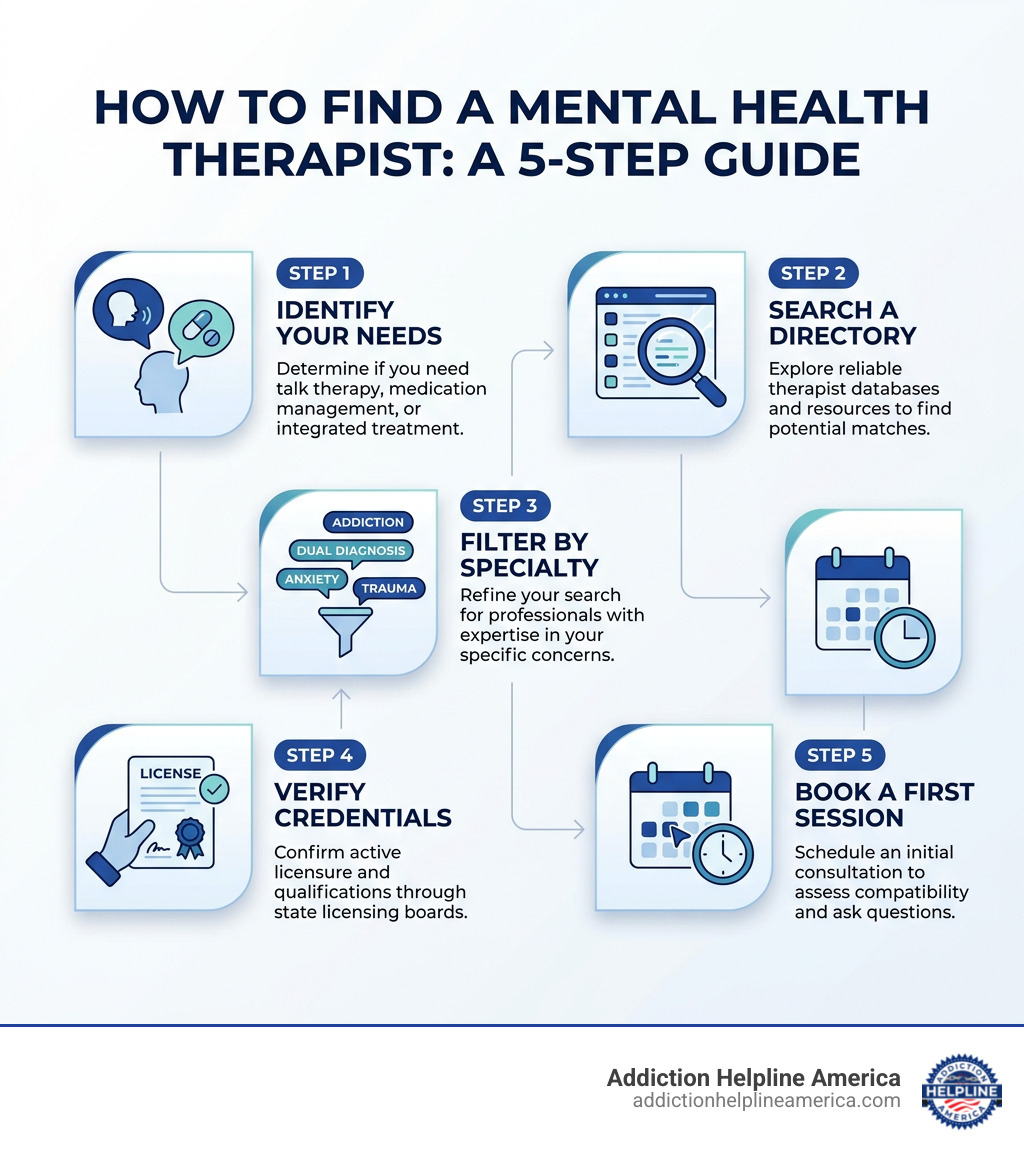
Find mental health therapist options that actually fit your needs — here’s how to get started fast:
- Identify what you need – talk therapy, medication, or both
- Search a directory – Psychology Today, GoodTherapy, or SAMHSA’s FindTreatment.gov
- Filter by specialty – look for addiction, dual diagnosis, anxiety, or trauma
- Verify credentials – check state licensing boards for active licensure
- Book a first session – assess fit, ask key questions, and trust your gut
Finding the right therapist is one of the most important steps you can take for your mental health. But for many people, it’s also one of the most confusing and exhausting.
Here’s the reality: In 2021, about 59.6 million American adults experienced some form of mental illness. Yet fewer than half of them received any treatment at all. That’s tens of millions of people struggling without support — not because they didn’t want help, but because the system is hard to navigate.
For people dealing with both addiction and mental health challenges — what’s called a co-occurring or dual diagnosis condition — the search gets even harder. You need a professional who understands how these issues interact, not just one piece of the puzzle.
The good news? With the right roadmap, finding quality care is absolutely possible.
At Addiction Helpline America, we’ve spent years helping individuals and families navigate the mental health and addiction treatment landscape — including connecting people with the right professionals to find mental health therapist support that addresses their full picture. We offer a free, confidential helpline available 24/7, so you’re never alone in this search.
Easy Find mental health therapist word list:
Understanding the Different Types of Mental Health Professionals
When you start your search to find mental health therapist services, the alphabet soup of initials behind a name can be dizzying. Understanding these roles helps you build the right “treatment team.”
The Primary Players
- Psychiatrists (MD or DO): These are medical doctors who specialize in mental health. Their primary role is medication management. They perform diagnostic evaluations and can prescribe and monitor medications. While some do talk therapy, most focus on the biological side of treatment.
- Psychologists (PhD or PsyD): These professionals have doctoral degrees. They are experts in psychological testing and various forms of talk therapy. They generally do not prescribe medication but are highly trained in diagnosing complex conditions.
- Licensed Clinical Social Workers (LCSW): These providers have a Master’s degree in social work plus supervised clinical experience. They focus on talk therapy and often help clients navigate social systems, like housing or employment, which is vital for those in recovery.
- Licensed Marriage and Family Therapists (LMFT): Specialized in relationship dynamics, these therapists look at how family systems affect individual mental health.
- Licensed Professional Counselors (LPC/LMHC): These are Master’s-level clinicians trained to provide individual and group therapy for a wide range of issues, from anxiety to substance use.
| Professional Type | Degree | Prescribes Meds? | Focus |
|---|---|---|---|
| Psychiatrist | Doctoral (MD/DO) | Yes | Biological/Medication |
| Psychologist | Doctoral (PhD/PsyD) | No* | Testing/Talk Therapy |
| LCSW/LPC/LMHC | Master’s | No | Talk Therapy/Behavioral |
*In a few states, psychologists with extra training have limited prescribing rights, but this is rare.
If you are dealing with addiction, we recommend looking for professionals who also hold certifications like Certified Alcohol and Drug Counselor (CADC). This ensures they understand the specific neurobiology of substance use.
Determining Your Specific Treatment Needs
Before you hit the search bars, we suggest a moment of self-reflection. Are you looking for a space to process emotions (Talk Therapy), or are your symptoms so severe that you need biological intervention (Medication)?
Often, the gold standard is a combination of both. As Dr. Herbert Pardes, former director of the National Institute of Mental Health, has noted, the integration of medical and behavioral therapies provides the most robust path to recovery. This is echoed by the National Institute on Drug Abuse (NIDA), which states that integrated treatment is essential for those with co-occurring disorders. Many people benefit from seeing a psychiatrist for medication and a therapist for behavioral changes. We also recommend getting a physical exam from your primary care doctor first; sometimes, physical issues like thyroid imbalances can mimic mental health symptoms. If you suspect your struggles are linked to specific conditions, check out our Bipolar Depression Treatment Guide 2025 for more targeted advice.
When to See a Psychiatrist vs. a Psychologist
Think of a psychiatrist as the person who stabilizes the “house” (your brain chemistry) and the psychologist as the person who helps you renovate the “interior” (your thoughts and behaviors).
If you’re experiencing hallucinations, severe mood swings, or suicidal thoughts, a psychiatrist is often the first stop for a diagnostic evaluation. For those dealing with trauma or long-term behavioral patterns, a psychologist or licensed counselor provides the consistent, weekly support needed for change. This distinction is especially critical for dual diagnosis cases where medication might be needed to manage withdrawal or underlying depression. You can learn more about specialized facilities in our Depression Treatment Centers Complete Guide.
How to Find Mental Health Therapist Near You

The search to find mental health therapist support usually starts locally. While teletherapy has made location less of a barrier, many still prefer the “vibe” of an in-person office. Whether you are in a major city like Los Angeles or a smaller community, finding local care is essential for long-term success.
Using Online Directories to Find Mental Health Therapist
The most efficient way to narrow your search is through established directories. Platforms like Psychology Today’s Therapy Directory allow you to filter by:
- Zip Code: Find someone within a 10-mile radius.
- Insurance: Only see providers who take your specific plan.
- Specialties: Filter for “Addiction,” “Trauma,” or “LGBTQ+.”
- Modality: Choose between in-person or online sessions.
Other helpful tools include the APA Psychologist Locator and GoodTherapy. If you are looking for specific regional support, such as in Louisiana, our guide on New Orleans Mental Health offers localized insights. Our helpline can also assist in finding vetted providers in the top 50 US cities.
Checking Credentials and Specializations
Don’t just take a bio at face value. We recommend verifying a therapist’s license through your state’s licensing board website (e.g., the California Board of Behavioral Sciences). This ensures their license is active and they haven’t had disciplinary actions.
Look for “Clinical Fellow” status in professional organizations, which often indicates a higher level of peer-vetted experience. For those in recovery, search for initials like LCADC (Licensed Clinical Alcohol and Drug Counselor). This specialization is a game-changer when treating co-occurring disorders.
Evaluating Therapeutic Approaches and Personal Fit
Not all therapy is “lying on a couch talking about your childhood.” Modern therapy is diverse and evidence-based.
- Cognitive Behavioral Therapy (CBT): Focuses on changing negative thought patterns. It’s highly effective for anxiety and depression.
- Dialectical Behavior Therapy (DBT): Excellent for emotional regulation and often used for borderline personality disorder and substance use.
- EMDR (Eye Movement Desensitization and Reprocessing): A specialized technique for processing trauma and PTSD.
- Somatic Experiencing: Focuses on how the body holds tension and trauma.
While the method matters, research shows that the therapeutic relationship (the “bond” between you and the therapist) is actually the biggest predictor of success. Dr. Edward Bordin, a pioneer in psychotherapy research, emphasized that this “therapeutic alliance” is the most consistent predictor of positive clinical outcomes, regardless of the specific modality used.
Success Story: “I struggled for years to find a mental health therapist who understood my dual diagnosis. When I finally connected with a specialist through Addiction Helpline America, I felt heard for the first time. That connection saved my life.” — Jamie R., Recovery Graduate.
Questions to Ask to Find Mental Health Therapist Who Fits
Most therapists offer a free 15-minute phone consultation. We recommend treating this like an interview. Ask:
- “Have you worked with people who have [your specific issue/addiction] before?”
- “What is your basic philosophy on recovery?”
- “How do you measure progress in your clients?”
- “What are your fees, and do you offer a sliding scale?”
For more help on what to look for regarding specific symptoms, see our Help Depression Anxiety Guide 2025.
Knowing When to Switch Therapists
Therapy is work, but it shouldn’t feel like a bad date that never ends.
Red Flags include:
- The therapist talks more about themselves than you.
- They seem distracted or check their phone.
- They judge you for your past or your struggles with substance use.
- You feel like you have to “perform” or hide things from them.
If the “vibe” isn’t there after three sessions, it’s okay to move on. Your mental health is too important to waste on a poor fit.
Navigating Insurance, Costs, and Affordable Options
The biggest barrier to find mental health therapist support is often the price tag. According to data from the National Association of State Medicaid Directors, navigating state-funded options and understanding coverage is a critical step for those facing financial hurdles.
- In-Network: Your insurance company has a list of “preferred” providers where you only pay a co-pay (e.g., $25 per session).
- Out-of-Network: You pay the full fee upfront, but your insurance might reimburse you for 50-80% of the cost later.
- Sliding Scale: Many therapists reserve spots for lower-income clients, charging based on what you can actually afford.
- Medicaid/Medicare: Many community clinics and certain private practices accept government insurance.
For a deeper dive into how insurance covers intensive care, read our Mental Health Rehab Complete Guide.
Finding Low-Cost and Community Resources
If you are uninsured, don’t lose hope.
- University Teaching Hospitals: Students finishing their degrees provide therapy at deeply discounted rates under the supervision of expert professors.
- NAMI (National Alliance on Mental Illness): They offer free support groups that are invaluable for peer connection.
- Local Mental Health Authorities: Every county has a mental health department designed to help those with limited resources.
Using State Medicaid and Medicare Directories
Navigating government sites can be a chore. Use the National Association of State Medicaid Directors map to find your state’s specific portal. These directories allow you to search specifically for providers who accept Medicaid or CHIP, ensuring your care is covered.
Emergency Resources and Immediate Support
If you are in a crisis right now, searching through directories isn’t the answer. You need immediate help.
- 988 Suicide & Crisis Lifeline: Call or text 988 anytime in the US. It’s free, confidential, and available 24/7.
- SAMHSA’s National Helpline: Call 1-800-662-HELP (4357) for referrals to local treatment facilities.
- Veterans Crisis Line: Dial 988 and press 1.
If you need a higher level of care immediately, such as stabilization in a hospital setting, our Psychiatric Hospital Near Me guide can help you find the nearest facility.
What to Do in a Mental Health Crisis
In an emergency—especially if substance use is involved—safety is the priority.
- Call 988 or a mobile crisis unit if available in your city.
- Go to the nearest Emergency Room. They can provide immediate stabilization and “bridge” prescriptions if you’ve run out of medication.
- Be honest about substance use. Doctors need to know what’s in your system to treat you safely and avoid dangerous drug interactions.
Frequently Asked Questions about Finding Therapy
What is the difference between a therapist and a psychiatrist?
A therapist (LCSW, LPC, Psychologist) focuses on talk therapy and behavioral changes. A psychiatrist is a medical doctor who primarily manages mental health through medication.
How much does therapy typically cost without insurance?
On average, private pay rates range from $100 to $250 per session. However, many community clinics offer services for as low as $10-$20 on a sliding scale.
How long does it usually take to find the right therapist?
It can take 2-4 weeks to research and have your first session. We recommend contacting at least three therapists at once to see who responds fastest and offers the best fit.
How do I find a therapist specializing in addiction or dual diagnosis?
Use filters on directories like Psychology Today for “Addiction” or “Co-occurring Disorders.” You can also call Addiction Helpline America for personalized help finding these specialists.
Conclusion
The journey to find mental health therapist support is rarely a straight line. It requires persistence, a bit of “shopping around,” and the courage to ask for help. You aren’t just looking for a doctor; you’re building a team that will help you reclaim your life.
Whether you’re dealing with anxiety, depression, or the complex challenges of addiction, you don’t have to do this alone. Addiction Helpline America is here to provide free, confidential guidance to connect you with the right recovery programs and mental health professionals. Call our 24/7 helpline at 1-800-662-HELP (4357) to start your journey today.
Don’t settle for “good enough” care. You deserve a therapist who truly understands your journey. If you’re ready to take that next step, visit our Professional Help page or call us today. We’re here for you, 24/7.