
Why Affordable Mental Health Care Matters Now More Than Ever
Sliding scale therapy is a flexible payment model where mental health providers adjust their fees based on your income and ability to pay, making therapy accessible even if you’re struggling financially. Here’s what you need to know:
Quick Answer: Finding Sliding Scale Therapy
- What it is: Pay what you can afford based on your income
- Who qualifies: Anyone with limited income, students, unemployed individuals, or those facing financial hardship
- Typical range: $40-$150 per session (vs. standard $100-$300)
- Where to find it: Community mental health centers, university clinics, private therapists, non-profit organizations
- Documentation: May need pay stubs or tax returns (some providers use honor system)
Mental health care shouldn’t be a luxury reserved for those who can afford it. Yet nearly one in five adults in the United States lives with a mental illness, according to the National Institute of Mental Health (NIMH), while millions go untreated simply because they can’t afford the cost. Standard therapy sessions can run anywhere from $100 to over $250 per hour, as noted by sources like Forbes Health—a price that puts consistent mental health support out of reach for many people dealing with depression, anxiety, trauma, or addiction recovery.
The good news? Sliding scale therapy opens doors that financial barriers typically keep closed. As Dr. Lynn Bufka, a senior director at the American Psychological Association, has emphasized, affordability is a key component of access. Instead of turning people away, many therapists, counseling centers, and mental health facilities adjust their fees based on what clients can actually pay. This isn’t charity—it’s a recognition that mental health is a right, not a privilege.
At Addiction Helpline America, we’ve connected thousands of individuals and families with affordable mental health resources, including sliding scale therapy options that fit their unique financial situations. Our free, confidential helpline is available 24/7 to help you find treatment that works for both your recovery needs and your budget.
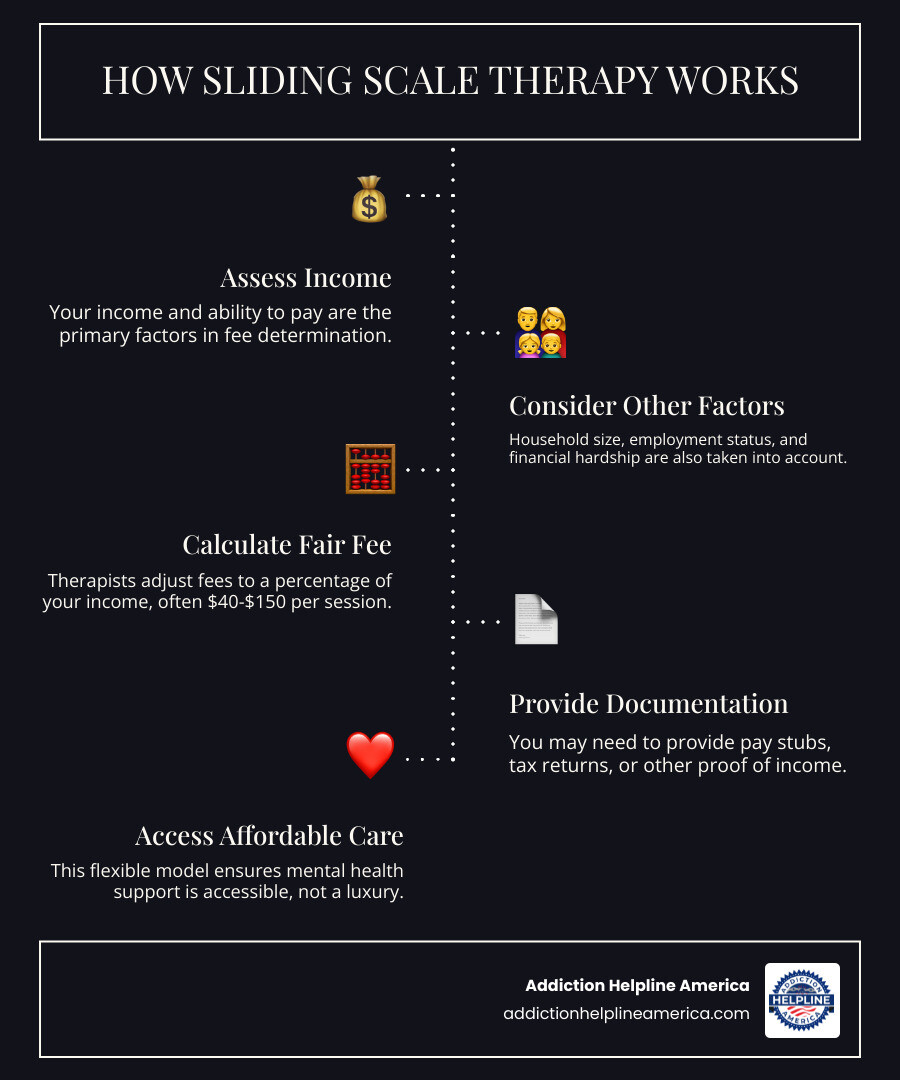
Quick look at Sliding scale therapy:
Understanding Sliding Scale Therapy: Your Path to Affordable Care
Navigating the costs of mental health care can feel overwhelming, but sliding scale therapy provides a guide of hope for many. This flexible payment model ensures that financial limitations don’t prevent you from accessing the support you need.

What is Sliding Scale Therapy?
At its core, sliding scale therapy is a pricing model where mental health professionals adjust their session fees based on a client’s income and ability to pay. Instead of a fixed rate for everyone, the cost “slides” up or down, making therapy more accessible to a broader range of people. It’s not a discount in the traditional sense, but rather a fair pricing structure designed to align the cost of care with your financial realities.
Many providers who offer sliding scale therapy do so because they believe everyone deserves access to mental health support, regardless of their economic status. This aligns with the American Psychological Association’s (APA) ethical principles, which encourage psychologists to contribute a portion of their time for little or no compensation (pro bono work). This approach allows therapists to serve the community while also sustaining their practice. We understand that finding quality care can be difficult, and our goal at Addiction Helpline America is to connect you with resources that prioritize your well-being.
Who is Eligible and What Documentation is Needed?
Eligibility for sliding scale therapy is primarily determined by your financial situation. Providers typically consider several factors, including:
- Income level: This is usually the primary determinant. The lower your income, the lower your fee may be.
- Household size: Therapists often take into account the number of dependents you support.
- Employment status: Being unemployed, underemployed, or a student can increase your eligibility.
- Financial hardship: Unexpected debt, high medical bills, or recent job loss can also be considered as factors influencing your ability to pay.
Specific populations often benefit greatly from sliding scale therapy, such as:
- Students without school-based mental health services
- Unemployed individuals
- Seniors on a fixed income
- Recent immigrants or refugees
- Individuals in transitional living situations
- Veterans in need of specialized care
- People living in rural areas with limited services
- Anyone dealing with high medical bills or other significant debts
To determine eligibility, therapists may request documentation. This can include:
- Pay stubs
- Tax returns
- Bank statements
- Proof of unemployment or student status
However, some providers operate on an “honor system,” trusting clients to accurately report their income and financial situation without requiring formal proof. It’s always best to ask your potential therapist about their specific requirements. For more information about finding behavioral health services that fit your needs, explore our guide on finding behavioral health services near you.
How are Sliding Scale Therapy Fees Calculated?
The calculation of sliding scale therapy fees can vary significantly from one provider to another, as therapists often have discretion in setting their own criteria. However, common methods include:
- Percentage of income: Some therapists use a formula, such as charging a small percentage (e.g., 0.002) of your annual income per session. So, if your annual income is $30,000, a session might cost $60.
- Federal Poverty Level (FPL) guidelines: Many providers base their rates on the Federal Poverty Level (FPL) guidelines, which are updated yearly. These guidelines use income and family size to determine eligibility for various programs, making them a useful benchmark for therapy fees. For example, a client with an income at 100% of the FPL might pay a minimum fee, while those with higher incomes pay incrementally more.
- Income ranges: A therapist might establish a tiered system where clients falling within specific income brackets pay a predetermined reduced rate. For instance, clients earning between $20,000 to $44,999 per year might be charged a reduced rate per therapy session.
- Minimum and maximum fees: Most therapists offering sliding scale therapy will have a minimum fee they can accept to cover their practice costs and a maximum fee (their standard rate). Your adjusted fee will fall somewhere within this range.
The process for determining your specific fee is usually discussed during an initial consultation or intake session. It’s a collaborative conversation aimed at finding a rate that is both affordable for you and sustainable for the therapist. This approach is central to many forms of psychotherapy, where a strong therapeutic alliance is key.
Benefits and Challenges of Sliding Scale Therapy
Sliding scale therapy offers significant advantages, but it’s important to be aware of potential challenges. Understanding both sides can help you steer your search for affordable mental health care effectively.

Key Benefits for Your Mental and Financial Well-being
The primary benefit of sliding scale therapy is its ability to democratize mental health care, making it accessible to individuals who might otherwise be excluded due to cost. Here’s how it can positively impact your mental and financial well-being:
- Improved access to care: For many, the high cost of therapy is the biggest barrier to seeking help. Sliding scale therapy directly addresses this, ensuring that financial status doesn’t dictate access to crucial support.
- Reduced stress about costs: Worrying about how to pay for therapy can add another layer of stress to an already challenging situation. With a flexible fee, you can focus on your healing journey without the constant burden of financial strain. As research shows, poverty is a significant source of stress and can exacerbate mental health conditions.
- Ability to choose a therapist: Instead of being limited to only those within your insurance network (which can be notoriously difficult to find for mental health), sliding scale therapy expands your options. This allows you to find a therapist for depression and anxiety whose specialization and approach truly resonate with your needs, leading to a more effective therapeutic relationship.
- Continuity of care during financial changes: Life happens. A job loss, unexpected expenses, or a change in income can disrupt therapy. Sliding scale therapy can offer the flexibility to adjust your fee if your financial situation changes, allowing you to maintain consistent care without interruption.
- Potential for faster progress: When therapy is affordable, you might be able to attend sessions more frequently or for a longer duration, which can lead to more consistent progress and faster outcomes in your mental health journey.
Potential Drawbacks and How to Steer Them
While incredibly beneficial, sliding scale therapy isn’t without its potential challenges. Being aware of these can help you approach the process with realistic expectations:
- Limited availability: Therapists often reserve a limited number of slots for sliding scale therapy clients to ensure their practice remains financially viable. This can lead to longer waiting lists or fewer openings with highly sought-after therapists.
- Fewer therapist choices: While sliding scale therapy expands options beyond insurance networks, not every therapist offers it. This might mean you have to broaden your search or consider therapists you initially hadn’t.
- Potential for administrative hassle: Some therapists might require regular income verification, which can feel like an administrative burden. Additionally, the negotiation process itself can be uncomfortable for some.
- The “trouble” for therapists: From a therapist’s perspective, managing a sliding scale therapy can sometimes lead to feelings of imposter syndrome (undervaluing their worth) or increased administrative work. As some practice consultants note, it can be a hassle and might impact their business model.
How to steer them:
- Ask respectfully and honestly: When inquiring about sliding scale therapy, be transparent about your financial situation without being demanding. “Frame it as a partnership: ‘I’m committed to this work and want to find a rate that is sustainable for both of us,'” advises one therapist business coach. This collaborative approach is often well-received.
- Be prepared for a “no”: Not every therapist offers a sliding scale, or their slots may be full. If you receive a “no,” don’t be discouraged. Ask if they have a payment plan or can refer you to a colleague or clinic that offers lower rates.
- Be persistent: Finding the right fit might take a few inquiries. Don’t give up if the first few attempts aren’t successful.
- Consider alternatives: If sliding scale therapy isn’t immediately available, explore other affordable options like community clinics, university training programs, or group therapy for addiction, which we’ll discuss later.
How to Find Therapists Offering Sliding Scale Fees
Finding a therapist who offers sliding scale therapy might require a bit of searching, but the resources are out there. We’re here to guide you through the process.
Online Directories and Local Resources
A great starting point is to leverage online directories and explore local community resources:
- Online Therapist Directories: Many popular therapist directories allow you to filter your search by payment options, including “sliding scale.” Platforms like Psychology Today and the Open Path Psychotherapy Collective are invaluable for finding providers who explicitly state they offer this option.
- Community Mental Health Centers (CMHCs): These centers are often government-funded or non-profit organizations designed to provide affordable mental health care, often on a sliding scale. You can find local centers through SAMHSA’s National Helpline or your state’s government website.
- University Counseling Programs: Many universities with psychology or counseling programs offer low-cost or sliding scale therapy services. These clinics are typically staffed by graduate students who are closely supervised by licensed professionals, ensuring high-quality care at a reduced rate.
- Non-profit Organizations: Various non-profit organizations are dedicated to mental health advocacy and support. They may have their own counseling services or maintain lists of providers who offer affordable options.
- Addiction Helpline America: We connect individuals nationwide to addiction and mental health treatment centers, and we can help you steer options for affordable care that fit your needs.
- Specific Resources: If you’re looking for support for specific conditions, resources like Find a therapist for depression and anxiety can be a good starting point.
How to Approach the Conversation with a Therapist
Once you’ve identified potential therapists, the next step is to initiate the conversation about sliding scale therapy. This is often best done during an initial consultation or inquiry.
Here’s how to approach it effectively:
- Request an initial consultation: Many therapists offer a brief, free phone consultation. This is an ideal time to discuss fees and financial concerns.
- Be honest and respectful: Clearly and calmly explain your financial situation. “It’s okay to be vulnerable about your financial needs,” says Dr. Joy Harden Bradford, a licensed psychologist and founder of Therapy for Black Girls. “Therapists who offer sliding scales want to make care accessible.”
- Explain your situation: Briefly describe why you’re seeking therapy and why you believe this particular therapist is a good fit. Showing you’ve researched their practice can demonstrate your commitment.
- Inquire about their policy: Ask how their sliding scale therapy works, what factors they consider, and what documentation (if any) they require.
- Ask about session limits: Some therapists might offer a sliding scale therapy for a limited number of sessions or for a specific period. Clarify any such limitations upfront.
- Be prepared to provide details: If they offer a sliding scale therapy, they will likely ask about your income, household size, and any significant financial hardships.
LIST of questions to ask a potential therapist:
- Do you offer sliding scale therapy?
- How do you determine your sliding scale therapy fees? (e.g., based on income, family size, FPL guidelines)
- What documentation do you require to verify income?
- Are there a limited number of sliding scale therapy slots, and are any currently available?
- What is the lowest fee you can offer, and what is your standard fee?
- Is the sliding scale therapy fee negotiable if my financial situation changes?
- Do you offer payment plans or referrals to other affordable resources if a sliding scale therapy isn’t possible?
- What is your cancellation policy for sliding scale therapy clients?
Therapists want to help. Approaching the conversation with respect and transparency increases the likelihood of a positive outcome. This is a key part of finding the right mental health facility for you.
Comparing Sliding Scale with Other Affordable Therapy Options
While sliding scale therapy is an excellent option for many, it’s just one piece of the puzzle when it comes to affordable mental health care. Understanding how it compares to other solutions can help you make the best choice for your circumstances.
Sliding Scale vs. Using Health Insurance
For many, health insurance is the first place they look for therapy coverage. However, it’s not always a straightforward solution:
- In-network vs. Out-of-network: If a therapist is “in-network,” your insurance company has a contract with them, and you’ll typically pay a co-pay or a percentage of the session cost after meeting your deductible. If they’re “out-of-network,” your insurance might cover a smaller portion, or nothing at all.
- High deductibles: Even with insurance, a high deductible (e.g., $3,000) can mean you’re paying full price for many sessions until you meet it. In such cases, a sliding scale therapy fee of $60-$150 per session might be significantly cheaper than paying the full $200-$300 out-of-pocket towards your deductible.
- Difficulty finding in-network providers: A significant challenge is the difficulty finding in-network providers. Insurance panels can be limited, leading to long waits or a lack of specialists.
- Superbills for reimbursement: If you see an out-of-network therapist, they might provide you with a “superbill” that you can submit to your insurance for potential partial reimbursement. This means you pay upfront, and the insurance company pays you back.
- When sliding scale is cheaper than a co-pay: For some, a sliding scale therapy fee might even be less than their insurance co-pay, especially if their co-pay is high or if their insurance doesn’t cover many sessions.
Sliding scale therapy can be particularly beneficial for those without insurance, those with high deductibles, or those who struggle to find an in-network therapist that meets their specific needs.
Alternatives like In-House Affordable Programs and Group Therapy
Beyond sliding scale therapy and traditional insurance, several other avenues can make mental health care more affordable:
- In-House Payment Plans: Some private practices, even if they don’t offer a formal sliding scale therapy, might be willing to work with you on a flexible payment plan. It never hurts to ask.
- Group Therapy: As renowned psychiatrist Dr. Irvin Yalom wrote, group therapy’s power comes from the shared experience and realization that “you are not alone.” It is often just as effective as one-on-one therapy and typically costs significantly less.
- Community Clinics: As mentioned, local community mental health centers often provide free or low-cost care, including therapy and support groups, frequently operating on a sliding scale therapy model. These are excellent resources for comprehensive support.
- Online Therapy: Virtual therapy is an increasingly popular and often more affordable option. An virtual therapy session in the U.S. costs between $65 to $129, on average, compared to in-person sessions usually landing between $100 to $200. It offers convenience and can eliminate travel costs.
- Employee Assistance Programs (EAPs): If you’re employed, your workplace may offer an EAP. According to the Society for Human Resource Management (SHRM), the vast majority of U.S. employers offer these programs, which provide confidential support, often including a few free counseling sessions.
- Therapists-in-Training: At university clinics or training institutions, you can see therapists-in-training (interns or practicum students) who are closely supervised by licensed professionals. Sessions with these providers often start at significantly lower rates (e.g., $60 compared to $100+ for a licensed therapist).
- Support Groups: Organizations like the Anxiety and Depression Association of America, Gamblers Anonymous, and the National Eating Disorders Association offer free support groups. While not a substitute for individual therapy, they provide invaluable emotional support and shared coping strategies.
- Self-Help Books: While not therapy, quality self-help books written by licensed psychologists can offer insights, coping mechanisms, and a better understanding of your situation, often at a minimal cost.
For a comprehensive look at various options, you can explore mental health treatment centers that might offer these programs.
Frequently Asked Questions about Sliding Scale Therapy
We often hear common questions about sliding scale therapy. Here are some clear answers to help you understand this valuable resource better.
Does the quality of therapy differ for sliding scale clients?
Absolutely not. Ethical guidelines and professional standards dictate that therapists must provide the same high quality of care to all clients, regardless of the fee paid. The American Counseling Association’s Code of Ethics states that counselors must not discriminate based on socioeconomic status. The reduced fee in sliding scale therapy is a financial accommodation to ensure access, not a reflection of a lesser service. Your therapist is committed to your well-being and will offer the same dedication and expertise to you as they would to a full-paying client.
Can I use my insurance with a sliding scale fee?
Generally, no. This is a common misconception. When therapists contract with insurance companies, they agree to specific rates. Offering a different, lower cash rate (like a sliding scale fee) to an insured client for the same service can be a violation of their insurance contract, as explained by practice management experts. Therefore, sliding scale therapy is typically for clients who are paying entirely out-of-pocket, meaning they do not plan to submit claims to their insurance. However, it’s always worth clarifying with your specific provider, as there might be rare exceptions or specific scenarios they can advise on.
What if a therapist doesn’t offer a sliding scale?
If a therapist you’re interested in doesn’t offer sliding scale therapy, don’t immediately give up hope! Here are a few things you can do:
- Ask about payment plans: Some therapists are open to breaking down their standard fee into smaller, more manageable installments.
- Inquire about referrals: The therapist might have colleagues or know of local clinics or university programs that offer lower rates or sliding scale therapy. They might also suggest other affordable options like group therapy.
- Ask about pro bono slots: While rare, some therapists reserve a very limited number of pro bono (free) slots for individuals in extreme financial hardship. It’s a long shot, but worth asking politely.
- Consider alternative options: As discussed, explore community mental health centers, university training clinics, online therapy platforms, and Employee Assistance Programs (EAPs).
Conclusion
The journey to mental wellness should never be blocked by financial barriers. Sliding scale therapy stands as a powerful testament to the belief that everyone deserves access to quality mental health care. By offering a flexible payment model based on your ability to pay, it removes a significant hurdle for countless individuals and families across the nation.
We hope this guide has empowered you with the knowledge and resources to find the affordable support you need. Whether through sliding scale therapy, community clinics, online platforms, or other alternatives, taking that first step towards prioritizing your mental health is a profound act of self-care.
At Addiction Helpline America, we are dedicated to connecting you with the right recovery program and mental health treatment options that fit your needs and your budget. Our free, confidential service is available 24/7 to provide personalized guidance. Don’t let cost stand in the way of your well-being.
Ready to take control of your mental health? Find a mental health facility today.