
Why Mental Wellness Resources Matter More Than Ever
Mental wellness resources are the lifelines that connect people to support, treatment, and healing when emotional challenges feel overwhelming. Whether you’re facing a crisis, seeking professional help, or looking for ways to strengthen your daily well-being, knowing where to turn can make all the difference.
Quick Access to Essential Mental Wellness Resources:
- Crisis Support (24/7): Call or text 988 for immediate help
- Professional Services: SAMHSA National Helpline at 1-800-662-4357
- Treatment Locator: Visit findtreatment.gov
- Peer Support: NAMI HelpLine at 1-800-950-6264
- Basic Needs: Dial 211 for food, housing, and local services
- Veterans: Press 1 after calling 988
- LGBTQ+ Youth: The Trevor Project at 1-866-488-7386
Mental health is not just the absence of illness—it’s your emotional, psychological, and social well-being combined. According to the Centers for Disease Control and Prevention (CDC), it affects how you think, feel, and act every day. Taking care of your mental wellness is as important as taking care of your physical health, a connection emphasized by the U.S. Department of Health and Human Services.
The good news? Help is available, often at no cost, and always confidentially. From immediate crisis support to long-term therapy, from self-care tools to specialized programs for specific populations, a vast network of resources exists to support your journey toward emotional well-being.
This toolkit brings together the most essential mental wellness resources in one place. You’ll find crisis hotlines that answer 24/7, guidance on finding professional care, specialized support for specific needs, and practical strategies for building daily resilience. Many of these services are completely free, including helplines, community programs, and government-funded treatment options.
At Addiction Helpline America, we’ve spent years connecting individuals and families with the mental wellness resources they need to heal and recover. Our team understands that finding the right support can feel overwhelming, which is why we provide free, confidential guidance to help you steer mental wellness resources custom to your unique situation.
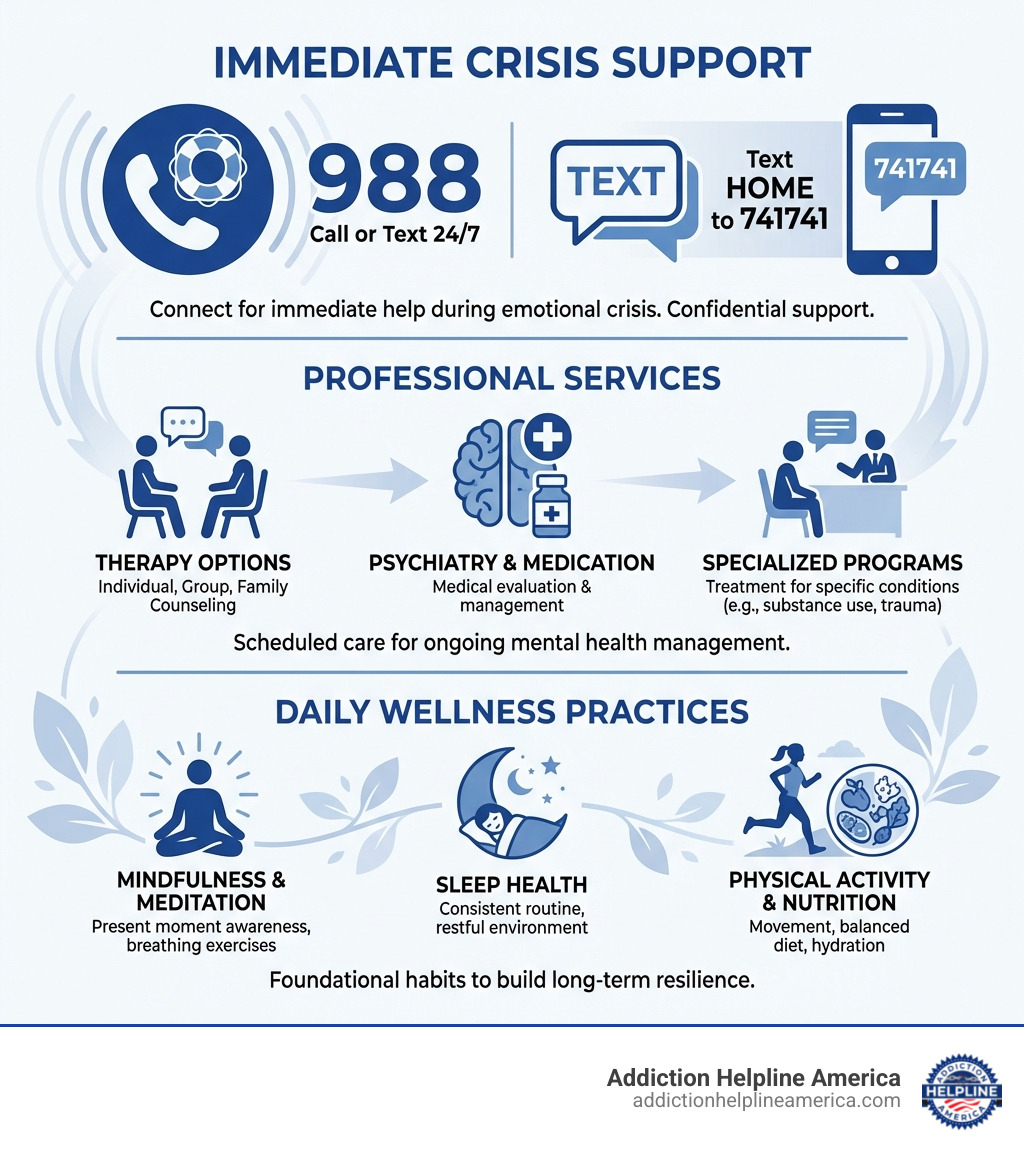
Quick look at mental wellness resources:
Immediate Crisis Support: Where to Turn When You Need Help Now
When moments feel overwhelming, knowing where to find immediate help is crucial. Crisis resources are designed to provide confidential, 24/7 support to anyone experiencing emotional distress or a mental health crisis. These services are often free and can be accessed via phone, text, or chat.
Hotlines and Text Lines for Urgent Support
In times of urgent need, these confidential, 24/7 resources connect you with trained counselors for support and guidance.
- 988 Suicide & Crisis Lifeline: Call or text 988 for free, confidential support if you are in suicidal crisis or emotional distress. You can also chat at 988lifeline.org.
- Crisis Text Line: Text HOME to 741741 for free, 24/7 support via text for issues like anxiety, depression, and suicidal thoughts. Visit crisistextline.org.
- Veterans Crisis Line: Veterans, service members, and their loved ones can call 988 and press 1, chat online at Crisis Chat, or text 838255 for 24/7 confidential support, often from fellow veterans. Vets4Warriors is another 24/7 peer support network for the military community.
- National Domestic Violence Hotline: For 24/7 confidential help, call 800-799-SAFE (7233), text “START” to 88788, or use their online chat at thehotline.org.
- National Sexual Assault Hotline: Survivors and their loved ones can get free, confidential support 24/7 by calling 800-656-HOPE (4673) or using the online chat.
- The Trevor Project: This resource provides 24/7 crisis support services specifically for LGBTQ young people. Reach them via text, chat, or phone at 1-866-488-7386. Learn more at thetrevorproject.org.
- SAMHSA’s Disaster Distress Helpline: For 24/7 crisis counseling related to natural or human-caused disasters, call or text 1-800-985-5990. More information is available on SAMHSA’s website.
- National Human Trafficking Hotline: Call 1-888-373-7888 for 24/7 confidential support in over 200 languages. Visit humantraffickinghotline.org.
- National Child Abuse Hotline: If you suspect child abuse or are a child needing help, call or text 1-800-4AChild (1-800-422-4453) 24/7. Visit childhelp.org.
- National Center for Missing & Exploited Children: Call 1-800-THE-LOST (1-800-843-5678) for assistance. Visit missingkids.org.
Key Crisis Numbers at a Glance:
- 988 Suicide & Crisis Lifeline: Call or Text 988
- Crisis Text Line: Text HOME to 741741
- Veterans Crisis Line: Call 988 and press 1, or text 838255
- National Domestic Violence Hotline: 800-799-SAFE (7233)
- National Sexual Assault Hotline: 800-656-HOPE (4673)
- The Trevor Project: 1-866-488-7386
- SAMHSA’s Disaster Distress Helpline: 1-800-985-5990
Recognizing a Mental Health Crisis
Knowing the signs of a mental health crisis can help you act quickly for yourself or a loved one. While a crisis varies by person, some common indicators suggest immediate help is needed.
Signs that professional help may be needed, according to the National Institute of Mental Health (NIMH):
- Severe symptoms lasting two weeks or more: Difficulty sleeping, appetite changes, inability to get out of bed, trouble concentrating, or loss of interest in once-enjoyed activities.
- Inability to perform daily tasks: Struggling with personal hygiene, work, or school.
- Intense feelings: Persistent irritability, hopelessness, or extreme sadness.
- Suicidal thoughts or behaviors: Talking about wanting to die, seeking methods to do so, or expressing extreme pain.
When to Call 911:
In a medical emergency or if there is imminent danger (e.g., a suicide attempt, severe self-harm, or violence), always dial 911. Specify that you need help for a mental health crisis.
How to Help Someone in Immediate Danger:
If you suspect someone is in crisis, express concern without judgment and listen actively. “Asking for help is a sign of strength, not weakness,” says Dr. Christine Moutier, Chief Medical Officer at the American Foundation for Suicide Prevention. “Crisis resources like 988 are there to provide immediate, compassionate support to anyone who is struggling.” Offer to help them connect with a crisis line. Training like Question, Persuade, Refer (QPR) can teach you how to identify warning signs and refer someone for help. For more information, visit the National Institute of Mental Health’s page on suicide prevention.
Finding Professional Mental Health Services
Once immediate safety is established, or if you’re looking for ongoing support, connecting with professional mental health services is the next step. A variety of providers and treatment formats exist to meet diverse needs.

At Addiction Helpline America, we connect individuals nationwide to mental health treatment centers, offering free, confidential, personalized guidance to find the right recovery program from our vast network.
Understanding Different Types of Support and Providers
Mental health support comes in many forms, custom to different preferences and needs.
- Individual Therapy: One-on-one sessions with a therapist to work on personal issues and goals.
- Group Counseling: Therapist-led sessions with others facing similar challenges, offering community and shared perspectives.
- Peer Support: Services from individuals with lived experience of mental health conditions, like those offered by NAMI (National Alliance on Mental Illness).
Understanding the different types of mental health professionals can also help you choose the right fit. The National Alliance on Mental Illness (NAMI) provides a helpful breakdown:
| Provider Type | Role | Key Characteristics |
|---|---|---|
| Psychiatrist | A medical doctor (MD) specializing in mental health. They can diagnose mental illnesses, prescribe and manage medication, and may also provide psychotherapy. | Focus on biological aspects of mental illness; can prescribe medication; often involved in medication management for complex conditions. |
| Psychologist | Holds a doctoral degree (Ph.D. or Psy.D.) in psychology. They diagnose and treat mental illnesses using psychotherapy (talk therapy), psychological testing, and research. They generally cannot prescribe medication (with few exceptions). | Focus on psychological assessment and talk therapy; expertise in various therapeutic modalities (CBT, DBT, etc.); cannot prescribe medication in most states. |
| Licensed Counselor (LPC, LMHC) | Holds a master’s degree in counseling. They provide psychotherapy, often focusing on specific issues like anxiety, depression, grief, or relationship problems, using various therapeutic techniques. | Focus on talk therapy; often specializes in particular areas; cannot prescribe medication. |
| Licensed Clinical Social Worker (LCSW) | Holds a master’s degree in social work. They provide psychotherapy, case management, and advocacy, often with a focus on how social and environmental factors impact mental health. | Focus on the interplay between individual and environment; provides talk therapy and connects clients to resources; cannot prescribe medication. |
How to Search for Professional Help
Finding a professional is easier than you might think. As psychologist Dr. John C. Norcross explains, “The therapeutic relationship is a critical factor in successful outcomes. It’s essential to find a professional with whom you feel safe, understood, and respected.” We are here to help you steer this process.
- SAMHSA’s National Helpline: Call 1-800-662-HELP (4357) for free, confidential, 24/7 treatment referral and information for mental health and substance use disorders.
- FindTreatment.gov: Use this confidential SAMHSA tool to find treatment for mental and substance use disorders near you.
- Addiction Helpline America: We provide free, confidential, personalized guidance to connect you with the right program from our network of treatment centers.
- NAMI Support Groups: Call the NAMI HelpLine at 1-800-950-NAMI (6264) (Mon-Fri, 10 a.m. to 10 p.m. ET) for free peer support and educational programs.
- Professional Association Directories: Find qualified professionals through these directories:
- Employer EAP Programs: Check with your HR department about Employee Assistance Programs (EAPs), which often provide free, confidential counseling.
- University Counseling Centers: Students can often access free or low-cost counseling services through their school.
- SAMHSA’s Guide: For more options, especially if you’re uninsured, see SAMHSA’s guide on how to find a health professional.
Finding Affordable Mental Wellness Resources
Cost should not be a barrier to care. Many affordable or free options exist.
- Community Health Centers: Find centers at findahealthcenter.hrsa.gov that offer care on a sliding scale based on income.
- Sliding Scale Fees: Many private therapists adjust fees based on your ability to pay. Don’t hesitate to ask.
- Health Insurance: Contact your insurance provider to understand your behavioral health benefits and coverage.
- Medicaid and CHIP: These government programs provide health coverage, including mental health services, for low-income individuals and families.
- Basic Needs Support (211.org): If unmet needs like housing or food are affecting your mental health, dial 211 or visit the website for confidential help.
- HealthCare.gov: Visit HealthCare.gov to learn about enrolling in Medicaid, CHIP, or a Marketplace insurance plan.
A Guide to Mental Wellness Resources for Specific Needs
Mental health challenges are diverse, and so are the people who experience them. A growing number of mental wellness resources offer targeted, culturally competent, and relevant support for specific concerns and populations.
Support for Common Concerns: Anxiety, Depression, Trauma, and Grief
Many people seek help for prevalent mental health concerns. These specialized resources can provide custom information and support.
- Anxiety: The National Institute of Mental Health (NIMH) offers detailed information on Anxiety Disorders.
- Depression: Learn about Depression Basics from NIMH or explore our Depression Treatment Complete Guide. NIMH also has information on Depression and Older Adults.
- Trauma and PTSD: NIMH provides guidance on Coping with Traumatic Events and information on Post-Traumatic Stress Disorder.
- Grief and Bereavement: Find guidance on Mourning and Grief and Coping With Loss. Organizations like Grief in Common and The Shore Grief Center offer peer support groups.
Specialized Mental Wellness Resources for Diverse Populations
Many organizations provide culturally sensitive and identity-affirming support for groups facing unique challenges. As Dr. Alfiee M. Breland-Noble, founder of the AAKOMA Project, states, “Culturally relevant care is not just a preference; it’s a necessity for effective treatment. It ensures that a person’s unique background, identity, and lived experiences are centered in the healing process.”
- Veterans: Vets4Warriors is a 24/7 confidential peer support network for veterans, service members, and their families.
- Maternal Mental Health: Postpartum Support International (PSI) offers resources for maternal mental health during and after pregnancy.
- BIPOC Communities:
- The Steve Fund: Supports the mental health of young people of color.
- Therapy for Black Girls: An online space encouraging the mental wellness of Black women and girls.
- Therapy for Black Men: Provides multiculturally-competent care to Black men.
- Asian Mental Health Collective: Works to make mental health accessible to Asian communities.
- Latinx Therapy: A national directory of Latinx therapists.
- Strong Hearts Native Helpline: A 24/7 helpline for Native Americans and Alaska Natives experiencing domestic and sexual violence. Call 844-7NATIVE (762-8483).
- LGBTQ+ Youth: The Trevor Project provides 24/7 crisis support via text, chat, or call.
- Older Adults: The Eldercare Locator connects older adults and their families to services. Call 1-800-677-1116.
Help for Co-Occurring Addiction and Mental Health Issues
It’s common for mental health conditions and substance use disorders to occur together (dual diagnosis). According to the National Institute on Drug Abuse (NIDA), integrated treatment that addresses both issues simultaneously is most effective.
Substance use can worsen mental health symptoms, and vice versa, creating a difficult cycle. Finding specialized care that understands this connection is crucial. Our Addiction and Mental Health page provides more information. We also offer a Mental Health & Substance Abuse Treatment Guide and resources for needs like In-Patient Rehab for Depression and Holistic Addiction Treatment.
Building Resilience: Self-Care, Mindfulness, and Emotional Wellness
Beyond professional treatment, cultivating daily habits for proactive wellness is fundamental to long-term emotional well-being. Self-care, mindfulness, and relaxation techniques are powerful tools for stress reduction and emotional regulation.
The Power of Mindfulness and Relaxation
Mindfulness is the practice of being present without judgment. As mindfulness expert Jon Kabat-Zinn defines it, mindfulness is “paying attention in a particular way: on purpose, in the present moment, and nonjudgmentally.” This practice can significantly reduce stress and improve emotional health by enhancing self-awareness and compassion.
Practices to cultivate mindfulness and relaxation:
- Meditation: Regular meditation can calm distracting thoughts. The National Center for Complementary and Integrative Health (NCCIH) offers resources on Meditation and what to know about it for health.
- Deep Breathing Exercises: Simple breathing techniques can quickly calm your nervous system.
- Yoga and Tai Chi: These practices combine physical postures, breathing, and meditation to promote mind-body relaxation.
- Relaxation Techniques: Explore methods like progressive muscle relaxation or guided imagery. The NCCIH provides information on Relaxation Techniques for Health and Mind and Body Approaches for Stress.
- Unwinding Anxiety Program: Some employers offer access to evidence-based programs like Unwinding Anxiety for guided lessons to help reduce anxiety.
Simple Mindfulness Exercises to Try:
- Mindful Breathing: Take a few moments to notice your breath.
- Body Scan: Lie down and bring attention to different parts of your body without judgment.
- Mindful Walking: Pay attention to the sensation of walking and the rhythm of your breath.
- Mindful Eating: Focus on the taste, texture, and smell of your food.
The Critical Role of Sleep in Mental Health
Quality sleep is a pillar of mental wellness. As research from Harvard Medical School highlights, lack of sleep can worsen anxiety and depression symptoms by impairing emotional regulation and concentration. Establishing good sleep hygiene is crucial.
- Sleep Hygiene Tips: Sticking to a regular sleep schedule (even on weekends) and creating a relaxing bedtime routine are key.
- Impact of Sleep Deprivation: Chronic sleep deprivation can lead to irritability, fatigue, and increased risk of mental health conditions.
- Insomnia: If you frequently struggle to fall or stay asleep, you may have insomnia, a common sleep disorder that significantly impacts mental health.
For comprehensive guidance, refer to Your Guide to Healthy Sleep from the National Heart, Lung, and Blood Institute. You can also find more information on Why Is Sleep Important? and What Is Insomnia? from various NIH institutes.
Frequently Asked Questions about Mental Wellness Resources
Navigating the landscape of mental wellness resources can bring up many questions. Here, we address some common inquiries.
What are the first steps to take if I’m worried about my mental health?
Taking the first step is a sign of strength. Here’s a recommended path:
- Self-Assessment: Reflect on your feelings. Are you experiencing distressing symptoms like sleep/appetite changes, persistent sadness, or trouble concentrating for two weeks or more?
- Talk to Someone Trusted: Sharing your concerns with a friend, family member, or mentor can provide relief.
- Contact a Primary Care Doctor: Your doctor can rule out physical causes and refer you to a mental health professional.
- Call a Helpline: If you’re not in crisis but need to talk, warmlines offer peer support. For immediate help, the 988 Suicide & Crisis Lifeline is always available.
- Use Online Screening Tools: While not a diagnosis, free online screening tools from organizations like Mental Health America (MHA) can help you understand your symptoms and guide a conversation with a professional.
How can I help a friend who is struggling but won’t seek help?
Supporting a friend who resists help can be challenging. Here’s how to approach it:
- Express Concern Gently: Use “I” statements to show you care without judgment (e.g., “I’ve noticed you seem down, and I’m worried about you.”).
- Listen Actively: Offer a non-judgmental ear. Sometimes, being heard is what’s needed most.
- Offer to Help Find Resources: Suggest looking up therapists or mental wellness resources together.
- Share Trusted Information: Gently provide links to resources like the 988 Lifeline or articles about what they might be experiencing.
- Set Boundaries: Supporting others can be draining. Protect your own mental health and recognize your limits.
- Consider QPR Training: Programs like Question, Persuade, Refer (QPR) teach you how to recognize suicide warning signs and refer someone to help.
What is the difference between a therapist and a psychiatrist?
While both are crucial for mental health care, their roles and training differ, as outlined by organizations like the National Alliance on Mental Illness (NAMI):
-
Therapist/Counselor:
- Who they are: A licensed professional (LPC, LCSW, etc.) with a master’s degree.
- What they do: They provide talk therapy (psychotherapy) to help individuals work through thoughts, emotions, and behaviors.
- Medication: They cannot prescribe medication.
-
Psychiatrist:
- Who they are: A medical doctor (MD) with a residency in psychiatry.
- What they do: They diagnose mental illnesses, understand their biological basis, and prescribe and manage medication. They may also provide therapy, but often focus on medication management.
- Medication: They can prescribe medication.
Often, the most effective treatment involves seeing a therapist for talk therapy and a psychiatrist for medication management. As Dr. Ken Duckworth, Chief Medical Officer for NAMI, explains, “For many conditions like depression or bipolar disorder, the combination of medication and psychotherapy is the gold standard of care, offering the best chance for recovery.” The National Institute of Mental Health (NIMH) also supports this combined approach for many conditions.
Conclusion
Taking the first step toward prioritizing your mental well-being is a powerful act of self-care. We hope this toolkit has illuminated the vast landscape of mental wellness resources available to you, proving that help is not only available but often free, confidential, and custom to your specific needs.
You are not alone in your struggles or your journey toward healing. From immediate crisis support to ongoing professional care, from specialized programs for diverse populations to simple daily practices for resilience, a comprehensive network exists to support you.
At Addiction Helpline America, we are committed to connecting you with the right support. We offer free, confidential, personalized guidance to help you steer these resources and find the recovery program best suited for you. Your well-being is our priority.
Find the right support for you with our complete mental health hotline guide