Understanding Addiction Support Services and Where to Find Help
Addiction support services are resources designed to help individuals struggling with substance use disorders. These range from 24/7 crisis hotlines and emergency services (988 or 911) to treatment facilities, counseling, medication-assisted treatment (MAT), and free peer support groups like AA and NA.
Millions of Americans face substance use disorders annually, but help is available, confidential, and often free or low-cost. You don’t need insurance to take the first step toward recovery.
This guide explores the full landscape of addiction support services, from immediate crisis intervention to long-term recovery resources. We’ll show you how to find treatment facilities, understand the different types of programs, and access specialized care for your unique situation.
At Addiction Helpline America, we connect individuals and families with comprehensive addiction support services through our 24/7 confidential helpline and nationwide treatment network. Our experienced specialists provide personalized referrals, educational resources, and ongoing support to help you steer your path to recovery.
Immediate Help: Crisis Hotlines and National Helplines
When facing a substance abuse crisis, you are not alone. A network of free, confidential helplines operates around the clock, staffed by caring professionals ready to offer support without judgment. These addiction support services are lifelines, available whether you’re ready for treatment or just need to talk.

How to Get Emergency Help for Substance Abuse
Taking the first step is as simple as making a call. Here’s who you can contact right now:
- The SAMHSA National Helpline: Call 1-800-662-HELP (4357) or text your zip code to HELP4U (435748) for 24/7 support. Trained specialists will listen and help you find local treatment options.
- 988 Suicide & Crisis Lifeline: If you’re in crisis or thinking of hurting yourself, dial or text 988. This free, confidential service provides immediate emotional support for anyone struggling with substance use, mental health, or both.
- Disaster Distress Helpline: Call 1-800-985-5990 for crisis counseling related to emotional distress from disasters, which can often trigger or worsen substance use.
- Local Helplines: Many states and counties offer specialized helplines (e.g., 211 or specific access lines) with deep knowledge of local resources.
At Addiction Helpline America, our confidential helpline and online chat connect you with specialists who understand your challenges. We can help you sort through your options and find the right care. Call Addiction Helpline America’s confidential helpline or find substance abuse help through Addiction Helpline America online.
The Role of Helplines in Connecting You to Care
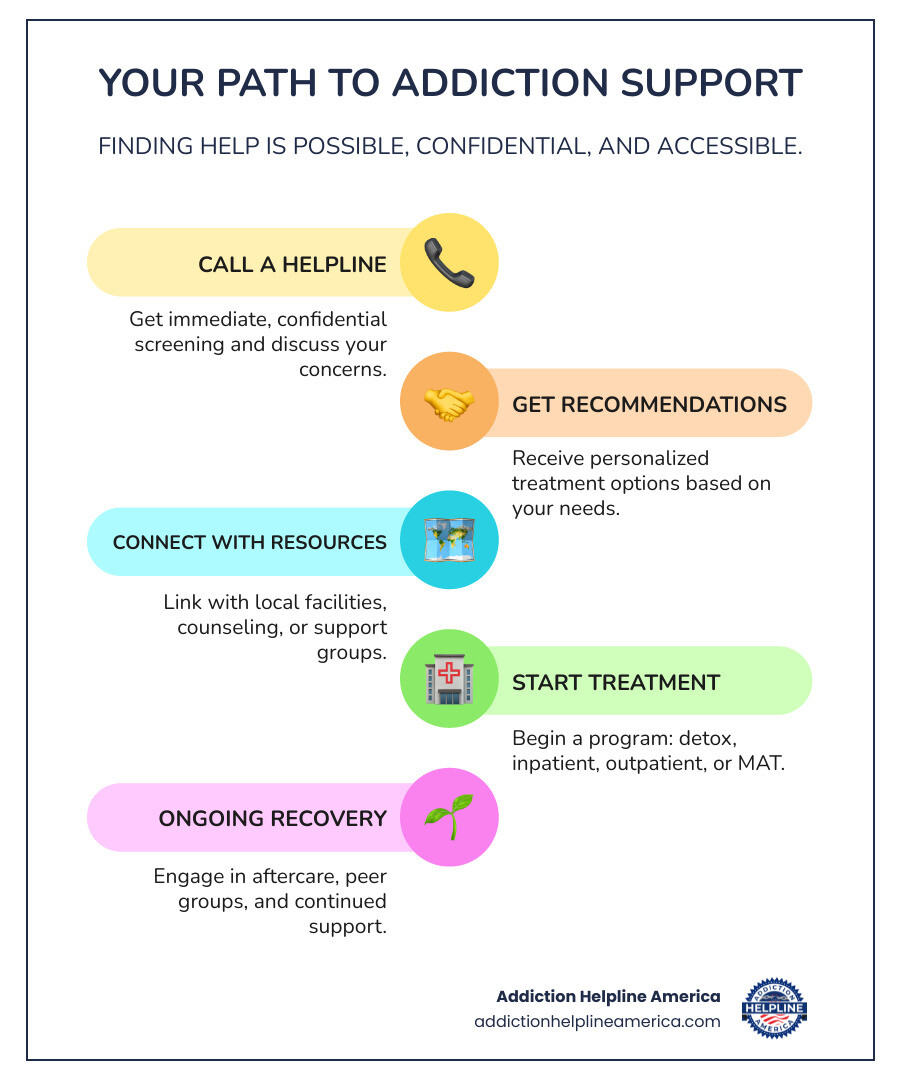
Helplines are your first point of contact with the system of addiction support services. When you call, a trained professional conducts a brief, confidential screening to understand your needs. This isn’t an interrogation; it’s a conversation to determine the best level of care for you, whether that’s medical detox, outpatient counseling, or another service.
Using extensive databases, these specialists can refer you to treatment providers based on your location, substance use, insurance status, and other needs. They also serve as educators, explaining different treatment programs, what to expect, and what resources are available for your family. The anonymity and 24/7 accessibility of helplines remove major barriers to seeking help, allowing you to explore your options without pressure or judgment.
The Continuum of Care: Types of Addiction Treatment Programs
Recovery is not one-size-fits-all. The continuum of care is a flexible system of addiction support services designed to meet you where you are in your journey. This personalized roadmap uses evidence-based treatments and adapts to your changing needs, whether you’re starting with intensive support or a more flexible option.

Medical Detoxification: The First Step
For substances like alcohol, benzodiazepines, or opioids, stopping use can cause dangerous withdrawal symptoms. Medical detoxification provides safe, supervised withdrawal management. Under 24/7 medical care, professionals administer medications to ease severe symptoms and ensure your physical safety. Detox is not treatment itself; it is the critical first step that stabilizes your body in preparation for the psychological work of recovery. Learn more on our Detox Treatment page.
Inpatient and Residential Treatment
Inpatient or residential treatment offers an immersive, structured environment away from daily triggers. You live at the facility for several weeks to a few months, engaging in a full schedule of individual therapy, group counseling, and educational sessions. This 24/7 support allows you to focus entirely on healing. Individual therapy helps uncover the root causes of addiction, while group counseling provides powerful peer support. Many programs also include holistic therapies like yoga and mindfulness. For those with co-occurring mental health issues, an Inpatient Facility for Mental Health can provide integrated care.
Outpatient and Virtual Treatment Options
Outpatient programs offer structured addiction support services with the flexibility to live at home. You attend scheduled therapy sessions while maintaining daily responsibilities like work or family care. This allows you to apply recovery skills in real-time. Levels of care vary from intensive options like Partial Hospitalization (PHP) and Intensive Outpatient Programs (IOP) to standard weekly counseling. Additionally, Virtual Rehab has made treatment more accessible than ever, allowing you to attend therapy and support groups from anywhere with an internet connection.
Medication-Assisted Treatment (MAT)
Medication-Assisted Treatment (MAT) is a highly effective, evidence-based approach that combines FDA-approved medications with counseling. Addiction changes brain chemistry, and MAT helps to stabilize it. Medications like buprenorphine, methadone, and naltrexone reduce cravings and withdrawal symptoms, quieting the physical aspect of addiction so you can focus on the psychological work of recovery in therapy. For opioid use disorder, MAT can reduce mortality by 50%. This approach treats addiction as a medical condition, addressing both the brain and behavior for better, lasting outcomes. Learn about medication-assisted treatment (MAT) or explore our Methadone Clinic Complete Guide for more details.
Finding and Accessing Addiction Support Services
Searching for addiction support services can feel overwhelming, but you don’t have to do it alone. Numerous tools and resources, including government locators and specialized programs, are designed to connect you to the care you need based on location, cost, and service type.
How to Use Addiction Helpline America’s Search Tools
At Addiction Helpline America, we simplify your search for treatment. When you contact us, your conversation is confidential and anonymous, protecting your privacy. Our specialists help you search by location and service type across our nationwide network, providing personalized recommendations that fit your life and needs. We work to keep our information current, but since availability changes, we encourage you to contact us directly for the most up-to-date details. Explore our Drug Rehab Centers Free Complete Guide or watch a video overview of finding treatment to learn more.
Specialized Addiction Support Services for Diverse Populations
Effective recovery often requires care custom to specific life experiences. Many addiction support services offer specialized programs for different groups:
- Youth and adolescents benefit from age-appropriate therapies that involve family and support educational goals.
- Pregnant and parenting women receive sensitive care that addresses the health of both mother and child in a safe, non-judgmental environment.
- Veterans can find programs that understand military culture and address co-occurring conditions like PTSD.
- Criminal justice-involved individuals are offered a path to rehabilitation through court-ordered programs that break the cycle of addiction and incarceration.
- LGBTQ+ individuals can access affirming care in a supportive environment where they can be open about their identity without fear of judgment.
- Pet owners may find Pet-Friendly Drug Rehab Centers, removing a common barrier to seeking treatment.
Integrated Care for Co-Occurring Disorders
About half of all people with a substance use disorder also have a co-occurring mental health condition like depression, anxiety, or PTSD. This is called a dual diagnosis. Treating both conditions at the same time is critical, as one often worsens the other. Integrated care provides a coordinated approach where one team addresses both your mental health and substance use. This method leads to better outcomes and lower relapse rates. When searching for addiction support services, ask if they offer dual diagnosis treatment. Our Dual Diagnosis Treatment LA page and Mental Health Services Guide 2025 offer more information on this vital approach.
Building a Lifelong Recovery Network
Formal treatment is the foundation, but lifelong recovery is sustained by a strong support network. This aftercare system, woven from peer groups, family, and professional counseling, acts as a safety net for your ongoing journey.
Peer Support Groups for Substance Abuse
Peer support groups are free, accessible addiction support services that provide a community of people with shared lived experiences. Led by peers in recovery, these groups offer profound healing and understanding.
- Narcotics Anonymous (NA) helps those who want to stop using drugs. Find an NA meeting center, helpline, or online support group.
- Alcoholics Anonymous (A.A.) is a 12-step program for people with a drinking problem. Find a local A.A. meeting center or an online support group.
- SMART Recovery offers a science-based, self-empowerment approach to addiction. Find SMART Recovery meetings in person or online.
These meetings provide a space for Anonymous Addiction Help and building a sense of belonging.
Help for Families and Friends
Addiction is a “family disease” that deeply affects loved ones. Family members and friends need support to cope with the emotional distress and learn healthy ways to support recovery without enabling. Groups like Nar-Anon, Al-Anon, and Alateen provide a safe space for families to heal.
- NAR-Anon supports those affected by another’s drug abuse. Search for a Nar-Anon meeting in your area.
- Al-Anon and Alateen support family, friends, and teens affected by someone’s drinking. Find an Al-Anon meeting in your area or get help for teens affected by someone else’s alcoholism.
Professional Addiction Family Therapy can also help rebuild communication and establish healthy boundaries.
The Importance of Aftercare and Continued Support
Completing a treatment program is just the beginning. Aftercare is crucial for preventing relapse and building a fulfilling life in recovery. A strong aftercare plan, a key part of addiction support services, often includes:
- Relapse prevention strategies to identify triggers and develop coping skills.
- Sober living homes that provide a supportive, drug-free environment to transition back to independent living.
- Ongoing counseling to process challenges and celebrate triumphs in recovery.
Aftercare is about building a new life through vocational training, education, and healthy hobbies. Our guide to Post-Rehab Drug Rehab Aftercare offers more insight into sustaining long-term sobriety.
Frequently Asked Questions about Addiction Support
You probably have questions—and that’s completely normal. When you’re considering addiction support services for yourself or someone you love, understanding your options can make all the difference. Here are answers to some of the most common questions we hear.
What is the difference between inpatient and outpatient rehab?
Inpatient rehab involves living at a treatment facility for 24/7 structured care, providing an immersive environment away from daily triggers. It’s ideal for those needing intensive support. Outpatient rehab allows you to live at home and attend scheduled therapy sessions, offering flexibility for those with work, school, or family commitments. The right choice depends on the severity of the addiction, your home environment, and any co-occurring disorders.
How can I get help for addiction with no money?
Cost should not be a barrier to recovery. Many free and low-cost addiction support services are available:
- Peer support groups like AA and NA are completely free.
- Government-funded programs offer free or low-cost treatment. The SAMHSA National Helpline at 1-800-662-HELP (4357) can connect you to them.
- Sliding scale fees are offered by many centers, adjusting costs based on your income.
- Medicaid often covers a significant portion of treatment costs in many states.
When you call Addiction Helpline America’s confidential helpline, our specialists can help you find affordable options.
What is the very first step to getting help?
The first step is acknowledging the problem and reaching out for support. You don’t need to have a plan or be sober to make the call. Contacting a confidential helpline like Addiction Helpline America, the SAMHSA National Helpline (1-800-662-HELP), or the 988 Suicide & Crisis Lifeline is a safe, non-committal way to gather information. A trained professional will listen without judgment and help you understand your options. This single step can open the door to a new life.
Conclusion
If you’ve read this far, you already know something important: addiction support services aren’t some distant, unreachable concept. They’re real, they’re accessible, and they’re waiting for you or your loved one right now.
The landscape of recovery is vast and varied—from the immediate comfort of a crisis hotline answered by someone who genuinely cares, to the structured healing environment of residential treatment, to the life-changing science of Medication-Assisted Treatment. There are flexible outpatient programs that fit around your life, peer support groups that understand your struggles without judgment, and specialized care for every unique situation. This isn’t a one-size-fits-all system; it’s a network designed to meet you exactly where you are.
Recovery is a journey, not a destination. Some days will feel like climbing a mountain. Other days will feel like flying. Both are part of the process, and both are valid. What matters most is that you don’t have to take a single step of that journey alone.
Hope and healing are possible—not just as abstract ideas, but as real, tangible outcomes that thousands of people achieve every single day. Financial barriers don’t have to stop you. The severity of your struggle doesn’t disqualify you. Your past doesn’t define your future. You are not alone in this fight, and a community of compassionate professionals, peers in recovery, and families who understand are all standing ready to support you.
At Addiction Helpline America, we’ve built our entire mission around one simple truth: everyone deserves personalized, confidential guidance in finding the right program for their needs. We’re not here to judge, to pressure, or to make decisions for you. We’re here to listen, to inform, and to connect you with the resources that fit your unique situation.
The hardest step is often the first one. But that step—the one where you reach out, where you say “I need help” or “Someone I love needs help”—is also the bravest. It’s the step that changes everything.
Explore your options today. Take that courageous first step towards a healthier, more fulfilling life. Your future self will thank you.