Understanding the 12 Steps of AA: Your Foundation for Recovery
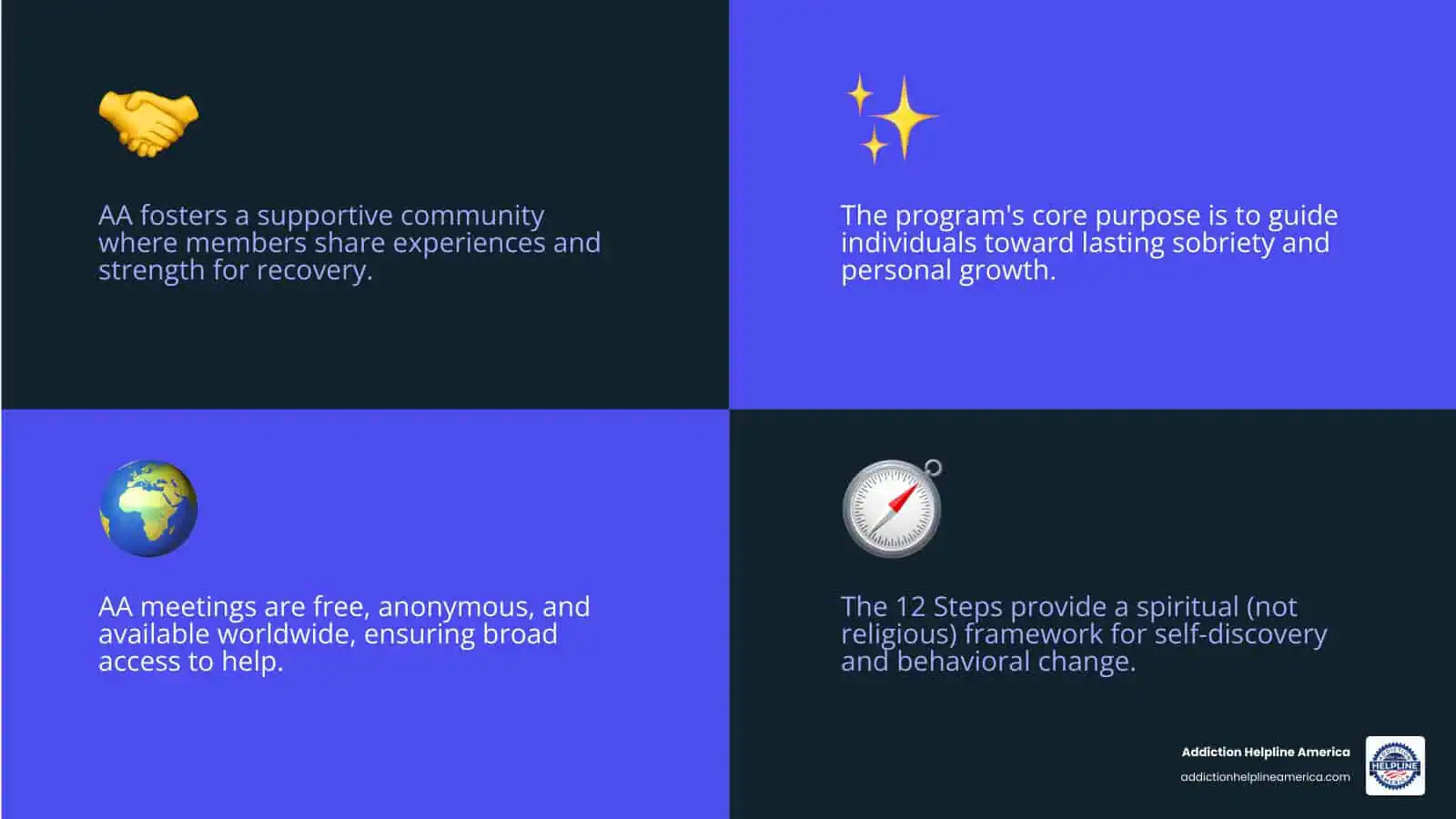
The 12 steps of AA are a proven framework for overcoming alcohol addiction and building a foundation for lifelong sobriety. Originally developed by Alcoholics Anonymous in 1935, these steps guide individuals through a process of personal change—from admitting powerlessness over alcohol to finding spiritual growth and helping others in recovery.
The 12 Steps of AA are:
- Admit powerlessness over alcohol and that life has become unmanageable
- Believe a Power greater than yourself can restore sanity
- Turn your will and life over to the care of a Higher Power
- Make a searching and fearless moral inventory
- Admit the exact nature of your wrongs to yourself, your Higher Power, and another person
- Become ready to have character defects removed
- Humbly ask your Higher Power to remove shortcomings
- List all persons you have harmed and become willing to make amends
- Make direct amends wherever possible, except when doing so would cause harm
- Continue taking personal inventory and promptly admit wrongs
- Seek through prayer and meditation to improve conscious contact with your Higher Power
- Carry this message to others and practice these principles in all areas of life
If you’re seeking help for yourself or a loved one struggling with alcohol addiction, understanding how the 12 steps of AA work is an important first step. The program is completely free and available in communities nationwide. The steps provide structure, accountability, and peer support—elements that research shows can significantly improve recovery outcomes.
At Addiction Helpline America, we’ve guided thousands of individuals and families toward effective treatment options that work alongside the 12 steps of AA. Our team understands how the 12-step model fits into comprehensive recovery plans, and we provide free, confidential support to help you find the right path forward.
A Detailed Breakdown of Each of the 12 Steps of AA
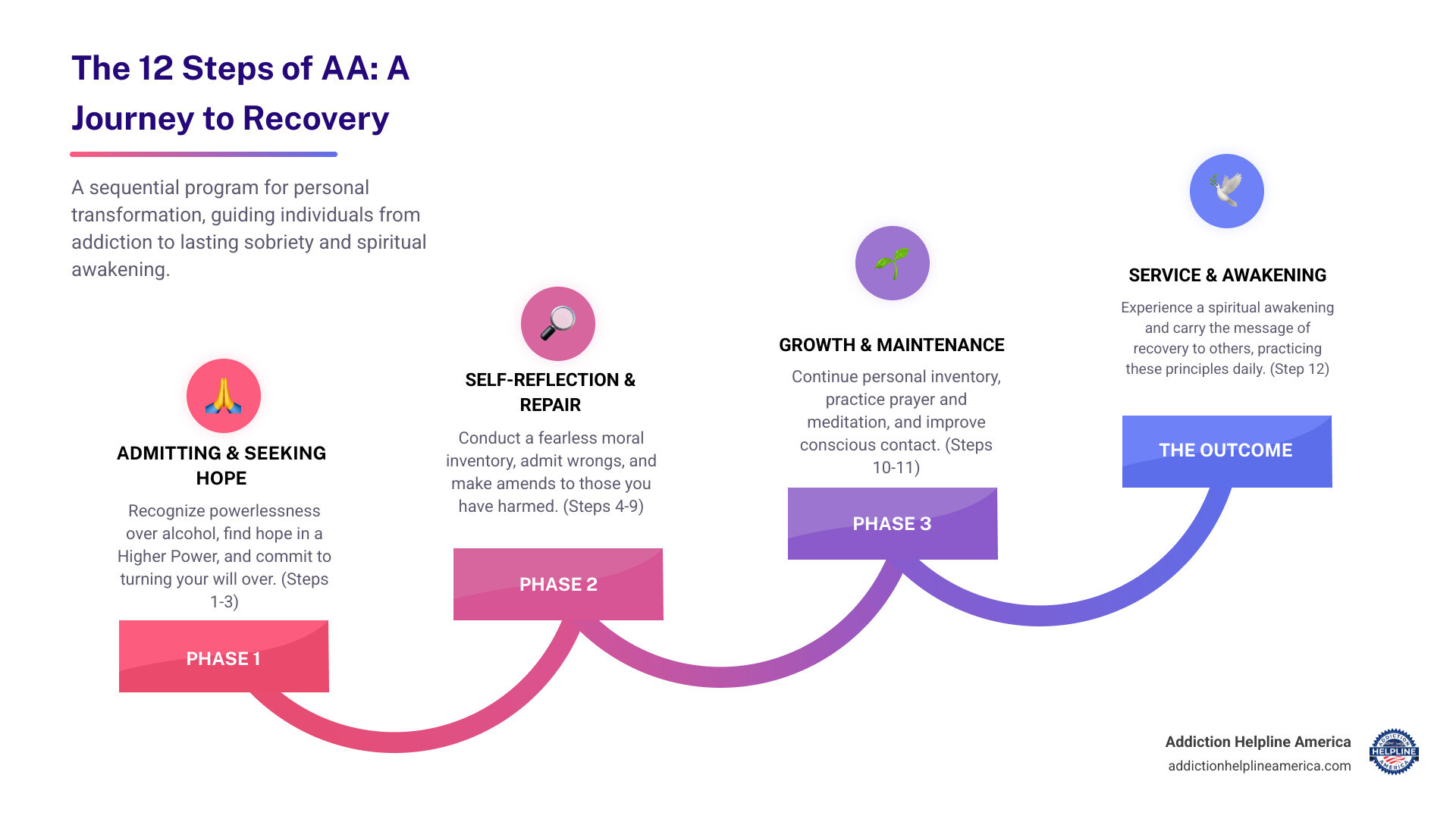
This section provides a deep dive into the purpose and meaning of each step, offering a roadmap for personal change. The steps are grouped into three key phases of the recovery journey.
Steps 1-3: Admitting Powerlessness and Finding Hope
The initial steps are about confronting the reality of addiction, opening up to the possibility of help, and making a fundamental decision to change. This foundational phase is crucial for beginning the journey of recovery.
Step 1: Honesty
“We admitted we were powerless over alcohol — that our lives had become unmanageable.”
This is often the most challenging, yet liberating, step. It asks us to honestly acknowledge that alcohol has taken control of our lives and that our efforts to manage it have failed. Our lives have become unmanageable not just because of drinking, but due to the consequences that ripple through every aspect—relationships, work, health, and self-esteem.
As we’ve seen, addiction can stem from low self-esteem and a negative self-opinion. Admitting powerlessness isn’t about weakness; it’s about recognizing the severity of the problem and accepting that outside help is essential. This acceptance of powerlessness over alcohol ultimately empowers us in other areas of our lives. It’s the first act of honesty, paving the way for true recovery. For a deeper understanding of the impact of alcohol, explore our Alcoholism Guide.
Step 2: Hope
“Came to believe that a Power greater than ourselves could restore us to sanity.”
With the admission of Step 1, a vacuum is often created. Step 2 introduces the concept of hope, suggesting that a power greater than ourselves can help us regain our sanity, which was lost to the chaos of addiction. This “Higher Power” is intentionally broad. It doesn’t require adherence to any specific religion or deity.
As we understand it, this Higher Power can be interpreted in countless ways: it could be the collective strength of the AA group, the principles of nature, a spiritual force, or simply the universe itself. The key is to accept the belief that something beyond our individual, addicted selves can restore our well-being and clear thinking. Many atheists and agnostics find great success in the 12 steps of AA by defining a Higher Power that resonates with their personal beliefs.
Step 3: Faith
“Made a decision to turn our will and our lives over to the care of God as we understood Him.”
Building on the hope found in Step 2, Step 3 is about making a conscious decision to act on that belief. It’s a surrender, not of defeat, but of trust. We decide to let this Higher Power guide our choices and actions each day, letting go of the need to control everything ourselves—a tendency that often fueled our addiction.
Practicing Step 3 is often described as “the opening of a door.” It’s an active choice to step aside and allow a greater force to work in our lives, moving us towards a healthier, more balanced existence. This decision doesn’t mean we become passive; rather, it means we align our intentions with a guiding force for good.
Steps 4-9: Moral Inventory and Making Amends
Once we’ve admitted our problem and opened ourselves to help, these steps guide us through a process of self-examination, accountability, and reconciliation.
Step 4: Courage
“Made a searching and fearless moral inventory of ourselves.”
This step calls for courage as we start on a thorough and honest self-examination. We take an objective look at our past thoughts, behaviors, and actions, identifying our character defects, resentments, fears, and harms we’ve caused. This isn’t about dwelling on guilt or shame, but rather about gaining a clear understanding of ourselves and the patterns that contributed to our addiction. It’s a fearless inventory, meaning we commit to uncovering painful truths without judgment, simply observing and documenting.
Step 5: Integrity
“Admitted to God, to ourselves, and to another human being the exact nature of our wrongs.”
Having completed our personal inventory, Step 5 is about sharing it. This act of admission is a powerful step towards integrity and freedom. We admit the exact nature of our wrongs to our Higher Power (as we understand it), to ourselves (solidifying our self-awareness), and crucially, to another trusted person. This person is typically a sponsor, a mentor who has already worked through the 12 steps of AA. This confession helps us stop living alone with our past experiences, reducing the burden of secrets and shame, and opening the door to genuine healing and honesty.
Step 6: Willingness
“Were entirely ready to have God remove all these defects of character.”
After identifying and admitting our defects, Step 6 focuses on becoming entirely ready to have them removed. This isn’t about us removing them, but about cultivating a willingness to allow our Higher Power to do so. It’s about letting go of our attachment to these patterns, even if they’ve provided a false sense of comfort or control in the past. This step requires humility and a deep desire for change.
Step 7: Humility
“Humbly asked Him to remove our shortcomings.”
Building on the readiness of Step 6, Step 7 is a humble request. We actively ask our Higher Power to remove the shortcomings and character defects that impede our spiritual growth and sobriety. This isn’t a demand, but a sincere plea, acknowledging that we cannot overcome these deeply ingrained patterns through willpower alone. It reinforces our reliance on a power greater than ourselves and deepens our spiritual connection.
Step 8: Willingness
“Made a list of all persons we had harmed, and became willing to make amends to them all.”
As we progress in our self-awareness, Step 8 shifts our focus outward. We create a comprehensive list of everyone we’ve harmed, directly or indirectly, through our drinking and associated behaviors. The crucial part of this step is becoming willing to make amends. This doesn’t mean we’re ready to act immediately, but that we cultivate the desire and intention to set things right. This willingness is vital for repairing damaged relationships and fostering reconciliation, often involving family members who have been deeply affected by our addiction. Learn more about how to support loved ones in recovery through Family Involvement in Rehab.
Step 9: Responsibility
“Made direct amends to such people wherever possible, except when to do so would injure them or others.”
Step 9 is where the willingness from Step 8 turns into action. We make direct amends to those we’ve harmed, taking responsibility for our past actions. This could involve a sincere apology, an offer of restitution, or simply acknowledging the pain we caused. The caveat “except when to do so would injure them or others” is critical; it ensures that our amends are constructive, not harmful. The process of making amends helps us let go of resentment and fosters forgiveness, both for others and ourselves, freeing our souls from the burden of guilt.
Steps 10-12: Lifelong Maintenance and Spiritual Growth
These final steps are about maintaining the progress we’ve made, continuing our personal and spiritual development, and sharing our experience with others.

Step 10: Discipline
“Continued to take personal inventory and when we were wrong promptly admitted it.”
Recovery is an ongoing process, not a destination. Step 10 emphasizes daily self-assessment. We continue to take personal inventory, examining our thoughts, feelings, and actions, and promptly admitting when we are wrong. This practice helps us prevent the buildup of resentments, fears, and character defects that could lead to relapse. It’s a discipline of self-honesty and self-correction, enabling us to live in the present and maintain spiritual progress.
Step 11: Spiritual Awareness
“Sought through prayer and meditation to improve our conscious contact with God as we understood Him, praying only for knowledge of His will for us and the power to carry that out.”
Step 11 encourages us to deepen our spiritual connection through regular practices like prayer and meditation. The goal is to improve our “conscious contact” with our Higher Power, seeking guidance and strength for daily living. We pray not for material things, but for knowledge of our Higher Power’s will and the power to carry it out. This daily spiritual practice fosters inner peace, resilience, and a sense of purpose, helping us steer life’s challenges soberly.
Step 12: Service
“Having had a spiritual awakening as the result of these steps, we tried to carry this message to alcoholics, and to practice these principles in all our affairs.”
The culmination of the 12 steps of AA is a “spiritual awakening.” This isn’t necessarily a dramatic, mystical experience, but rather a profound shift in perspective, a newfound sense of peace, purpose, and connection that comes from living by these principles. With this awakening, we are called to two actions: carrying the message of recovery to other suffering alcoholics (Q14) and practicing these principles in all aspects of our lives. Carrying the message means sharing our experience, strength, and hope, often by sponsoring newcomers. This act of service reinforces our own sobriety and creates a powerful cycle of healing. It’s a key relapse prevention strategy, as helping others helps us stay sober. For more strategies, visit our page on Relapse Prevention Strategies.
The Philosophy, History, and Effectiveness of the 12-Step Model
Understanding the origins and principles of the 12 steps of AA can provide deeper insight into why this model has helped millions.
Origins and History of the Program
The 12 steps of AA didn’t just appear out of thin air; they evolved from a rich history of spiritual and self-help movements. Alcoholics Anonymous was founded in 1935 by Bill Wilson (Bill W.) and Dr. Bob Smith (Dr. Bob) in Akron, Ohio. Bill W., a New York stockbroker, and Dr. Bob, an Akron surgeon, both struggled with severe alcoholism.
Their journey began after Bill W. had a profound spiritual experience and found sobriety. He had been introduced to the Oxford Group, a Christian evangelical movement that emphasized moral inventory, public confession, and making amends. Notably, Carl Jung, the renowned psychiatrist, played an indirect role by advising one of Bill W.’s mentors, Rowland H., to seek a spiritual solution after traditional medicine failed him.
The principles that would become the 12 steps of AA were formalized and published in 1939 in the book Alcoholics Anonymous, affectionately known as the “Big Book.” This book served as a guide for those who couldn’t attend meetings and became the foundational text for the entire program. It outlines the 12 steps of AA and the 12 Traditions, providing a comprehensive framework for individual recovery and group unity. To dig deeper into the foundational texts, we recommend exploring The Twelve Steps and Twelve Traditions Book.
How the 12 Steps of AA Promote Recovery

The 12 steps of AA promote recovery by offering a structured, supportive, and holistic path to sobriety. Our experience and extensive research show several key mechanisms at play:
- Peer Support and Community: AA provides a fellowship of individuals who share a common problem, fostering a sense of belonging and reducing the isolation, shame, and stigma often associated with alcoholism. This shared experience creates a powerful motivational environment.
- Accountability: Working the steps with a sponsor and sharing in meetings provides a crucial layer of accountability. This external support helps individuals stay committed to their recovery journey.
- Structure and Guidance: The steps offer a clear, actionable roadmap for personal change. They systematically address the underlying emotional, spiritual, and psychological factors that drive addiction, rather than just focusing on the drinking behavior itself.
- Spiritual Growth: The emphasis on a Higher Power and a spiritual awakening encourages individuals to develop a deeper sense of purpose and connection, which can be a powerful antidote to the emptiness often felt in active addiction.
- Self-Reflection and Honesty: Steps like the moral inventory (Step 4) encourage deep self-assessment, helping individuals understand their patterns, behaviors, and motivations. This honesty is vital for genuine healing.
The effectiveness of the 12 steps of AA is supported by research. According to the Substance Abuse and Mental Health Services Administration (SAMHSA) in its National Survey of Substance Use from 2023, 12-Step models are used by nearly 50% of treatment centers nationwide. Studies indicate that participation in AA, NA, or CA is associated with a greater likelihood of abstinence, improved psychosocial functioning, and greater levels of self-efficacy. Research also shows that beginning 12-Step participation while in treatment is associated with better outcomes, and consistent, early, and frequent attendance/involvement is linked to better substance use outcomes. The 12 steps of AA help people to not only stop drinking but to heal deeper wounds and build a new way of living.
Benefits and Criticisms of the 12 Steps
Like any recovery pathway, the 12 steps of AA come with both significant benefits and some common criticisms. Understanding both sides can help individuals make informed decisions about their recovery journey.
Benefits of Following the 12 Steps (Q6):
- Free and Accessible: AA meetings are completely free to attend, making recovery accessible to anyone, regardless of their financial situation. They are widely available in communities across the nation.
- Strong Community Support: The fellowship provides a powerful network of peer support, reducing isolation and fostering a sense of belonging. This shared experience helps individuals feel understood and supported.
- Structured Pathway: The steps offer a clear, actionable guide for personal change, providing tools for self-reflection, emotional healing, and spiritual growth.
- Long-Term Sobriety: Many participants report that the program helps them achieve and maintain long-term abstinence, developing stronger coping skills and resilience.
- Personal Growth: Beyond sobriety, the steps encourage individuals to develop integrity, humility, responsibility, and a commitment to service, leading to a more fulfilling life. You can learn more about these positive outcomes on our 12 Step Promises page.
Drawbacks or Criticisms of the 12 Steps (Q7):
- Spiritual/Religious Focus: The emphasis on a “Higher Power” can be a barrier for some individuals, particularly atheists or agnostics, who may struggle with the spiritual language. However, as we discussed, this concept is highly personal and not dogmatic.
- Concept of Powerlessness: For some, admitting powerlessness can feel disempowering or conflicting with personal agency. Yet, within AA, it’s viewed as a necessary surrender to the disease, allowing for empowerment in recovery.
- Not a Universal Fit: While highly effective for many, the 12 steps of AA may not resonate with everyone. Some individuals may prefer secular approaches or alternative treatment modalities.
- Lack of Professional Guidance: AA is a peer-led program and does not offer professional medical or psychological treatment. It works best when integrated with professional care, especially for those with co-occurring mental health disorders.
- Anonymity vs. Openness: While anonymity is a core principle, some may find the lack of personal identification in certain contexts challenging.
Practical Application of the 12 Steps and Support Options
While the 12 steps of AA are a cornerstone of recovery, it’s important to know how to engage with the program and what support options are available.
How to Start and Work the Program
Starting your journey with the 12 steps of AA can feel daunting, but it’s simpler than you might think. Here’s how we recommend you begin (QFAQ):
- Find a Meeting: The easiest way to start is by attending an AA meeting. You can find local meetings in most communities. Meetings come in different formats:
- Speaker Meetings: Members share their personal stories of recovery.
- Discussion Meetings: Participants discuss specific topics related to recovery.
- Step Studies: Groups dig into one of the 12 steps of AA or 12 Traditions.
Meetings can be “open” (anyone can attend, including non-alcoholics) or “closed” (for alcoholics only). Don’t hesitate to try a few different meetings to find one that feels right for you.
- Keep an Open Mind: As a newcomer, you’re not expected to immediately accept or follow all the steps. The program encourages you to listen, learn, and keep an open mind.
- Get a Sponsor: A sponsor is a fellow AA member with significant sobriety who has worked through the 12 steps of AA themselves. They provide personal guidance, support, and mentorship as you steer the program. This one-on-one connection is invaluable.
- Read the Big Book: The book Alcoholics Anonymous (the “Big Book”) is the primary text of the program and offers detailed explanations of the steps and personal stories of recovery.
- “90 Meetings in 90 Days”: Many sponsors suggest attending 90 meetings in your first 90 days of recovery. This intense immersion helps newcomers establish a routine, build a support network, and absorb the principles of the program. While not a strict rule, it’s a powerful way to start.
- Work the Steps: With the help of your sponsor, you’ll begin to work through the 12 steps of AA. This isn’t a race; it’s a personal journey, and the timeline varies for everyone.
Adapting the Steps for Other Addictions
The foundational principles of the 12 steps of AA are remarkably adaptable. While originally developed for alcohol addiction, the model has been successfully modified and applied to a wide range of other addictions and compulsive behaviors (Q5).
Today, you’ll find numerous 12-Step programs addressing various issues, including:
- Drug Addiction: Narcotics Anonymous (NA), Cocaine Anonymous (CA), Crystal Meth Anonymous (CMA)
- Gambling Addiction: Gamblers Anonymous (GA)
- Eating Disorders: Overeaters Anonymous (OA), Anorexics and Bulimics Anonymous (ABA)
- Sex and Love Addiction: Sex Addicts Anonymous (SAA), Sex and Love Addicts Anonymous (SLAA)
- Codependency: Codependents Anonymous (CoDA)
The core idea remains the same: admitting powerlessness over the specific addiction, seeking help from a Higher Power, taking a moral inventory, making amends, and carrying the message to others. This adaptability highlights the universal truths embedded in the 12 steps of AA regarding human struggle, self-reflection, and connection as pathways to recovery. To learn more about various forms of addiction, visit our Most Common Addictions page.
Support Beyond the 12 Steps
While the 12 steps of AA provide a powerful framework, we recognize that recovery is often a multi-faceted journey that benefits from a comprehensive approach. The 12 steps of AA are a peer-led program and do not offer medical or clinical treatment. For many, combining 12-Step participation with professional care leads to the most successful outcomes (Q10).
Here are some additional support options:
- Professional Addiction Treatment: This can include inpatient or outpatient rehab programs that offer medical detox, therapy, counseling, and aftercare planning. Many treatment centers nationwide use 12-Step models, integrating them with evidence-based therapies. Explore comprehensive options at our Addiction Treatment guide.
- Co-occurring Disorders: If you’re dealing with both substance use disorder and mental health conditions (like depression or anxiety), a specialized approach is crucial. While 12-Step programs can be beneficial, groups like Dual Recovery Anonymous (DRA) specifically cater to individuals with co-occurring disorders. Our Dual Diagnosis Rehab guide provides more information.
- Individual and Group Counseling: Therapy with a licensed professional can help address underlying trauma, develop coping mechanisms, and explore personal issues in a confidential setting.
- Alternatives to the 12-Step Model: For those who prefer a non-spiritual or secular approach, alternatives exist, such as:
- SMART Recovery: Focuses on self-empowerment and self-reliance using cognitive behavioral therapy (CBT) techniques.
- LifeRing Secular Recovery: Emphasizes personal responsibility and developing a “sober self.”
- Secular Organizations for Sobriety (SOS): Promotes sobriety through rational thought and self-help.
- Moderation Management (MM): For those seeking to reduce their drinking rather than abstain entirely (though not suitable for severe alcohol use disorder).
- Specialized Support Resources: Various organizations provide free or low-cost support, including government-funded programs like Medicare, Medicaid, and those offered by the Department of Veteran’s Affairs.
At Addiction Helpline America, we are dedicated to providing free, confidential, and personalized guidance to help you steer these options. We connect individuals nationwide to addiction and mental health treatment centers that align with their unique needs and preferences.
Frequently Asked Questions about the 12 Steps of AA
Do I have to believe in God to join AA?
No, you absolutely do not have to believe in God in the traditional sense to join AA or work the 12 steps of AA. This is one of the most common misconceptions. The program emphasizes a “Higher Power as we understood Him,” which is intentionally left open to personal interpretation.
This means your Higher Power can be anything that represents a force greater than yourself. For many, it’s simply the AA group itself, the collective wisdom and support of other members. For others, it might be nature, the universe, a spiritual principle, or even a concept like “good orderly direction” (GOD). The spiritual aspect is about accepting that individual willpower alone isn’t enough to overcome addiction and that reliance on something outside oneself is necessary. Many atheists and agnostics successfully work the 12 steps of AA by defining a Higher Power that resonates with their personal worldview.
What is the difference between the 12 Steps and the 12 Traditions?
While both are fundamental to Alcoholics Anonymous, the 12 steps of AA and the 12 Traditions serve different purposes (Q9):
- The 12 Steps: These are a program of personal recovery. They are a set of guiding principles for individual members to achieve and maintain sobriety. The steps focus on self-examination, spiritual growth, making amends, and helping others. They guide how an individual recovers.
- The 12 Traditions: These are guidelines for the unity and effective functioning of AA groups and the fellowship as a whole. They address how groups relate to each other, to the public, and to outside organizations. The Traditions ensure that AA remains focused on its primary purpose—to carry its message to suffering alcoholics—and that it avoids internal conflicts, financial messs, and external controversies. They guide how AA as an organization and its groups operate.
The Steps are for you, the individual. The Traditions are for us, the fellowship.
How long does it take to work through the 12 Steps?
The timeline for working through the 12 steps of AA is highly individual and varies significantly from person to person (Q8). There is no set schedule, and it’s not a race to finish.
Some people, particularly with the guidance of a sponsor, may complete their first pass through all twelve steps within their first 90 days of recovery. Others might spend several months or even years on particularly challenging steps, such as Step 4 (the moral inventory) or Step 9 (making amends).
The 12 steps of AA are designed as ongoing practices rather than one-time achievements. Many individuals revisit the steps throughout their recovery journey, deepening their understanding and applying the principles to new life situations. The focus is on thoroughness and genuine change, not speed. The process is continuous, fostering lifelong personal and spiritual growth.
Your Path to Recovery Starts Today
The 12 steps of AA offer a proven and powerful framework for overcoming alcoholism and building a new life. While the journey is personal, you don’t have to walk it alone. Combining peer support with professional guidance can provide the comprehensive care needed for lasting sobriety. If you or a loved one are ready to take the first step, Addiction Helpline America is here to help you explore your options. Contact us to find a treatment program that aligns with your needs. Our service is free, confidential, and available 24/7.
Find an Alcohol Addiction Rehab Center; National Drug Abuse Hotline Numbers; Professional help; Confidential guidance.